
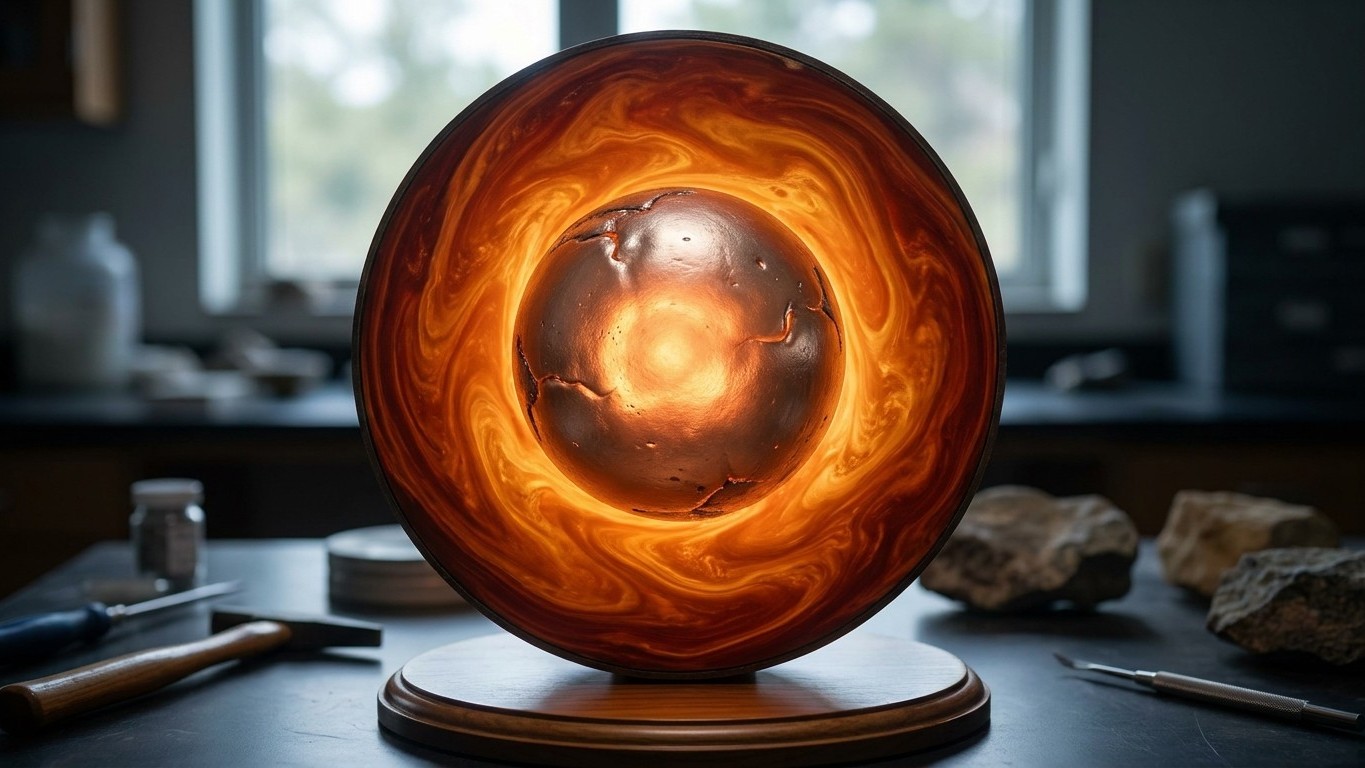
Five thousand kilometers beneath our feet, a sphere of iron and nickel, almost as wide as the Moon, does not rotate at the same pace as the ground we tread on. Since 2010, the Earth’s inner core has slowed enough to fall behind the planet’s surface, and since 2025, American researchers have even detected that its surface deforms slowly, like dough changing shape under pressure. Two discoveries, one certainty: this metal “seed” buried at the globe’s center is considerably less fixed than once believed.
Key takeaways
- The central seed now rotates more slowly than the Earth’s surface
- Seismic waves reveal a deformation of its structure in recent times
- How the surrounding liquid is gradually molding this metallic core?
A seed discovered less than a century ago
Geography classes tend to make us forget a point: until 1936, many believed the Earth’s center to be entirely liquid. It was the Danish geophysicist Inge Lehmann who theorized otherwise in 1936 and who named the famous “seed” of solid iron that sits at the heart of the liquid outer core. A blazing marble, squeezed by unimaginable pressures, that remains solid despite temperatures rivaling the surface of the Sun.
The problem is that we obviously cannot send a probe there. All we know about it rests on a seismic trick: the precise mechanism of this rotation remains debated, because our knowledge comes from careful analysis of seismic waves produced by earthquakes or nuclear tests, when they pass through the Earth’s center. Practically, researchers look for earthquakes that repeat nearly identically in the same spot—often near the South Sandwich Islands, in the South Atlantic, a region particularly active seismically. If the waves generated by two twin earthquakes, separated by several years, do not traverse the core in the same way, it signals that the seed has rotated slightly, or changed, between the events.
The great slowdown, confirmed study after study
The turning point comes in 2023. A team from Peking University, led by Xiaodong Song and Yi Yang, published in Nature Geoscience an analysis covering six decades of seismic waves. Their conclusion: the inner core began to rotate slightly faster than the rest of the planet in the early 1970s, before slowing down and synchronizing with the Earth’s rotation around 2009, then slipping into a “negative trend” since. In plain terms: the seed now turns more slowly than the surface. The same researchers also propose a bold hypothesis, a pendulum-like motion: the inner core would oscillate with respect to the surface, completing roughly a seven-decade cycle.
A second team, the University of Southern California’s group led by John Vidale, confirmed the phenomenon the following year using an even larger dataset. The researchers compiled and analyzed seismic data recorded around the South Sandwich Islands from 121 repeated earthquakes between 1991 and 2023, as well as data from Soviet, French, and American nuclear tests. The result is clear: the inner core began slowing around 2010, moving more slowly than the Earth’s surface. Vidale himself summed up his initial astonishment: “When I first saw the seismograms indicating this change, I was puzzled.”
Where does this braking come from? The proposed explanations hinge on the seed’s immediate surroundings. The slow-down of the inner core is due to the agitation of the surrounding liquid iron in the outer core, which generates Earth’s magnetic field, as well as the gravitational forces exerted by the dense regions of the mantle lying above. The seed is not free to spin unimpeded: it is buffeted by the moving metallic magma that surrounds it and held by the heavier zones of the mantle thousands of kilometers above.
2025: the seed is no longer really “solid”
That is where the story takes an unexpected turn. In their bid to refine rotation measurements, Vidale and his team stumble upon something else. A study shows signs of structural deformation at the interface with the liquid outer core, suggesting that the inner core is not merely slowing its rotation but also changing shape. Published in Nature Geoscience in February 2025, the discovery shakes a decades-old dogma: the seed, long described as a rigid, unalterable ball, would actually exhibit surface movement.
The suspected mechanism bears a somewhat technical name, “viscous deformation”: modern techniques have since refined the picture, indicating that the boundary of the inner core could undergo slow shape changes caused by viscous deformation. Vidale himself points to the likely culprit: “What we are observing in this study for the first time is probably the outer core perturbing the inner core.” The liquid moving around the seed not only slows it down, it subtly remodels its contours, a bit like a sea current sculpting the surface of an underwater rock over millions of years, except the time scale here is measured in years, not geological eras.
Should we worry about the center of our planet changing pace? Not really. The same research teams insist that at most, scientists might detect a change of a few fractions of a second in a day’s length, on the order of a thousandth of a second—an imperceptible variation in daily life. The true significance of these studies lies elsewhere: they demonstrate that Earth’s metallic heart, long treated as a fixed school-book datum, remains an active object of investigation, capable of surprising researchers who have watched it for more than thirty years.
Sources: tameteo.com | futura-sciences.com
