
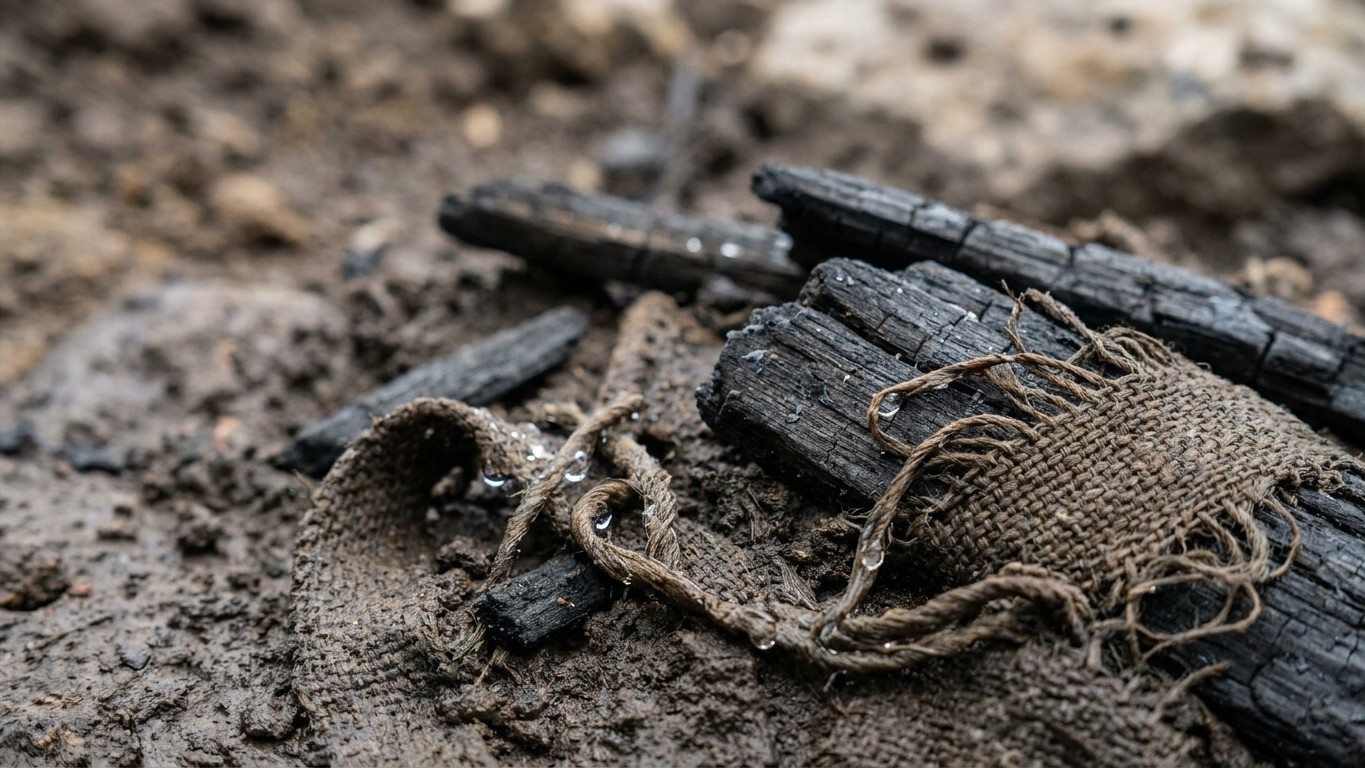
A fire that burned for only a few hours sealed nine months of daily life for nearly three millennia. This is the story of Must Farm, a stilt village in Cambridgeshire built around 850 BCE and destroyed by a violent blaze less than a year after its construction, according to the conclusions of excavations conducted by the Cambridge Archaeological Unit between 2015 and 2016. Neither the flames nor the three thousand years that followed managed to erase the traces of its inhabitants: wood, textiles, food remnants in pots — all survived thanks to a combination of brutal and improbable circumstances.
Key takeaways
- An entire village collapses into a river and disappears beneath the mud in a matter of hours
- Textiles intact dating back 2,850 years reveal textile craftsmanship of astonishing finesse
- Meals preserved in pots narrate how Bronze Age people really ate
A village that collapses into its own river
The site lies near Whittlesey, in the Flag Fen basin, on the bed of a former channel that is now gone. At the time, four large round wooden houses and a square-entry structure stood on stilts above a slowly flowing river, rising roughly two meters above the riverbed, with footbridges connecting some of the main houses, and surrounded by a two-meter-high fence made from cut palings. A genuine lakeside stronghold, built to endure.
But the sturdy machinery malfunctioned almost immediately. Dendrochronological analyses show that the roof timbers were still “green,” confirming that construction dated from about nine months to a year earlier. The hamlet had scarcely risen from the water when a fire swept through it. Thatched roofs collapsed onto the dwellings, which themselves toppled into the channel below, carrying their contents with them. The cause of this disaster remains a complete mystery: “the cause of the fire that ravaged the settlement will probably never be known,” summarized David Gibson of the Cambridge Archaeological Unit. Domestic accident, lightning strike, or a deliberate attack? No hypothesis could be decisively resolved.
It was precisely this collapse that saved everything. As the debris fell into the water, the flames were smothered in an instant, and the rubble sank into an oxygen-poor clay. Without oxygen, bacteria could not break down the organic matter. Charred wood, plant fibers, and food remnants were all preserved as if under a glass dome, shielded from decay for nearly three thousand years.
Textiles and meals preserved in the mud
What makes Must Farm exceptional is not only its age, but the very nature of the objects uncovered there. The textiles, in particular, constitute an archaeological rarity in Britain: more than 180 fragments of fabric were uncovered, according to the official excavation report published by Cambridge’s McDonald Institute for Archaeological Research. These fabrics, woven from fine flax, displayed a soft, velvety feel with neat seams and hems, though it was not possible to identify specific garments. Some threads measured barely two-tenths of a millimeter in thickness, a degree of fineness that challenges the image of Bronze Age societies.
The mudflat also preserved items in everyday use. Archaeologists catalogued 128 ceramic artifacts — jars, bowls, cups, and cooking vessels — of which 64 pots were still in use at the time of the fire. Some containers still held their contents, transformed by heat into a vitrified residue yet clearly identifiable, revealing a diet of cereal gruels, honey, and stews of beef, mutton, and fish. The site even yielded game prepared with honey, evidence that the marsh-dwelling inhabitants did not merely survive: they ate well.
The wooden furniture also survived the centuries intact. Boxes and bowls carved from willow, alder, and maple are present, along with around forty skeins of thread still sometimes wound on their original thread, and about fifteen wooden buckets. A Cambridge Archaeological Unit archaeologist, Chris Wakefield, remarked on the tool marks found on these objects: “all the axe marks were used to shape and carve the wood. They all look fresh, as if they were made just last week.” A dizzying sense of time, when you consider these gestures date back nearly thirty centuries.
Domestic intimacy that challenges Bronze Age clichés
Far from the image of rudimentary, frigid huts often associated with this period, Must Farm presents an interior that is almost cozy. The excavations revealed a division of labor by zones within the round houses, somewhat like our own homes today. Archaeologists thus established that the layout of the round houses replicated that of modern dwellings, with distinct activity zones for cooking, sleeping, and textile production. This organization of space suggests Bronze Age families at the end of the era possessed a sense of domestic comfort far more developed than commonly imagined.
The hamlet was not isolated from the wider world either. A necklace found at the site is adorned with beads from Denmark and Iran, evidence of exchange networks that linked Europe and the Near East nearly three thousand years ago. The two volumes of the final report, published in 2024 by the McDonald Institute after a excavation project costing £1.1 million, funded by Historic England and the site owner Forterra, formally close the chapter on the excavations. Yet most of the site, half-destroyed by gravel quarrying before its discovery in 1999, will forever lie buried beneath the Cambridgeshire mud — ironically, the best possible place in the world to preserve a village that burned.
Sources: ancient-origins.net | historicengland.org.uk
