
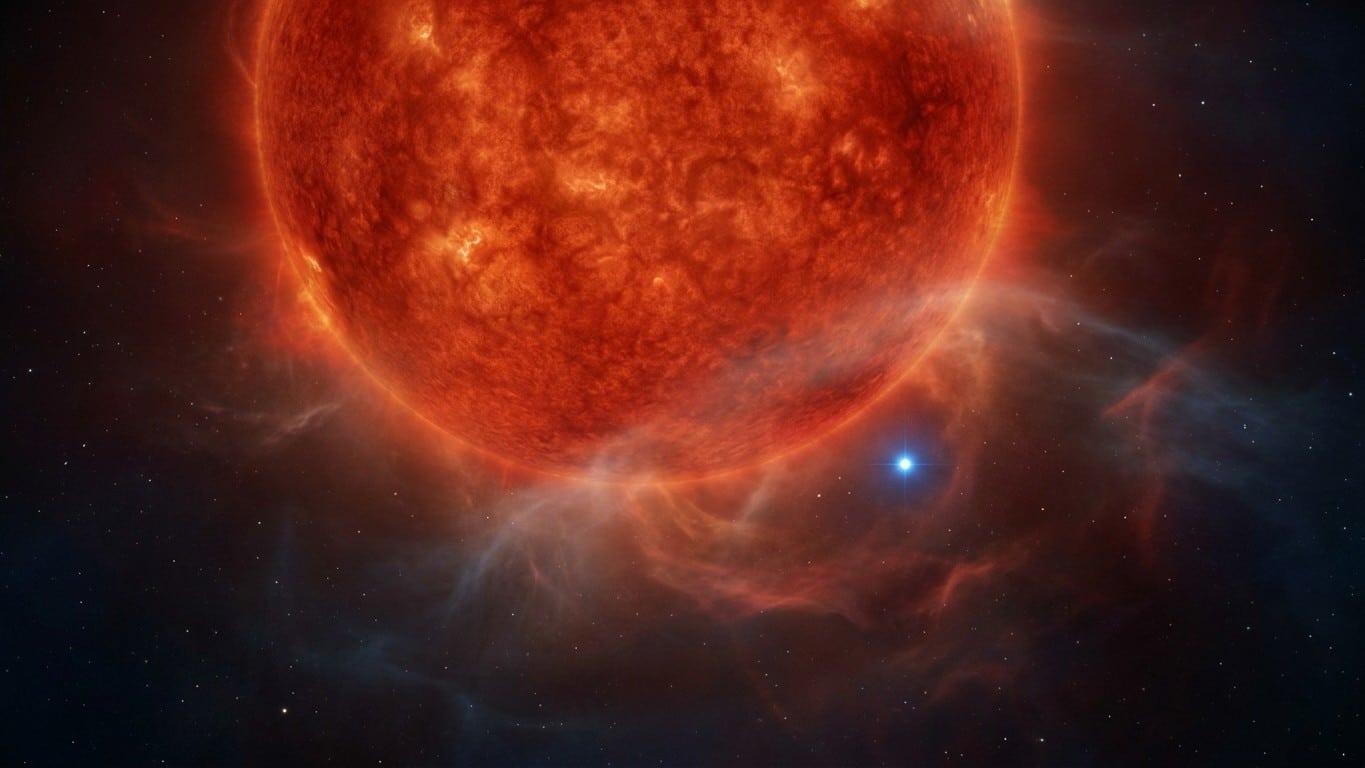
A blue star, small beside its giant neighbor, has been orbiting Betelgeuse for a century without anyone being able to see it. Named Siwarha, it has just been detected for the first time by a NASA team thanks to the ‘Alopeke instrument installed on the Gemini North telescope in Hawaii. This discreet companion finally explains a mystery that has intrigued astronomers for decades: why Betelgeuse, the red supergiant star in the Orion constellation, shows brightness variations according to a secondary cycle of about six years, in addition to its regular pulsations.
Key takeaways
- A companion star has been orbiting Betelgeuse for a hundred years but remained completely invisible to telescopes
- Why has this object so close (four times the Earth-Sun distance) escaped our instruments for so long?
- Siwarha has only about 10,000 years before spiraling permanently into the flames of its giant neighbor
A star hidden in the glare of a stellar monster
Betelgeuse is no ordinary star. It is one of the brightest stars in the night sky, and the closest red supergiant to Earth, with a radius about 700 times that of the Sun. Viewed from Earth, if placed in the Sun’s position, it would extend beyond Jupiter’s orbit. Such a mass should crush any nearby presence. And yet.
For more than a century, astronomers observed a strange phenomenon: in addition to its main pulsation of about 400 days, Betelgeuse exhibited a second, slower brightness variation on a cycle of roughly 2,100 days, about six years. For over a century, scientists studying Betelgeuse could not explain why the star dimmed and brightened according to this ~2,100-day rhythm, while the shorter 400-day cycle was understood. This kind of long rhythm is known to astrophysicists as a “long secondary period.” The phenomenon affects about a third of luminous, cool giants, but its origin remained a complete mystery.
In 2024, two independent research teams mined decades of photometric and spectroscopic data. Two papers published in 2024 examined decades of photometric and spectroscopic data from observers around the world, concluding that the six-year variability was best explained by the effects of a smaller, fainter companion star orbiting invisibly within Betelgeuse’s extended atmosphere, a companion capable of accumulating dust at certain points in its orbit and dispersing it elsewhere, periodically dimming our view of the star. The problem was that nobody could photograph this hypothetical companion. Attempts to locate this hypothetical star with Hubble and Chandra yielded nothing, until now.
‘Alopeke, the instrument that tracks phantom stars
The breakthrough came from a rarely used technique: speckle imaging. Thanks to the ‘Alopeke instrument installed on the Gemini North telescope, a team of astronomers discovered a companion star in an extremely tight orbit around Betelgeuse. ‘Alopeke, which means “fox” in Hawaiian, is an imaging technique that uses very short exposure times to freeze distortions caused by the Earth’s atmosphere. concretely, the device takes thousands of photographs in just a few milliseconds each, which helps avoid blur caused by atmospheric turbulence—the very thing that makes stars twinkle to the naked eye.
The team, led by Steve Howell of NASA’s Ames Research Center, compared two sets of images taken four years apart. The 2020 observations coincided with the moment when the companion would be behind Betelgeuse from our viewpoint, and no companion appeared in those images; the 2024 observations, taken a few days after the companion’s greatest projected angular separation, show evidence of a star right beside Betelgeuse. In short, a cosmic hide-and-seek game, choreographed by orbital mechanics rather than luck.
The detection occurred under extreme conditions. The companion lies at a relatively close distance to Betelgeuse’s surface, about four times the Earth-Sun distance. It literally moves through the halo of gas and dust surrounding the supergiant, which explains why it remained invisible for so long: buried in the glow of a star a million times brighter. The combined astrometric and velocity data showed a pattern best explained by a small companion star orbiting a little more than twice Betelgeuse’s radius away, and although it is nearly a million times less luminous and twenty times less massive, this star left undeniable imprints.
Siwarha, “her bracelet,” and an impending end
The chosen name is not arbitrary. The companion is known as Betelgeuse B or Siwarha, which means “her bracelet” in Arabic, a name that echoes Betelgeuse’s traditional Arabic name, often translated as “the Hand of Orion,” and reflects the close bond between the two stars. The name Siwarha was officially recognized in September 2025; the star appears as a low-mass star, around 1.4 to 1.6 solar masses, probably a hot, blue-white main-sequence star, formed at the same time as Betelgeuse about 10 million years ago. In short, a twin birth, two stars born together and fated to a radically different destiny.
For Siwarha does not have a particularly bright future. Its extreme proximity to Betelgeuse dooms it. The powerful tidal forces will spiral the small star into Betelgeuse, triggering its demise, an event scientists estimate will occur within the next 10,000 years. On a cosmic scale, that is a blink of an eye. Siwarha is currently traversing the outer layers of gas of its giant neighbor, leaving in its wake a disturbed trail of matter, somewhat like a boat cutting through water and leaving a wake behind it.
Since the July 2025 announcement, the scientific community has not let up its surveillance. A European telescope, the Very Large Telescope in Chile, has recently managed to directly image the companion with a statistical significance far higher than the initial results, confirming what the Hawaiian instrument had only sketched. Proof that the Betelgeuse story and its discreet companion is far from over: the next favorable observing window, in 2027, already promises fresh data on this starry couple as improbable as it is fleeting on the scale of stars.
Sources: noirlab.edu | eurekalert.org
