
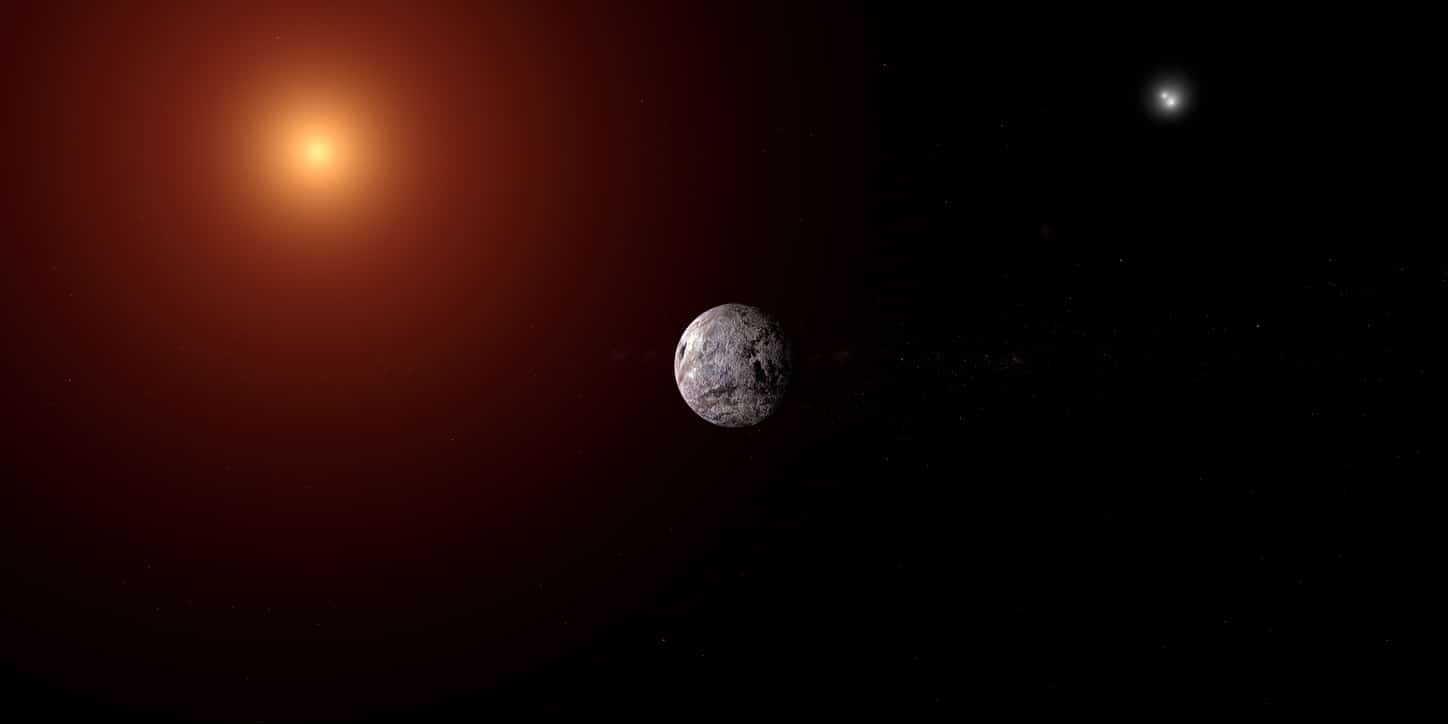
Within roughly a billion years from now, the Sun will grow in size, become brighter and hotter, which could render the Earth uninhabitable. However, a chance encounter with a moving star could offer a way to save our planet. This potential interaction might shift the Earth into a cooler orbit, or even release it entirely from the solar system, according to a new theoretical study.
Is the Earth Already Doomed?
The evolutionary path of stars, including our own Sun, includes an inevitable phase: the red giant stage. At present, our star shines by fusing hydrogen into helium in its core, a process that provides the light and warmth we know. Yet, as the hydrogen supply dwindles, the Sun will swell, potentially swallowing the inner planets of our solar system, including Earth.
This outcome results from the expansion of the star’s outer layers, which drives a substantial increase in its size and brightness. It is expected to reach its peak in about five billion years. However, terrestrial life will have long since disappeared. Indeed, even if Earth currently sits within the Sun’s habitable zone—the region where liquid water could exist—the natural evolution of the Sun will cause that zone to widen, gradually moving Earth away from this critical region over the next billion years. This transition could then lead to the loss of liquid water, and with it, the conditions necessary for life.
The Impact of a Wandering Star
Imagine a scenario in which the Earth is kicked out of its orbit and, potentially, saved by the passage of a wandering star that comes a little too close.
To explore this possibility, a team of astronomers set out to simulate the behavior of our solar system if a star were to pass nearby within the coming billion years.
Note that the closest known approach of a star occurred a few million years ago. At that time, the object came within about 10,000 AU of the Sun. That distance is about ten thousand times greater than the Earth–Sun distance.
Here, out of pure curiosity, the team ran calculations of planetary motions by simulating stars of various sizes approaching at different distances, including encounters as close as 1 AU. In total, they conducted 12,000 simulations to explore a range of possible configurations.
The results showed that in more than 90% of the simulations, there was no change to the orbits of the solar system’s planets. Overall, it would seem that a passing rogue star would have only a modest impact on our planet, whether for better or worse.
A Possible “Capture”
Yet, in certain simulations, the flyby of a star ends up nudging the Earth into a more distant, colder orbit. In other scenarios, planets—including Earth—could be hurled into the Oort Cloud, a sphere of icy bodies at the solar system’s fringe.
More intriguingly, several simulations also indicated that a wandering star could exert enough gravitational pull on Earth to capture it into its own orbit around the passing star, effectively steering our planet through space around a new stellar companion. In such a case, our world might receive enough energy from this new partner to sustain liquid water on its surface.
However, counting on a lifesaving star to rescue Earth would not be wise. Rather than placing our hopes in a celestial savior, researchers suggest that we should pursue an Earth-based solution—either by altering our planet’s orbit or by blocking a portion of the incoming solar energy.
Another bold alternative proposed by some scientists is to consider deliberately moving the Earth by changing its trajectory using advanced technology. While this scenario currently belongs more to science fiction, there are theories about using enormous solar sails or redirected asteroids to gradually adjust the Earth’s orbit. By slowly changing the distance between Earth and the Sun, this approach could theoretically keep our planet within the habitable zone, even as the Sun evolves. If future technological breakthroughs allow such an achievement, it could provide a sustainable option for preserving life on Earth in a solar system that is perpetually transforming.
The study’s details are published in the arXiv preprint database.
