
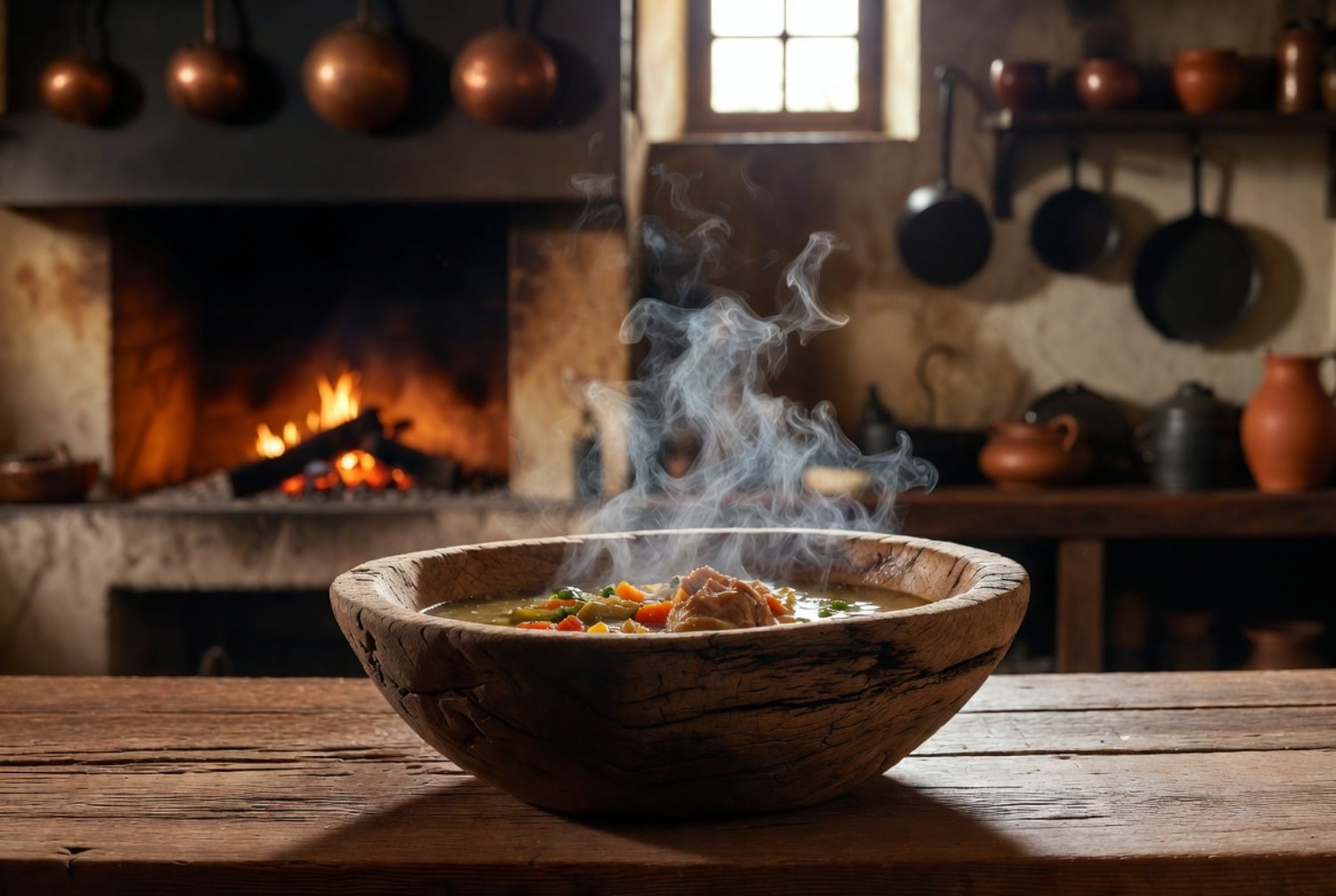
In the nineteenth century, beef broth was prescribed by physicians to treat depression, fever, and even dementia. This therapeutic obsession with liquid meat gave rise to products we still know today: Oxo, Bovril, and even Marmite. An astonishing story that blends chemistry, colonialism, and medical marketing.
What you will learn
- How Justus von Liebig transformed a kitchen broth into an industrial medical product in the nineteenth century
- Why Victorian doctors prescribed meat juice for nearly every ailment
- How these remedies ended up in our kitchen cupboards instead of our pharmacies
A Medicine in Every Cup
In 1851, adult patients at a London hospital were given half a liter of beef broth daily as part of their medical treatment. It wasn’t a meal—it was a prescription. Victorian medical records are full of beef broth recommended for digestive disorders, fevers, depression, and dementia.
This belief rested on a simple but widespread idea: the essential nutrients lay in the liquids of the meat, not in its solid fibers. A false premise, but one that would give birth to a global food industry.
The Chemist Who Industrialized Broth
It was the German scientist Justus von Liebig who formalized this intuition in 1847. A founder of modern organic chemistry, he developed a process that reduced beef into a concentrated paste—the direct ancestor of the bouillon cube. His initial aim was social: to feed urban poor populations who could not afford fresh meat.
The problem was the cost: thirty kilograms of beef were needed to produce one kilogram of extract. The solution came from South America, where beef was an almost-free by-product of the leather industry. In 1865, Liebig teamed up with engineer George Christian Giebert to found the Liebig’s Extract of Meat Company — LEMCO — whose Oxo line remains marketed to this day.
Surprising Cooking Methods
19th-century beef broth recipes were more sophisticated than one might imagine. Many of them advised cooking raw meat in sealed jars submerged in boiling water — an early form of sous vide, under pressure. This technique preserves more nutrients than simple boiling, producing a liquid with an intensely concentrated flavor.
Some recipes went even further, combining this cooking with pressing the half-cooked meat in a metal press. The result: a bloody juice, highly heme-rich — that metallic taste typical of offal rich in heme. Nutritious for the anemic, probably. Appetizing for everyone? Not necessarily.
From Medicine to the Kitchen Cupboard
By the end of the nineteenth century, scientific debates began to undermine the medicinal claims of beef broth. Some doctors pointed out that most of the meat’s nutrients were wasted in the process — only the aromas, notably monosodium glutamate, actually survived the concentration.
With the establishment of national pharmaceutical standards and the advent of modern medicines, the meat juice gradually left pharmacy shelves for kitchen cupboards. Companies followed suit: Valentine’s Meat Juice became a culinary ingredient in 1906; Oxo remains a thriving brand. The dehydration technology for chicken broth, perfected for NASA astronauts, also ends up in our supermarkets.
