
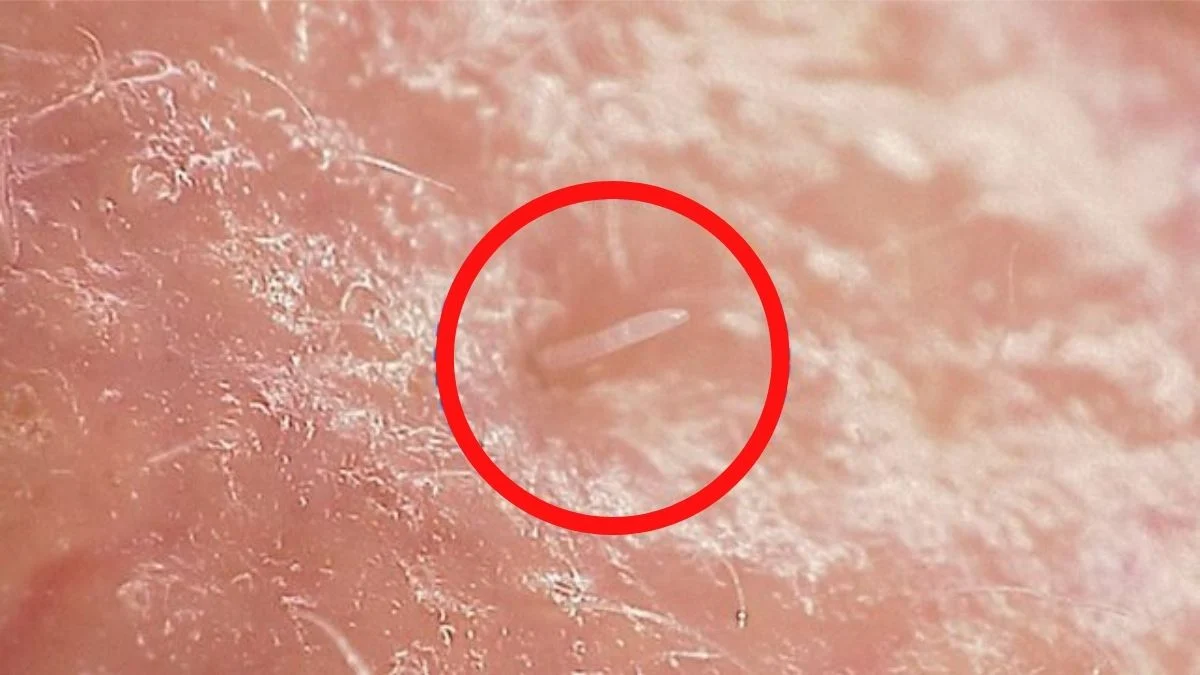
Almost all humans host microscopic mites buried head-first in their hair follicles. A genomic study published in Molecular Biology and Evolution reveals that these creatures are so well adapted to human life that they are evolving toward a symbiotic fusion with our bodies — and no, they do not expel their waste on your face when they die.
What you will learn
- Why these mites only surface at night — and which gene they have lost that makes them sensitive to light
- How their ultra-reduced genome reveals their total dependence on humans
- Why they could play a beneficial role for your skin — and what we used to wrongly believe about them
You’re probably hosting residents on your face
Demodex folliculorum is a microscopic mite about a third of a millimeter long, with a sausage-shaped body, that spends almost its entire three-week life buried head-first in your facial hair follicles. It is born on you, feeds on dead skin cells, mates on you at night, and dies on you. Humans are its only possible habitat.
So dependent on us that it is evolving from an ectoparasite — an organism that lives on the exterior of a host without killing it — toward an obligate symbiont, potentially in a mutually beneficial relationship. In other words, these mites could gradually “merge” with humans.
A genome reduced to the absolute essentials
To understand this evolution, researchers from the universities of Reading, Bangor and Vienna sequenced the full genome of D. folliculorum. The result: it is the most reduced genome ever observed among closely related mite species — only the bare minimum of genes coding for proteins required for survival.
Each leg is driven by just three unicellular muscles. This extreme reduction is explained by a lifestyle that has been remarkably secure: few natural threats, little competition, limited exposure to other mites. Without strong selective pressure, unnecessary genes gradually disappear.
Among the genes lost are those involved in protecting against UV and those that regulate wakefulness in daylight. That is why D. folliculorum comes out only at night — not by choice, but due to a genetic incapacity to tolerate light.
They use your melatonin to reproduce
Another genomic peculiarity: the mites cannot produce melatonin themselves. In most small invertebrates, this hormone promotes mobility and reproduction. Researchers suggest that D. folliculorum uses the melatonin naturally secreted by human skin at dusk to trigger its nocturnal activity and mating.
Speaking of mating, the male reproductive organs have migrated to the front of the body, with the penis pointing upward from the back. This forces the male to position itself beneath the female while they balance precariously on a hair to mate — all night long.
Neither invading parasites, nor poop bombs
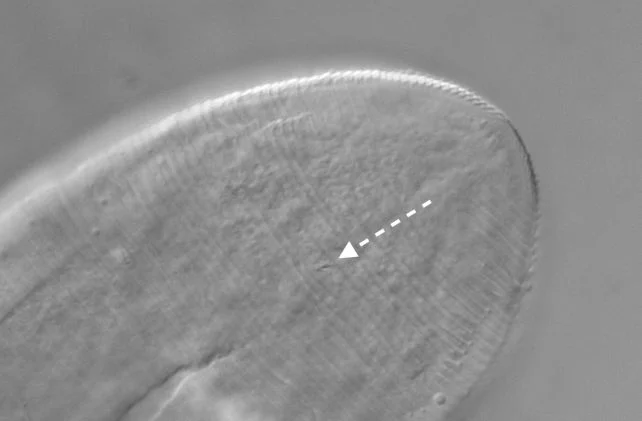
For years, scientists believed that D. folliculorum lacked an anus and stored its waste internally, expelling it upon death onto your skin. Genomic analysis shows that this was incorrect: the mites do possess tiny functional anal openings.
As for their role, it might even be beneficial. Their long coexistence with humans suggests they could help keep facial pores unclogged. However, an evolutionary dead end awaits them: their genetic diversity is so low and mating opportunities so limited that their long-term evolutionary future remains uncertain.
