
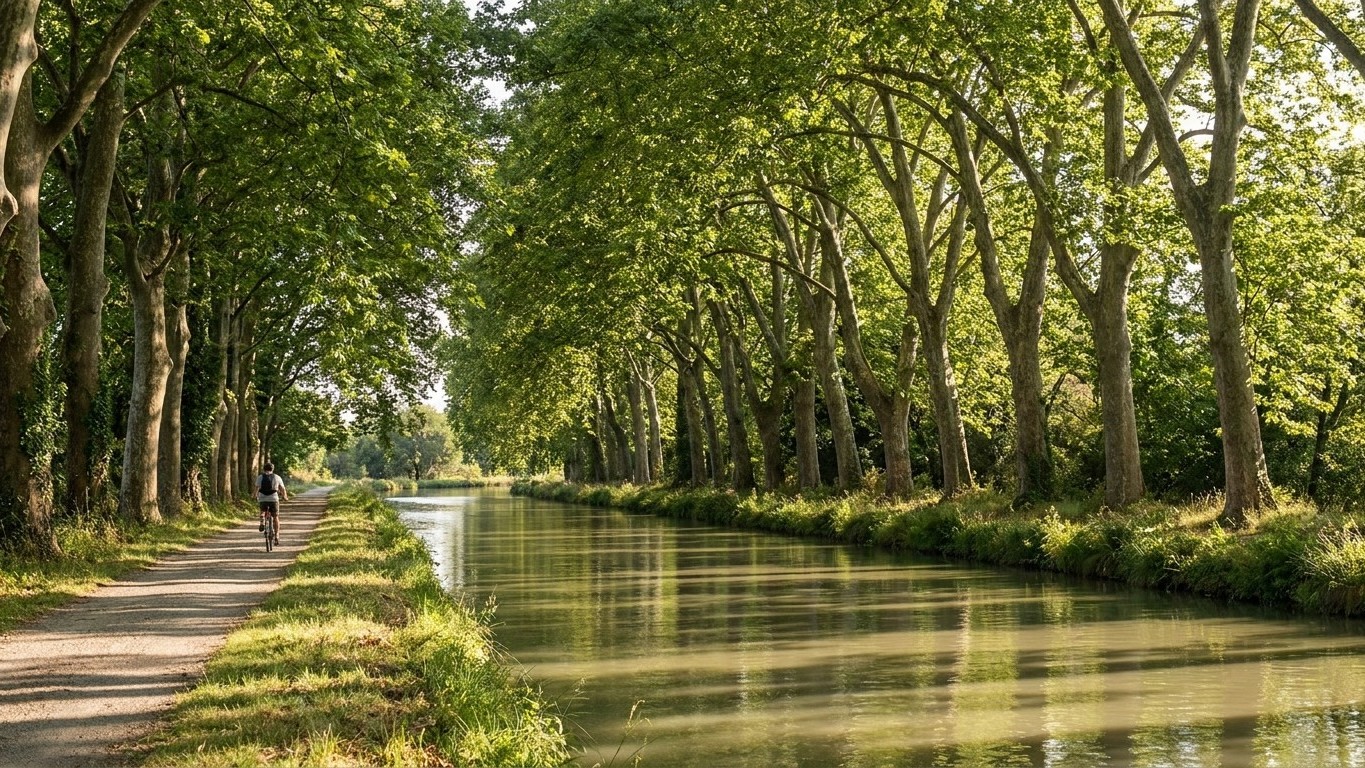
Thirty-three thousand three hundred and fifty. That is the number of plane trees that the French waterways authority (VNF) has had to fell along the Canal du Midi since the appearance of a deadly disease, out of the 42,000 trees that once lined the waterway. Just over four out of five trees. Along the Canal du Midi, there are now 33,350 plane trees felled out of the 42,000 counted along the canal before the disease appeared, according to VNF figures dated January 2026. The famous tree-covered vault, the canopy that earned the canal its World Heritage inscription, is slowly fading from the landscape.
The story of this vegetal slaughter reads like a crime thriller. The arrival of brown rot (or canker) in France dates back to the Allied troops’ landing in Provence in 1945; the ammunition crates of American soldiers were made of plane wood, already infected with the canker that began to spread at that time. The responsible fungus, Ceratocystis platani, takes several decades to creep up toward Languedoc. The first outbreak on the canal itself was detected in 2006, near Villedubert, between Carcassonne and Trèbes. Since then, there has been no lull. For twenty years, the French waterways authority has been engaged in the fight to curb the spread of the canker disease that strikes the plane trees along the Canal du Midi. The appearance of this microscopic fungus in 2006 transformed the landscapes iconic to the Canal du Midi: within a few years it decimated hundreds and then thousands of plane trees lining the canal for almost two centuries.
À retenir
- An invisible but inexorable fungus has been decimating the green guardians of a UNESCO wonder for twenty years
- Root systems uprooted by the disease undermine riverbanks and threaten the canal’s structural integrity
- The green reconstruction will cost 220 million euros, roughly twice what has been mobilized so far
A fungus with no available treatment
The worst aspect of this situation lies in science’s total impotence before the blight. Once a tree shows symptoms—purple markings on the bark and progressive desiccation of the crown—there is no remedy. The only countermeasure is to systematically fell infected trees, as well as those within a safety radius, to slow the root and airborne spread. This explains the scale of the cuts: each winter, hundreds, sometimes thousands of trees come down under the saw, burned on site to prevent any dissemination.
Not all territories along the canal are affected equally. The Aude department, where the disease first appeared, accounts for most of the losses, with tens of thousands of trees uprooted over successive campaigns. Hérault follows closely. Haute-Garonne, on the other hand, remains surprisingly spared, with only a few hundred plane trees sacrificed since the crisis began. A contrast that shows how the fungus’s progression depends more on water flow, soils, and local maintenance practices than on a simple geographic distance from the initial outbreak.
An UNESCO-listed canopy that is slipping away
The Canal du Midi celebrated in 2026 the thirtieth anniversary of its inscription on the UNESCO World Heritage List. A bitter anniversary, given that the very element that partly justified this international recognition is dissolving before our eyes. The renowned tree-lined vault of the Canal du Midi, recognized for its universal value as part of the UNESCO designation, will gradually disappear. Not a rapid and dramatic degradation, but a slow erosion, winter after winter, gradually transforming certain sections, notably in Minervois, into sparse alignments where there once stretched a continuous shade across more than 240 kilometers.
The disappearance of the plane trees does not only affect aesthetics. Their roots had kept the banks in place for nearly two centuries. Once the trees are uprooted, this root network also disappears, weakening the embankments and forcing VNF to carry out, in parallel, costly stabilization works; dozens of kilometers of banks have already been restored. The canal’s ecosystem also suffers: cavities in trunks, roosting sites for bats, natural nesting sites for birds—all habitat disappears with diseased trees. To compensate, more than 1,800 nesting boxes and artificial roosts have been installed along the length.
A 220-million-euro project, funded in dribs and drabs
Since 2012, VNF has launched a broad replanting program to try to reconstitute a tree-covered landscape, if not identical, at least coherent. New tree species are gradually replacing the plane trees, and more than 22,000 trees have already been replanted out of the 33,000 felled. The choice of replacement species is far from improvised: the hairy oak, robust and capable of reaching a height comparable to that of the plane tree, has been selected as the new identity species and is expected to cover around 40% of the linear reach in due course. Other trees, chosen for their resistance to the Mediterranean climate, such as the sycamore maple, the large-leaved lime, or the umbrella pine, complete this mosaic of vegetation aimed at limiting the risk that a single disease could wipe out an entire green corridor again.
The funding question remains, weighing heavily on VNF’s shoulders. Since the project began, Voies navigables de France has invested nearly 110 million euros in this initiative, including 13 million from regional authorities (Occitanie Regional Council, Departments of Hérault, Aude and Haute-Garonne) and 11 million from donations. Yet the total budget needed to complete the uprooting, replanting, and bank stabilization is estimated at 220 million euros, roughly double what has been mobilized so far. A call for donations remains open to businesses, foundations, and individuals through VNF’s philanthropy mission, every euro collected adding to a still-incomplete financial puzzle.
According to projections by VNF experts, no original plane tree will remain along the canal within about ten years. That timeline suggests a landscape definitively transformed long before the young hairy oaks, planted only about four meters apart, have had time to re-form a continuous canopy above the water. For the barges and cyclists who currently tread the canal, the cool shade of certain sections already belongs largely to the past.
Sources: replantonslecanaldumidi.fr | ici.fr
