
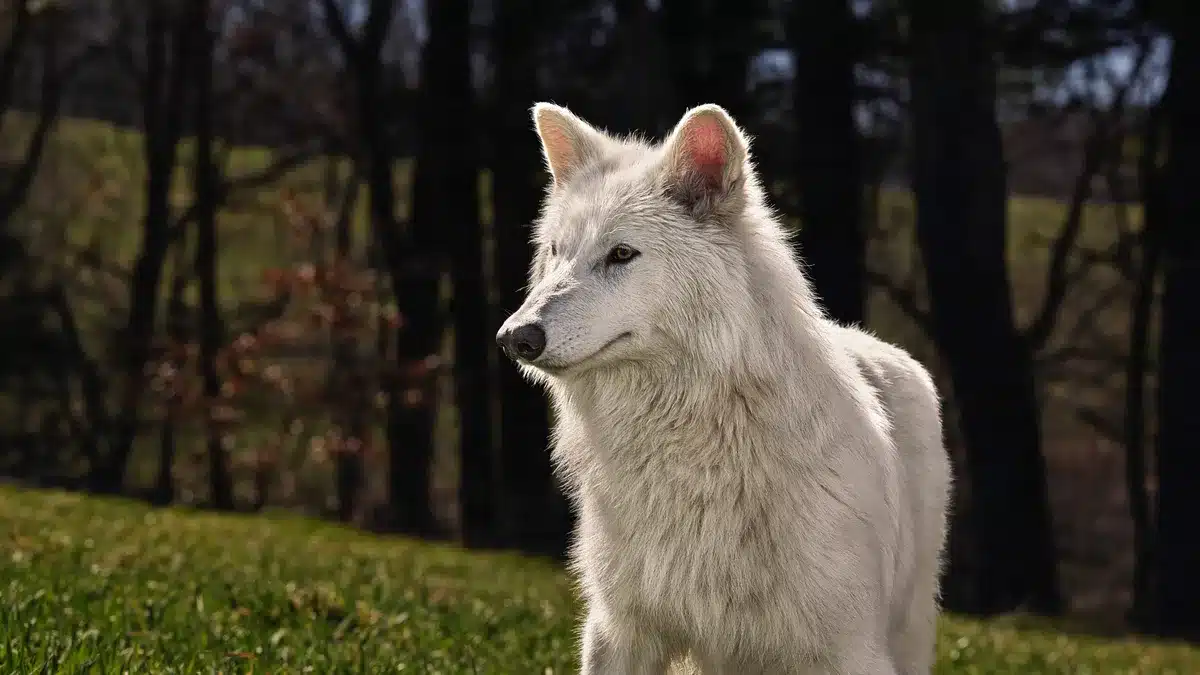
Ten thousand years ago, the formidable wolf dominated the North American plains. Larger than today’s gray wolf, this fearsome predator disappeared along with most of the glacial megafauna. Today, a team of scientists is trying to bring it back to life — or at least restore its appearance — through genetic editing.
The stars of this audacious bet? Romulus, Remus, and Khaleesi, three wolf cubs raised by Colossal Biosciences, a company specializing in de-extinction technologies. At six months old, the first two already weigh about 20% more than a standard gray wolf, surpassing 40 kg. Their younger sister, still growing, is also showing above-average growth.
Terrible wolves, but not quite
Despite their name and their appearance, these animals are not true dire wolves. Technically, it is currently impossible to clone an extinct species due to DNA that is not sufficiently intact. What Colossal has achieved is a genetic reinterpretation: from gray-wolf embryos, researchers modified 14 genes to endow them with physical traits similar to Canis dirus.
The goal isn’t pure reconstitution, but the development of technologies capable of aiding the conservation of threatened species. For some experts, such as paleogeneticist Nic Rawlence, talking about “de-extinction” is still a misuse of terms. But at Colossal, this approach is presented as a tool in service of living beings.
A springboard to save today’s species
And this isn’t just a media stunt. Alongside the “dire wolves,” Colossal also announced the birth of four genuine red wolves, a species on the brink of extinction with barely two dozen individuals roaming in the wild. Unlike the modified wolf cubs, these clones — named Hope, Blaze, Cinder, and Ash — are genetically identical to the original species, cloned from carefully preserved founding lines.
Result: a 25% gain in genetic diversity for a seriously threatened species, a rare victory in the field of conservation.
The Northern White Rhino in sight
Another ambitious project: saving the Northern White Rhino, of which only two females remain capable of reproduction. By using frozen eggs and sperm, and developing viable embryos, Colossal hopes to recreate individuals and implant them into females of the southern sister species.
This kind of effort, blending biotechnology, conservation, and innovation, could redefine our approach to fighting extinctions. Even as some voices raise ethical and ecological concerns about such an approach.
