
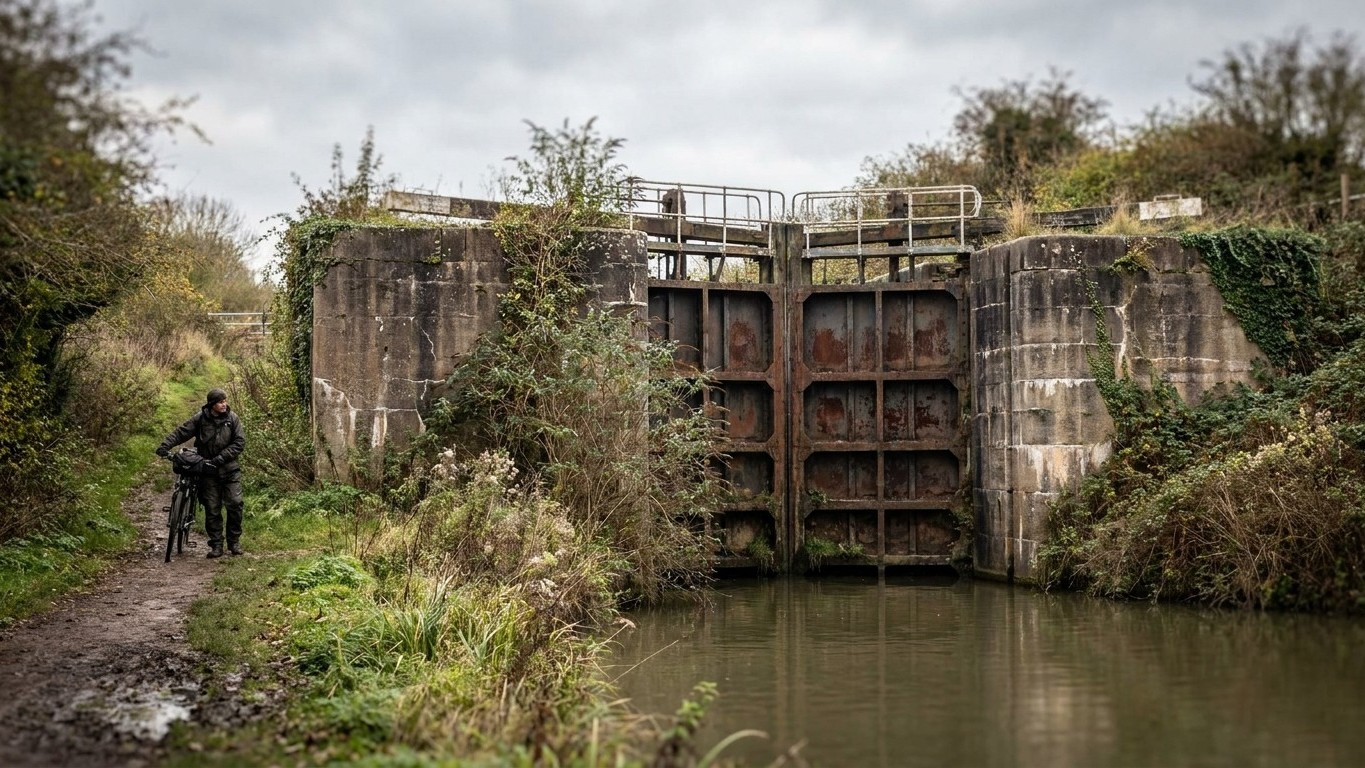
A lock capable of swallowing convoys of 4,500 tonnes, inaugurated with great fanfare, which has never seen the traffic it was designed for. This is the paradox that has slept for nearly thirty years between Mulhouse and Niffer, in Haut-Rhin. In 1996, the State completed the upgrade of this Alsatian stretch of the Rhône-Rhine canal to European broad gauge. A year later, in October 1997, it simply repealed the declaration of public usefulness that would have allowed extending this waterway to the Saône. The project of the century had turned into a riverine dead end.
À retenir
- A brand-new lock, built in 1996, that never saw the traffic intended for it
- The State spent about €2.3 billion in current euros on a segment that leads nowhere
- In 1997, the Jospin government abandoned the dream of a North Sea–Mediterranean river highway
A Brand-New Stretch That Goes Nowhere
Between Niffer on the Rhine and Mulhouse, France did indeed construct a stretch built to European broad gauge, but this segment leads nowhere, trapped between an international river and a network still built to the Freycinet gauge of the 19th century. In concrete terms, vessels able to carry the equivalent of several dozen trucks have literally nowhere to go once they leave this portion. The section completed in 1995 features a state-of-the-art lock capable of receiving convoys of 4,500 tonnes, but since the project was halted in 1997, this infrastructure remains a riverine cul-de-sac: barges have no route to continue toward Dijon or Lyon.
The original ambition extended far beyond Alsace. Once in service, the high-capacity waterway would have allowed motorized ships of 2,000 tonnes and pushed convoys of 4,400 tonnes to reach Port-Saint-Louis on four days from Niffer, along the Grand Canal d’Alsace and into the Rhône delta. An inland river highway linking the North Sea to the Mediterranean, capable of rivaling the Rhine-Main-Danube canal that Germany had just put into service. The project, led by the Société de réalisation de la liaison fluviale, aimed at a 229-kilometer link between Laperrière-sur-Saône and Niffer. On paper, a strategic axis for continental freight. In practice, a project that would grind to a halt.
Why the State Pulled the Plug in 1997
Two arguments toppled the project: money, and the Doubs valley. Financially, the bill grew dizzying. Between 1995 and 1996, a reassessment of total costs had surged the figure from 17 billion to nearly 49 billion francs, including interest and VAT. A report commissioned by Bercy and the ministries of Transport did nothing to reassure: an April 1996 assessment by the General Inspectorate of Finances and the Conseil général des Ponts-et-Chaussées, following a request from the Ministers of Economy and Finance and Transport, cast a chill over the project.
Environmentally, the route crossed a particularly sensitive area. The link would have had a major impact on the environment and local life as it followed the Doubs valley, passed through Mulhouse, Montbéliard, Besançon, and Dole, and ran near 33 protected or listed sites, 36 historic monuments, and 196 archaeological sites. This was enough to galvanize a strong ecological opposition, backed at the highest levels of government. The Lionel Jospin government halted the project in 1997, led by Dominique Voynet, then Minister of Territorial Planning and the Environment. The decision was not symbolic: it was legally formalized by the decree of 30 October 1997 repealing the declaration of public utility concerning the Saône-Rhine improvements.
This is corroborated by the Senate, in a 1998 report devoted to major transport infrastructures, cited as a reference in this affair for almost thirty years. The Prime Minister had repealed, on 30 October 1997, the declaration of public usefulness for the Saône-Rhin link between Laperrière (Côte d’Or) and the Grand Canal d’Alsace at Niffer. Ironically, the DUP, signed in 1978 and renewed a decade later, was due to expire on 30 June 1998, so the State chose to kill it eight months before its natural death rather than let it simply lapse.
A Calculated Mess: Lands Re-sold
The financial tally of the abandonment remains impressive. The Senate, in its 1998 report, laid out a blunt assessment of this waste: the total cost of works on the 283 kilometers of navigable waterways approached 15 billion francs, the equivalent of about €2.3 billion in current terms, just for the works already completed. Billions spent on a single lock and a few tens of kilometers of widened canal, never achieving their objective.
Then came the question of lands bought over decades for a route that would never see the light of day. Almost all of these lands had been acquired by the Navigation during 1968–1970, and the municipalities along the proposed route bore for about thirty years the effect of a land freeze that could have supported many general-interest projects. The State ultimately decided to strike: following the abandonment of the large-gauge Saône-R Rhine link, it was decided to sell off the built and non-built lands acquired under this framework, by both the State and the Compagnie nationale du Rhône.
What Remains Today of the Grand River Dream
The file has been reopened several times, without ever succeeding. An information report on the economic and social prospects of developing the European Rhine-Rhône axis was presented to the National Assembly on 15 November 1999 to relaunch the link, but economic or ecological opposition remained strong and nothing came of it. The final blow arrived later. The Duron report estimated the costs of Saône-Moselle and Saône-Rhin works at €15–17 billion over 350 kilometers, a sum so large that the commission placed the project among those with horizons beyond 2050.
Today, attention has shifted entirely. Recent investments focus on renovating the historic Freycinet locks and developing canal tourism, not on reviving the large-gauge plan. There is no revival of the large gauge on the agenda for this link. Thirty years on, the Doubs valley retains its bends, the Niffer lock still operates for residual traffic, and the Rhine-Rhône canal remains what it has been since 1997: a project half-built, half-buried, that never received its other half.
Sources: geoconfluences.ens-lyon.fr | revue-ein.com
