
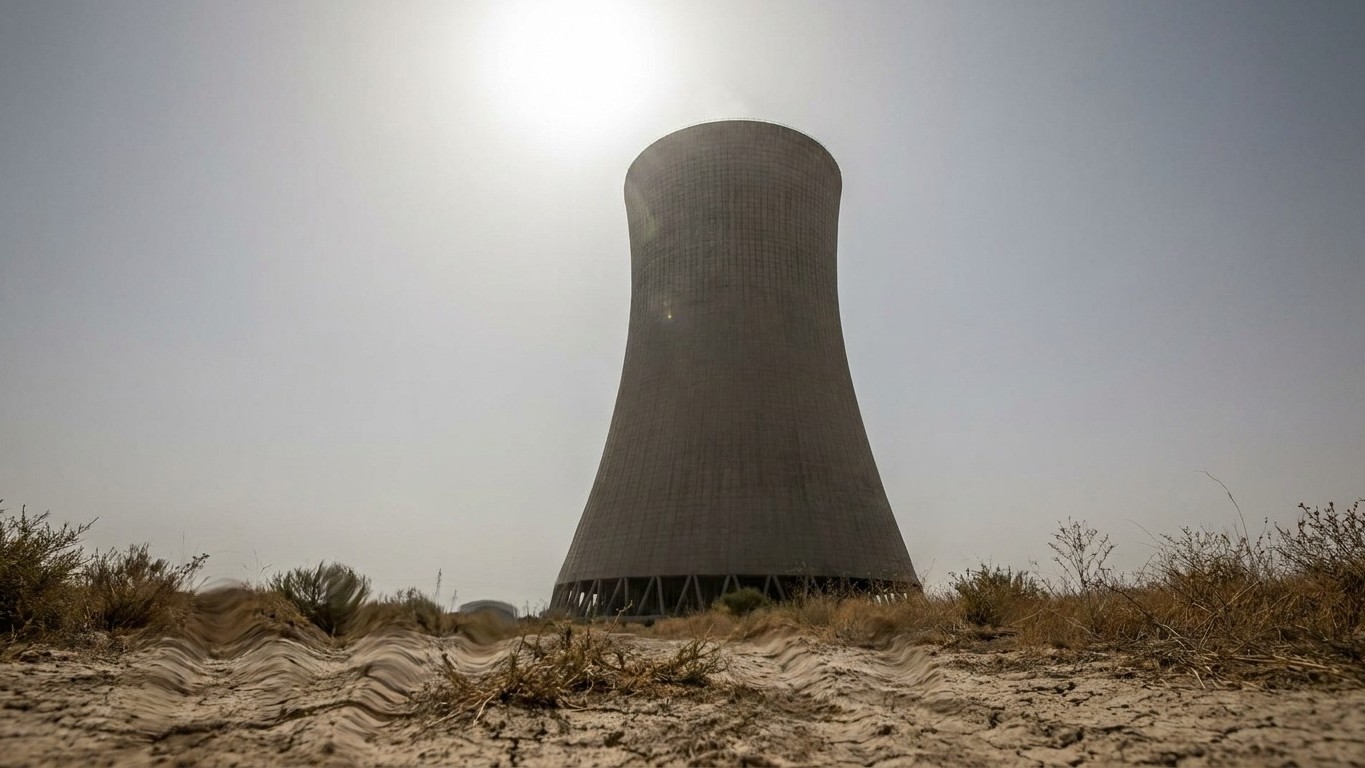
Three reactors shut down, eight others running at reduced power, and yet no red alert on the electricity grid. On Sunday, July 12, 2026, in the midst of a heatwave that placed 37 departments under red alert, EDF halted three nuclear reactors and curbed the output of eight more, totaling eleven units out of France’s 57-strong fleet. The three reactors that were stopped shared a striking commonality: Golfech No. 2 on the Garonne, Bugey No. 3 on the Rhône, and Chooz No. 2 on the Meuse, whose cooling circuits depend on rivers whose temperatures were rising dangerously. This wasn’t a lone technical hiccup. It wasn’t an accident; it’s a protocol: heat limits the thermal discharges of riverside plants.
Key takeaways
- Eleven reactors affected, zero alert on supply: why the grid did not flash red?
- External heat rattles French nuclear — but not as expected
- An electricity sector so robust it exports even at 40°C: the real hidden scandal
Eleven reactors affected, zero alert on supply
Sunday, July 12, 2026, at the height of a heatwave that placed 37 departments under red alert, EDF shut down three nuclear reactors and reduced the output of eight others, amounting to eleven units out of the 57 in France’s fleet. The three reactors that were stopped shared a striking commonality: Golfech No. 2 on the Garonne, Bugey No. 3 on the Rhône, and Chooz No. 2 on the Meuse, whose cooling circuits depend on rivers whose temperatures were climbing dangerously. This isn’t a one-off technical hiccup. It isn’t an accident; it’s a protocol: heat limits the thermal discharges from riverside plants.
In numerical terms, the capacity loss is far from negligible. The three stopped reactors total 2,700 MW of lost capacity, while the eight units curtailed—operating at 50% to 80% of nominal power—remove an additional 3,000 to 4,000 MW. Over a full day, the tally rises: over 24 hours, the loss reaches roughly 120,000 to 150,000 MWh, the equivalent of the daily consumption of 15 million people. That is enough to unsettle any grid operator. Yet no. Despite the loss of 11 reactors, RTE did not trigger any red alert on supply.
Why French rivers are becoming the Achilles’ heel of nuclear power
The mechanism is physical, not political. Nuclear reactors depend entirely on cold water to cool their cores: when the temperature rises, France’s nuclear fleet wobbles. Faced with the Garonne and Rhône approaching regulatory thresholds, the state had to intervene urgently to avert a more serious scenario. The Ministry of the Economy published an exemption in the Official Journal for the Bugey plant, valid until July 20, 2026, allowing reactors 4 and 5 to continue operating despite temporary breaches of thermal discharge limits.
This episode isn’t a meteorological fluke. The heatwave follows a similar episode in June 2026, when three reactors (Golfech, Bugey, and Nogent-sur-Seine) had already been shut down; the repetition within a month illustrates the French energy system’s fragility in the face of extreme temperatures. EDF is aware of this and has quantified the cost of adaptation. The company disclosed in early 2026 an adaptation plan estimated at €8.7 billion over fifteen years, including measures to improve resilience of nuclear production during extreme heat periods. At Civaux, in the Vienne, part of the solution already exists: a system that cools the water discharged by the cooling towers before releasing it into the environment is already in operation. The challenge is to roll it out, at a cost likely to run into hundreds of millions per site.
The real paradox: exporter even at 40°C
That is where the narrative of a “country on the brink of a blackout” collapses. Far from being on a tightrope, France is actually experiencing one of the strongest electrical semesters in its history. France exported 56.8 TWh of electricity in the first half of 2026, with a net export balance of nearly 51 TWh, a level never reached in a first half. And the heatwave did not alter this trend. The heatwave did not modify this general pattern: even when France consumes a bit more electricity, it remains broadly an exporter, summarizes Thomas Veyrenc, chief executive for economy, strategy and finances at RTE.
Solar even played the role of emergency responder at the precise moment when nuclear faltered. Solar power, boosted by the same sun that weighs on nuclear, filled part of the gap: spot prices even went negative between 10:00 and 17:00 on July 12, an irony of the French electricity system where the same heatwave that curbs one source of production enhances another at the same moment. A shift that says a lot about the mutation of the French energy mix, where nuclear remains the leading actor but is no longer alone on stage.
This abundance isn’t just a matter of national pride or export earnings, though they carry weight: these exports generated €5.4 billion in 2025 versus €5 billion in 2024. It primarily changes the character of the energy debate. As long as France exports that much, there is no risk of usage conflict among sectors seeking to electrify: industry, digital, transport, and buildings can switch to electricity without supply tension. The real issue is therefore not immediate shortage, but the accelerated wear of a nuclear fleet built for a climate that no longer exists. Each additional heatwave nudges French rivers closer to the threshold beyond which even a ministerial exemption will not be enough to save the arrangement.
Sources: atoo-energie.com | economiematin.fr
