
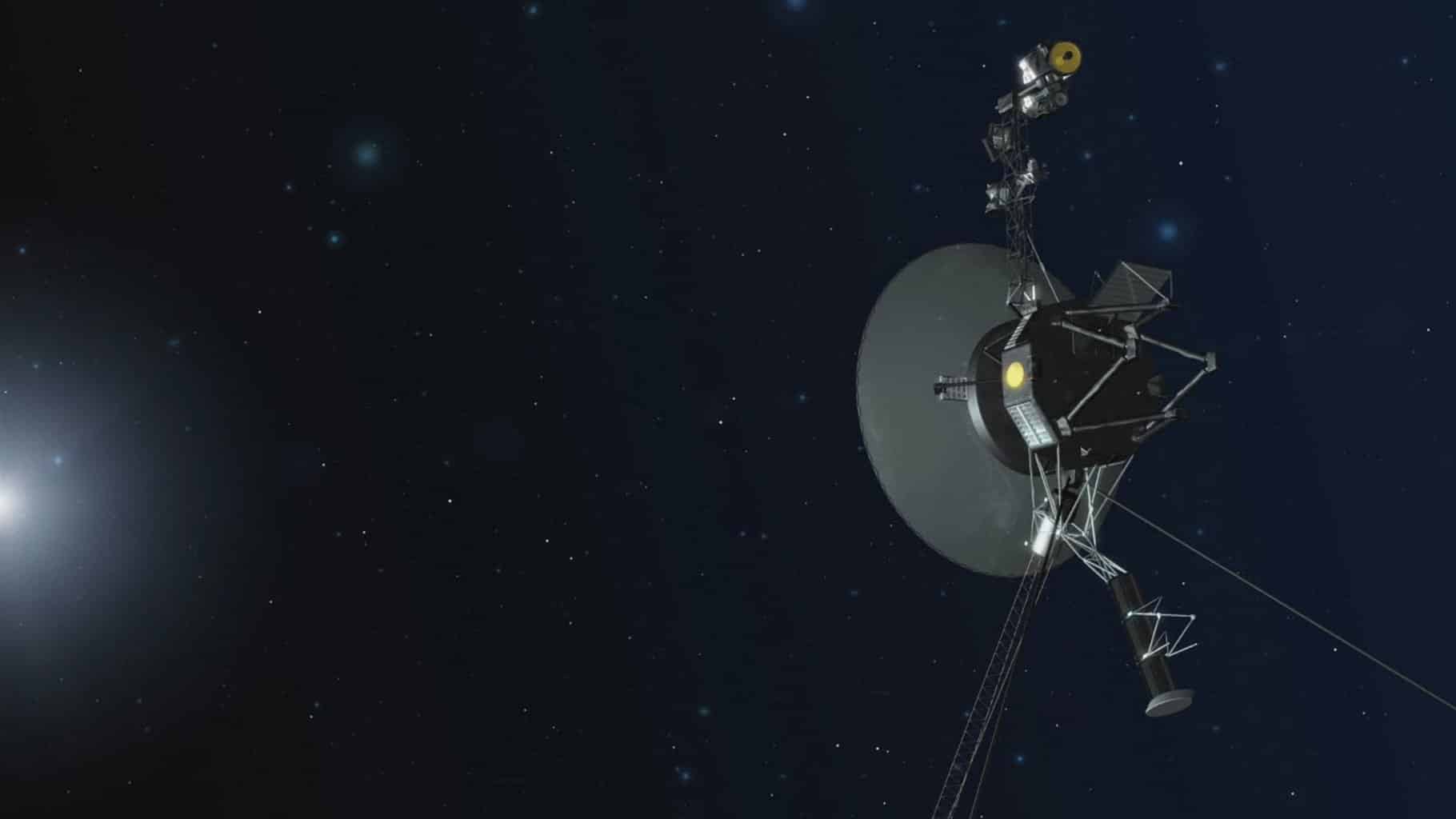
Since its launch in 1977, the probe Voyager 1 has never stopped moving forward. Silent and fearless, it speeds through the cosmic void at more than 61,000 km/h. In almost five decades of travel, it has left the familiar solar environment behind to plunge into interstellar space. And by the end of 2026, it will cross a symbolic and unprecedented boundary in human history: the distance that light travels in 24 hours.
This unit, called a light-day, equals about 25.9 billion kilometers. In other words: where light takes a full day to reach us, our farthest ambassador will have taken… half a century.
A legendary probe, always on the move
Launched by NASA on September 5, 1977, a few days after its twin Voyager 2, Voyager 1 had as its initial mission to explore the outer planets of the Solar System. It gave us the first detailed views of Jupiter and Saturn, revolutionizing our understanding of these giants.
But the journey did not stop there. After leaving the planetary region, Voyager 1 continued, ever farther, until it crossed the heliopause in 2012, the boundary where the solar wind yields to the interstellar medium. It thus became the first human-made object to leave the heliosphere — that protective bubble generated by our Sun.
Why a light-day is enormous
To give a more concrete idea: light takes a little over 8 minutes to reach Earth from the Sun (that is 1 astronomical unit or ~150 million km). Voyager 1, on the other hand, is currently more than 166 astronomical units away, and the time for a radio signal to reach the probe now exceeds 23 hours.
This means that by November 2026, signals will take a full 24 hours to complete the one-way trip from Earth. On that date, Voyager 1 will have reached a one-light-day distance. It will cross this threshold on November 15, 2026 relative to Earth, and on January 28, 2027 relative to the Sun.
This milestone is not merely symbolic. It embodies how staggeringly vast human exploration remains on a galactic scale. A light-day is but a hair’s breadth in the ocean of the Universe.
How far will it go?
Voyager 1 is far from finished. Even if its scientific instruments gradually shut down in the early 2030s, the probe will continue to drift in the void — silent, but intact. At its current speed, it will take about 40,000 years to move two light-years away, the outer boundary of the Solar System as estimated (roughly halfway between us and the nearest star, Proxima Centauri).
Because contrary to what one might think, Voyager 1 has not yet completely “left” the Solar System. While it has indeed surpassed the heliosphere, it still operates within the Sun’s gravitational influence, particularly in the region believed to be the Oort Cloud, a vast hypothetical sphere of icy comets.
A reminder of our cosmic smallness
The upcoming event — crossing a day-length distance — gives us a dizzying perspective. Even with advanced technologies, no crewed craft has ever come close to such an achievement. Apollo 10 still holds, since 1969, the record for human speed (nearly 40,000 km/h) — about six times slower than Voyager 1 — and at that speed it would take 155 days to reach only 1 AU. These numbers give us pause.
Space, our next great challenge
As Voyager 1 moves farther into the unknown, it carries with it a message for potential extraterrestrial civilizations: the famous Golden Record, a disk containing sounds, images, and music from Earth. A fragile, yet magnificent, hope for cosmic contact.
And above all, it leaves behind a lesson: the Universe is immense, the journey is long, but human audacity knows no bounds.
