
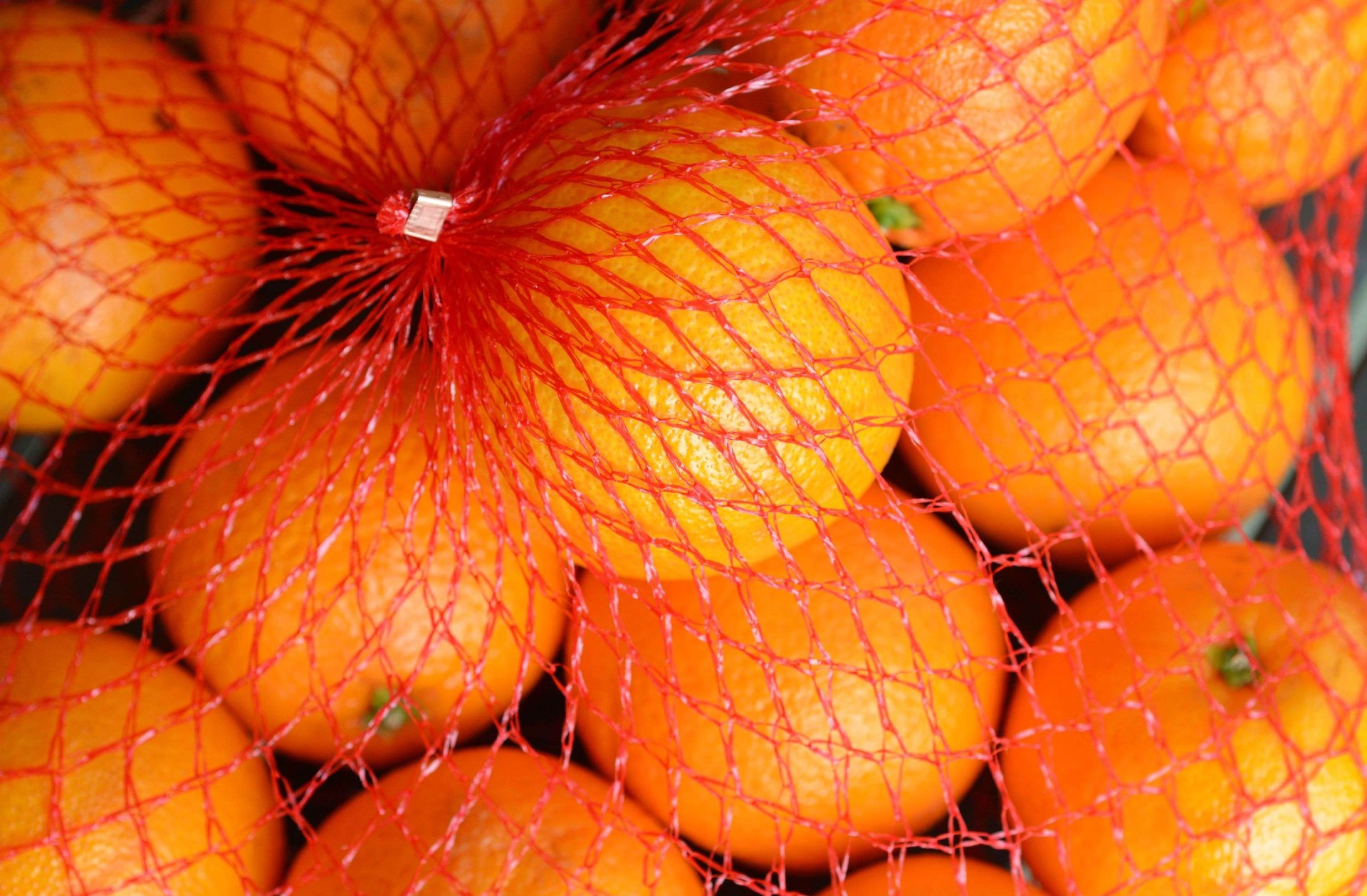
These red nets that wrap oranges in supermarkets are not there by chance. They exploit a documented visual phenomenon — the confetti illusion — which pushes your brain to perceive a color more intensely than reality. A psychologist from the University of Giessen in Germany learned this the hard way when he came home with green oranges.
What you will learn
- How the red net actually alters the perceived color of a fruit, even if it’s slightly green
- What the confetti illusion is and why your brain can’t bypass it
- Why this principle applies to many other fruits and vegetables you buy every week
A visual illusion in the produce department
Karl R. Gegenfurtner, a psychologist at the University of Giessen in Germany, wasn’t trying to crack a marketing mystery that day. He had simply returned from the supermarket with a net of oranges that had seemed perfectly ripe under their packaging.
Once home, removing the net, the surprise was total: each orange displayed a pronounced green tint, far from the bright orange seen on the shelf.
It wasn’t a defect in the batch. It was the physics of perception.
The confetti illusion, or how the brain fuses colors
The phenomenon at play is called the confetti illusion. It describes the brain’s tendency to mix a color with those surrounding it, rather than processing it in isolation.
Concretely: when a net of red or orange threads surrounds a fruit, your visual system automatically merges the adjacent colors. A slightly greenish orange ends up bathed in warm tones, and your brain records the result as a ripe, juicy fruit.
This isn’t a flaw in human sight — it’s a feature. The brain constantly seeks to simplify visual perception, to smooth color transitions, and to produce a coherent image. The net exploits exactly this mechanism.
A principle applied far beyond oranges
Gegenfurtner published in 2024 a study documenting this phenomenon with photographs to support it. His conclusion is clear: fruit sellers have understood and exploited this illusion for a long time.
Looking at supermarket aisles, the principle reveals itself everywhere. Lemons are packaged in yellow nets — in a red net, they would take on an unappetizing orange hue. Zucchinis, onions, potatoes follow the same logic: the packaging is systematically the color of the ideal specimen.
Your brain, the produce aisle’s primary accomplice
What this study reveals goes beyond a simple orange anecdote. It illustrates how much our purchasing decisions can be influenced by visual mechanisms we do not consciously control.
No one intentionally chooses to buy a green fruit thinking it’s orange. But the brain, left to itself in an aisle, makes perceptual shortcuts that marketing has learned to anticipate with precision.
If the red net actually boosts sales, the question remains open — no study has measured it directly yet. But the perceptual mechanism, it is now well documented.
