
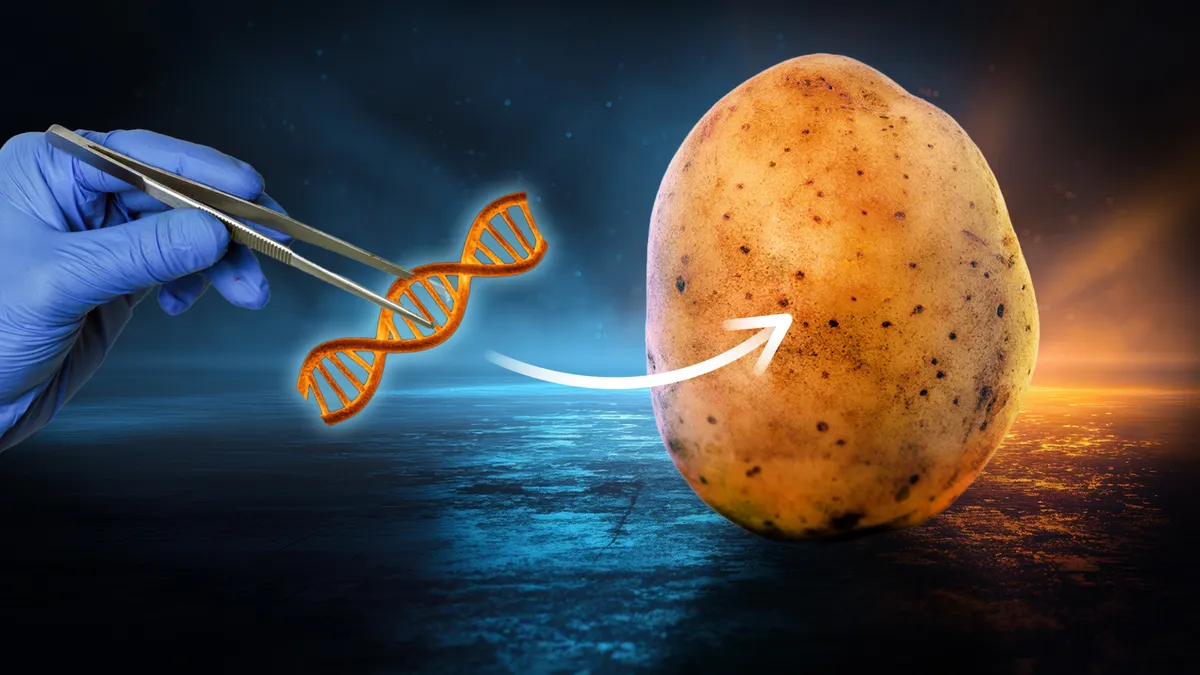
Researchers from the University of Chicago and Beijing have introduced the human gene FTO — directly linked to obesity predisposition — into rice and potato plants. The result: up to a 50% increase in yield under real-world conditions, longer roots, and better drought resistance. And the phenomenon repeats across all the plants tested.
What you will learn
- Why researchers expected a disaster and achieved the opposite result
- What concrete applications this discovery could have in the face of food insecurity and climate change
An idea deemed absurd that changed everything
In 2021, an intercontinental team bringing together researchers from Chicago, Beijing and Guizhou proposed a hypothesis that no one would have taken seriously in a standard scientific meeting: introducing a mammalian gene linked to human obesity into plants to see whether their growth would be affected.
The gene in question is called FTO — nicknamed “Fatso” during its discovery, not for its effect but for the unusual size of its sequence. In humans, possessing a single copy of this gene increases obesity risk by 30%. Two copies: 70%.
In plants, this gene does not exist. It is precisely this void that intrigued the researchers.
A result three times beyond expectations
The first plant tested was rice. In the lab, the effect was immediate and unprecedented: a yield three times higher than unmodified crops. In field conditions — closer to real farming — the gain stabilized around 50% in yield and additional biomass.
But the surprises did not stop there. The modified plants exhibited more efficient photosynthesis, significantly longer roots, and increased drought resistance. Far from disturbing the plant’s systems, the FTO gene seemed to have freed the organism from its natural growth limits.
Potatoes later displayed the same results. Then grass, trees, watercress, lettuce. Every species tested responded in the same way.
Why it works: a defenseless bomb
The theory advanced by the researchers to explain this mechanism is as simple as it is radical. The FTO protein does not naturally exist in plants, so they have no mechanism to counter its action.
“FTO arrives and there are no restrictions on where it can access,” explains Chuan He, co-director of the project. “It’s a bomb.”
Without a natural inhibitor, the protein acts freely on the messenger RNA (mRNA) molecules that regulate cell growth — accelerating and amplifying a process that plants were already performing, but in a restrained manner.
Applications that go beyond food
The universality of the phenomenon across such different plant species opens a vast field of potential applications. Beyond edible crops, researchers envision drought-resistant grasses for arid regions, or trees with deeper roots capable of withstanding the violent storms whose frequency is increasing with climate change.
The team is also exploring the possibility of achieving the same results without introducing a human gene — by activating mechanisms already present in the plant genome. It is a promising avenue, but one that will require entire generations of crops grown under real-world conditions before being validated.
