
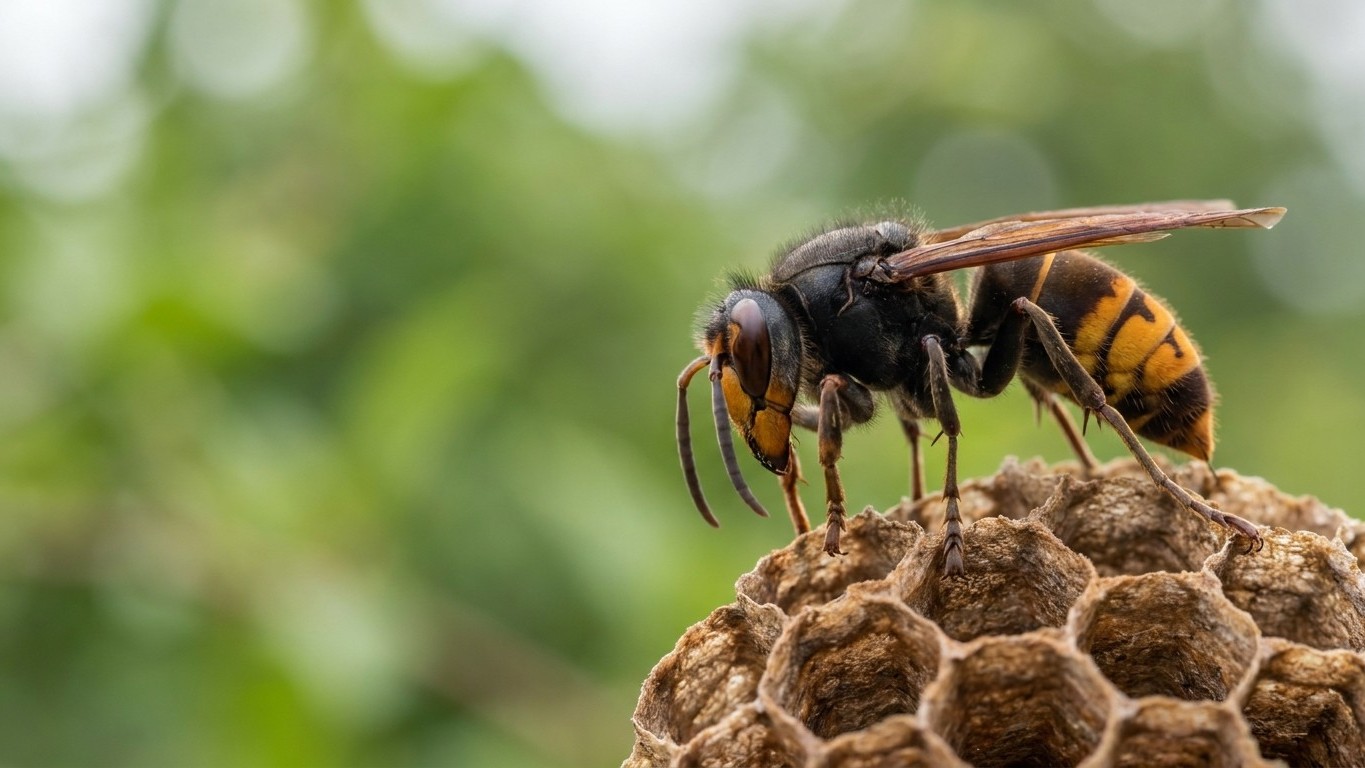
Three million euros per year against a bill of 98 million. In a single equation, that is the paradox at the heart of France’s new strategy against the Asian hornet: a first national plan has just been launched, yet it covers only a tiny fraction of the damage this insect inflicts every year on beekeeping and biodiversity.
Key takeaways
- A container of Chinese pottery released queens of Vespa velutina in 2004, triggering an invasion that kills about 20% of domestic honeybees each year
- The real cost: 98 million euros annually, of which 80 million in lost pollination — yet the State funds only up to 3 million
- Depending on your postal code and your insurance, the hornet may remain free or cost you more than 100 euros: who is really footing the bill?
An invasion started from a crate of Chinese pottery
It all began with a logistic mishap that stayed under the radar for a long time. Accidentally arriving in France in 2004 inside a container of Chinese porcelains, the Asian hornet colonized more than 90 French departments in two decades. The precise starting point lies in Nérac, in the Lot-et-Garonne: a container from China delivered with its cargo a few queens of Vespa velutina, the Asian hornet. At the time, no one imagined what would follow.
The spread was rapid. The species advances roughly 70 to 100 kilometers each year, depending on the source, and between 200,000 and 350,000 nests are estimated to be active every autumn on French soil, a figure that remains imprecise due to the lack of systematic census. With no natural predator on the territory, the insect thrives especially where honeybees lack adequate defenses, and this feared invader kills about 20% of domestic honeybees each year. In certain areas, the pressure is such that beekeeping becomes simply impossible: entire apiaries disappear, without any official map documenting this quiet retreat.
98 million euros: the detail of a bill that makes you dizzy
It is UNAF, the National Union of French Beekeeping, that laid the numbers on the table. The breakdown of losses calculated by UNAF is telling: 6 million euros for the beekeeping sector, 12 million euros for nest destruction, 80 million euros in lost pollination. In total: around 98 million euros per year. The bulk of the damage is not visible inside the hives but in the fields: it is the pollination service provided for free by the insects that collapses.
On the ground, field research among professionals provides a tangible measure of the damage: 94% of the 3,918 professional beekeepers surveyed report being affected. Some farms lose up to 50% of their hives in a single season. A single nest, by itself, acts like a machine devouring pollinators: a nest of Asian hornets, in one season, consumes more than 10 kilograms of insects, i.e., more than 100,000 individuals according to UNAF estimates. The hornet Vespa velutina’s diet is about 40% honeybees, according to the official plan. The remaining 60% are not harmless either: they also affect wild pollinators already weakened at the European scale.
The national plan: six times bigger than before, but 3% of the problem
In the face of this hemorrhage, the State finally moved. On March 27, 2026, the Minister Delegate for Ecological Transition, Mathieu Lefèvre, launched from Remiremont in the Vosges the first national plan to combat the Asian hornet. The law of March 14, 2025, and its decree of December 29, 2025, set the legal framework. The plan spans six years, renewable. On paper, the shift is real: the announced envelope, three million euros per year, marks a break. It is, formally, six times the 2025 budget, which stood at 500,000 euros via the Green Fund.
But arithmetic soon cools the enthusiasm. Relative to the 98 million euros of annual losses, the 3 million euros represent about 3% of the problem. Spread across some 35,000 potentially affected municipalities, that amounts to less than 86 euros per municipality per year! The minister himself acknowledges the temporary nature of the amount: the envelope is “indicative” and can evolve based on the results of the first years. A frank admission that speaks volumes about the fragility of the arrangement.
Professional organizations did not mince their words. UNAF, alongside the National Beekeeping Union and other federations, denounced a text they deemed largely insufficient; the 3 million announced will not go to beekeepers, no concrete measure protects the apiaries, and the actual budget needed is estimated at 110 million euros. On franceinfo, UNAF secretary general Patrick Granziera summed up the field’s frustration: “How do you expect us to act with three million euros?” He cited a telling example: “Just in Dordogne, in one year they spent over 200,000 euros on nest destruction,” he notes.
Who really pays in the end?
In concrete terms, public money does not end up in residents’ pockets. From May 1, 2026, a dedicated platform opens on Aides-territoires. Local authorities and approved associations can file funding requests for control actions: nest destruction, hive protection, selective trapping, training. The crucial point: this window is not open to individuals! If you have a nest in your garden, you will not access it directly. The logic of the program is cascading: the State funds the municipalities, which fund (or not) individuals. Result: depending on the commune where you live, the destruction of a nest can be free or cost you more than 100 euros out of your own pocket.
Facing this gap, the private market has started to fill the void. Since April 2026, one insurer has innovated in this area: since April 2, 2026, Crédit Mutuel’s insurance automatically includes, on all its homeowners and non-occupant property multi-risk policies, a fixed annual allowance of 150 euros for the destruction of an Asian hornet nest. It is a first in France. A detail that illustrates the current situation: the State has set a national framework, but it is still the postal code, or the insurance company, that ultimately decides whether the hornet bill remains on your tab or not.
Sources: europesays.com | media24.fr
