
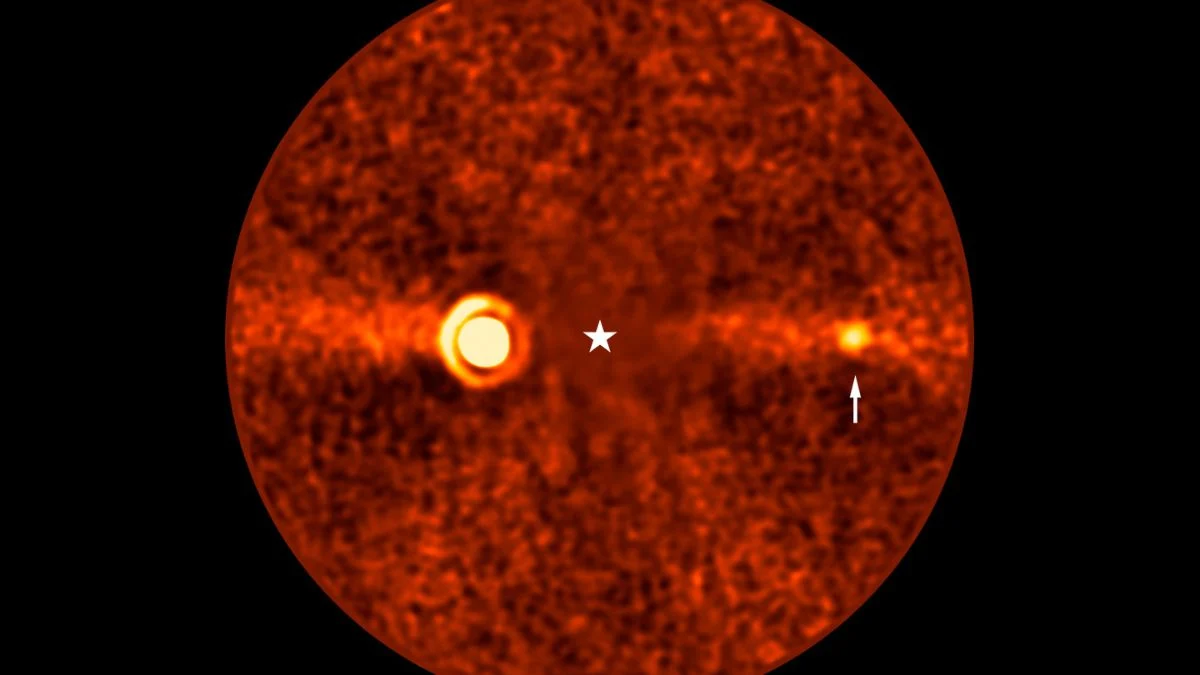
There are treasures hidden in plain sight, noticed only when you’re looking for something else. That’s a bit like what happened when a team of astronomers pointed their instruments at a well-known star, solely to observe a planet they had already identified. The result: a surprise guest slipped into their images, lurking in the shadows for more than a decade. Named Beta Pictoris d, she now holds a singular record—the faintest planet ever photographed directly from Earth. An achievement announced in the heat of summer, reminding us how many secrets the sky still keeps at a mere 64 light-years from us.
What you will learn:
- How a routine observation led to a completely unexpected discovery
- Why this planet escaped telescopes for more than a decade
- What Beta Pictoris d reveals about the formation of planetary systems
When looking for one planet reveals another by accident
At the outset, there was no intention to make a discovery. The astronomers simply wanted to monitor the evolution of an old acquaintance: Beta Pictoris b, a gas giant already cataloged around this star. A routine observation, of the sort performed hundreds of times each year. Except that, by carefully scrutinizing the data, a subtle signal drew their attention where nothing was expected.
Detected in 2025, this new planet could only be confirmed by tracing back through time, thanks to observations accumulated over more than ten years. It’s a little like turning through old photo albums and finding a face that had already appeared in earlier pictures without anyone ever recognizing it. To validate their find, the researchers combined recent and older images from the Very Large Telescope (VLT) of the European Southern Observatory, complemented by the archives of the James Webb Space Telescope.
A ghost adrift in an ocean of stellar light
If this planet managed to elude astronomers for so long, it isn’t due to a lack of instrument power. The real problem lies in glare. Picture trying to spot a firefly fluttering next to a lighthouse: the star’s light drowns out everything around it. And Beta Pictoris is no ordinary star. It is the second-brightest star in the Painter’s constellation, shining up to a billion times brighter than the planet that accompanies it.
Add to that another obstacle: Beta Pictoris d orbits far from its star, more than twice as far as its neighbors—nearly the distance that separates Neptune from the Sun. Remote and inconspicuous, it is revealed as one hundred times fainter than Beta Pictoris b, earning today the title of the faintest planet ever imaged from Earth. A true cosmic phantom, long invisible in an ocean of light.
Portrait of a cold little sister in an unusual system
The Beta Pictoris system was already rich in appeal. The host star is almost twice as massive as the Sun, about one and a half times larger and nearly nine times as luminous. Most notably, it is extraordinarily young: about 23 million years old, a blink in cosmic terms. It is surrounded by vast debris disks that stretch five times farther than the Sun–Pluto distance, and are regularly brushed by comets.
In this dramatic setting, two gas giants—Beta Pictoris b and c—already orbited, each weighing roughly ten times Jupiter’s mass. The new arrival appears as a little sister: more modest, at just 2.4 times Jupiter’s mass, and warmer, with a temperature hovering around 330 °C. A planetary family now richer and more contrasting than anyone had imagined.
What this discovery changes for the hunt for exoplanets
Beyond its fortuitous nature, this finding sends a strong signal to the scientific community. It proves that it is possible to extract from the shadows worlds that are extraordinarily dim, provided one cross-checks data accumulated over more than a decade. In other words, the archives of major telescopes may still conceal many planets waiting for a fresh look to be revealed.
This approach—merging old and new observations from the VLT and the James Webb Space Telescope—opens the path to detecting smaller, colder, and more distant planets. It could refine our understanding of how planetary systems form and organize themselves, especially around stars as young as Beta Pictoris.
By spotting the faintest world ever photographed from Earth, the astronomers remind us of a heartening truth: sometimes the most beautiful discoveries aren’t sought out; they simply come into view. So, how many other cosmic ghosts lie hidden in the images we already possess, waiting for us to recognize them?
