
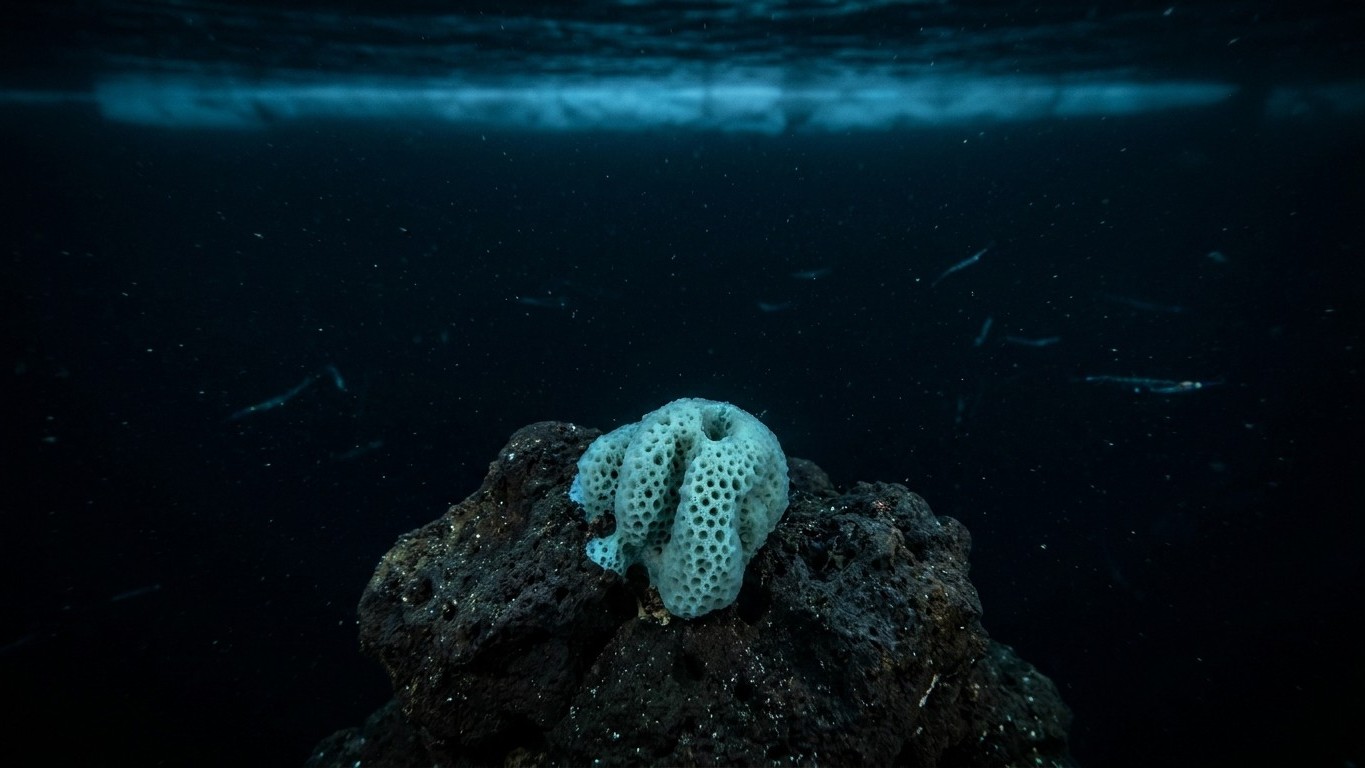
Nine hundred meters of ice, five hundred meters of freezing water, and yet: life. In 2018, a team of British researchers from the British Antarctic Survey drilled into the Filchner-Ronne ice shelf hoping merely to retrieve a sediment core. Sponges and other animals were found on a rock beneath 900 meters of ice and 500 meters of water in Antarctica, spotted by chance by an underwater camera after the researchers had drilled into the Filchner-Ronne ice shelf to obtain a seabed sediment core. No one expected to find anything living at that exact spot.
The reaction of the scientists speaks volumes about the reach of this discovery. No sunlight reaches these creatures, which are thought to feed on nourishment carried from hundreds of kilometers away, and marine biogeographer Huw Griffiths confessed he had never imagined seeking this kind of life, believing it could not exist there. A rare admission in a scientific milieu accustomed to anticipating discoveries. Here, chance outpaced theory.
Key takeaways
- Complex life thrives several kilometers from any light source beneath the Antarctic ice
- Carbon dating reveals this ecosystem has existed for nearly 6,000 years uninterrupted
- Other recent discoveries show that hidden oases under ice shelves are far more common than previously imagined
An unseen pantry, but a real feast
The puzzle lies in the nourishment. Under an ice shelf, no sunlight penetrates, so no photosynthesis, and therefore, in theory, no base food source for an ecosystem. Yet the sponges found on this rock beneath the Filchner-Ronne flourish, thriving tens or even hundreds of kilometers from the nearest light source. This is not an isolated case.
Meanwhile, a few hundred kilometers away, another German team from the Alfred Wegener Institute achieved a similarly perplexing result beneath the Ekström ice shelf, near the Neumayer III station. Using warm water, the team drilled two holes through nearly 200 meters of the Ekström ice shelf in 2018. What they brought up from the seabed surprised even the most seasoned researchers: fragments of life collected on the seafloor were extraordinary and completely unexpected, and despite their location several kilometers from the open sea, the biodiversity of the specimens collected was exceedingly rich.
How to explain this abundance without local light or photosynthesis? The team concluded that there must be enough algae carried under the ice shelf from the open waters to feed a solid trophic network. These creatures live on morsels dropped from a far-off table, a marine current acting as a conveyor belt of food across kilometers of ice.
Colonies thousands of years old
Carbon dating brings another surprise, perhaps the most dizzying. These animals are not newcomers enjoying temporary access to this subglacial shelter. As co-author Gerhard Kuhn, who coordinated the drilling project, explained, another surprise was to discover how long life had existed here: carbon dating of the dead fragments of these deep-sea creatures ranged from the present day back to 5800 years ago. Six millennia of continuous life, hidden beneath an ice sheet thick enough that no one had ever lifted it.
This figure is not anecdotal. It means that an entire ecosystem has persisted through major climatic variations, invisible and ignored by science until this drilling. Despite living 3–9 km away from the nearest open water, a life oasis could exist continuously for nearly 6,000 years beneath the ice shelf. Hard not to be swept up by a sense of temporal vertigo: these sponges and bivalves were already there when the pyramids of Egypt had not yet come into existence.
Other hidden worlds, other surprises
Antarctica has not finished yielding this kind of secret. In 2022, a New Zealand team led by marine physicist Craig Stevens studied a subterranean river near the Kamb Glacier, right at the heart of the Ross Ice Shelf. The researchers discovered a previously unseen ecosystem, tucked away in a river beneath a third of a mile of ice, drilling through the ice to lower a camera. The result surpassed all expectations.
Hundreds of amphipods, those tiny shrimp-like crustaceans, swarmed the camera as it descended into the river. A member of the expedition summarized the scale of the shock: “in a normal experiment, seeing even one of these creatures would make us leap for joy. There, we were overwhelmed.” It was enough to turn a routine drill into a moment of collective astonishment.
More recently still, the calving of a giant iceberg granted scientists direct access to a portion of the seafloor that had been sealed beneath the George Vt ice shelf. The detachment of the iceberg exposed a region never seen by human eyes, revealing a vibrant and thriving ecosystem. Researcher Patricia Esquete, a member of the expedition, draws a conclusion that challenges earlier studies: “now we know that under ice shelves, at least within the first 15 kilometers from the front, there exist diverse and well-established ecosystems.”
What these expeditions share goes beyond mere scientific anecdotes. Each one overturns a long-held assumption: that no complex life could survive far from light, hidden away by hundreds of meters of solid ice. The paradox is almost cruel for these millennial ecosystems, untouched for millennia precisely because nothing or no one could reach them: the accelerated melting of ice sheets, however, may succeed where centuries of extreme cold had failed, finally exposing them to a world they have never known.
Sources: media24.fr | tomsguide.fr
