
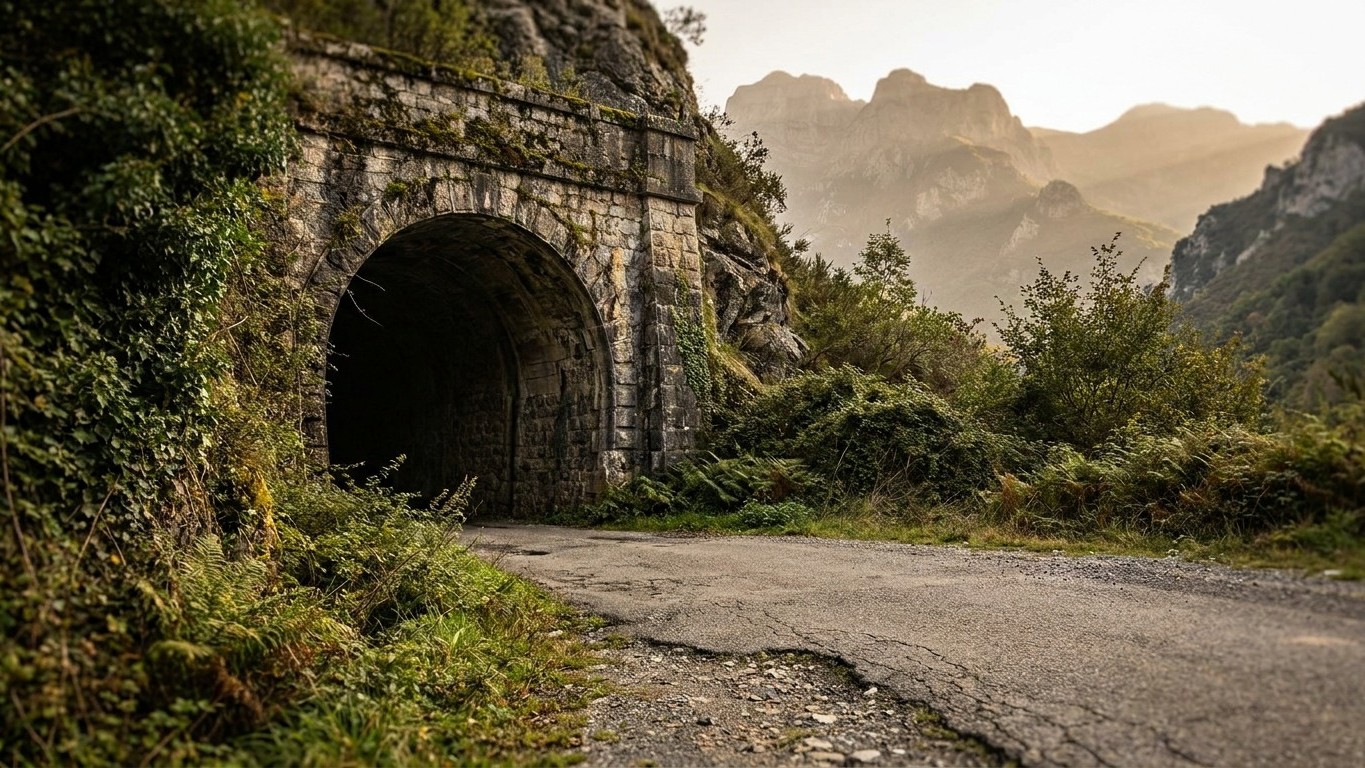
A bridge collapses on a frosty night, an international treaty is ignored, and eight kilometers of tunnel are paved over to become a highway: this is how France lost, without ever admitting it officially, one of its most strategic international railway lines. The Pau-Canfranc line, which linked Béarn to the Spanish Aragon across the Pyrenees, has been closed at the border side since March 27, 1970. Its Somport tunnel, safeguarded by a Franco-Spanish convention dating back more than a century, ended up buried under asphalt to let cars pass instead of trains.
To note
- A banal technical accident turns a bridge into a ruin and closes a strategic international artery
- The historic Somport rail tunnel disappears beneath asphalt, quietly flouting a century-old diplomatic commitment
- After 56 years of waiting, reopening is on the horizon around 2032 with an estimated cost of 93 million euros
A runaway train in the icy night
Everything begins with a banal technical incident that turns into a railway disaster. On March 27, 1970, the weather is frosty. A freight consist of seven wagons loaded with maize and a tank wagon, hauled by two electric locomotives of type BB 4200, encounters difficulties related to the damp cold and the endemic voltage drops in the catenary on the steep ascent toward Etsaut. The Urdos electrical substation, intended to feed this particularly steep section, is not operational that day.
Deprived of enough power for its rheostatic brakes, the train begins to slide backward down the steep grade with no driver aboard, passes through the Lescun-Cette-Eygun station and reaches the Estanguet bridge located in a bend, where centrifugal force derails the first wagon which drags the bridge and the rest of the train into the Gave d’Aspe. An operational mishap, with no casualties, but which seals for more than half a century the fate of an entire valley. Three months. It took roughly that long for the administration to understand that this bridge would never be rebuilt.
The tunnel sacrificed despite the 1904 treaty
The most troubling aspect of this matter is not the event of 1970 itself, but the decades that followed. The line had been built under an international convention between Paris and Madrid. On August 18, 1904, the Spanish ambassador and Théophile Delcassé signed an international convention providing for the construction of three Transpyrenean lines, including the Occidental Transpyrenean, from Oloron to Zuéra via Somport. This text committed the two states not only to build the line but to keep it in operation.
Yet, once the accident occurred, no one ever restored the rail connection on the French side. Worse: when France and Spain later decided to bore a road tunnel to relieve a congested national road that had become dangerous, it was the historic rail tunnel that served as the easy solution. The Somport rail tunnel was converted after the partial closure of the line in 1970 and rebuilt in a tramway fashion: the rails were removed and sections of track inserted into a hard road-like lining, allowing the joint passage of trains and road vehicles. A waiting spur, in short, before a real road tunnel was finally built just beside it, inaugurated in 2003, definitively relegating the rail facility to the status of an emergency gallery.
The question is no longer really debated among historians: the legality of the suppression of the rail line is questioned, since it should have been kept in operation according to the Franco-Spanish treaty. An irony for a protected infrastructure. Built between 1909 and 1917 by the Midi Company, this spiral tunnel was inscribed as a historic monument by decree of December 28, 1984, without that status protecting its original rail use. They protect the stone, not the function. A very French paradox.
A reopening that is slowly taking shape
Fifty-six years after the Estanguet accident, movement at last begins, but at a pace that resembles a legislative crawl more than a high-speed train. On the French side, the Pau-Bedous section reopened in 2016, bringing the operative length of the line to 60 kilometers. The real hurdle remains the cross-border stretch: there is a missing segment of roughly 30 kilometers between Bedous and the French entry to the Somport tunnel, and SNCF Réseau has recently launched a public consultation concerning the renewal of this section.
On the Spanish side, the railway administration Adif has finally opened its purse. Spain will invest 2.2 million euros for the reopening of the Somport tunnel, an amount intended to define the civil engineering and track works necessary to restore the infrastructure. Yet the financial imbalance between the two sides remains substantial: Spain estimates the total cost of reestablishing rail traffic between Canfranc and the Somport tunnel at 93 million euros. Brussels stepped in as early as 2019, with nearly 3 million euros to fund preliminary studies, and again in 2023 for the declaration of public utility on the French side.
The timing remains the question, and prudence is warranted. The current outlook for this axis is somewhat complex, but France and especially Spain are determined to resolve the issue, even if the process is lengthy, with some estimates forecasting a reopening around 2032. That would be 62 years after the Estanguet bridge collapsed into the Gave d’Aspe. In the meantime, the Canfranc ghost station has found a second life: since 2023, its monumental building houses a luxury hotel, turning into a refined lounge what was once Europe’s largest international station.
Sources: railtech.be | pyrenees-pireneus.com
