
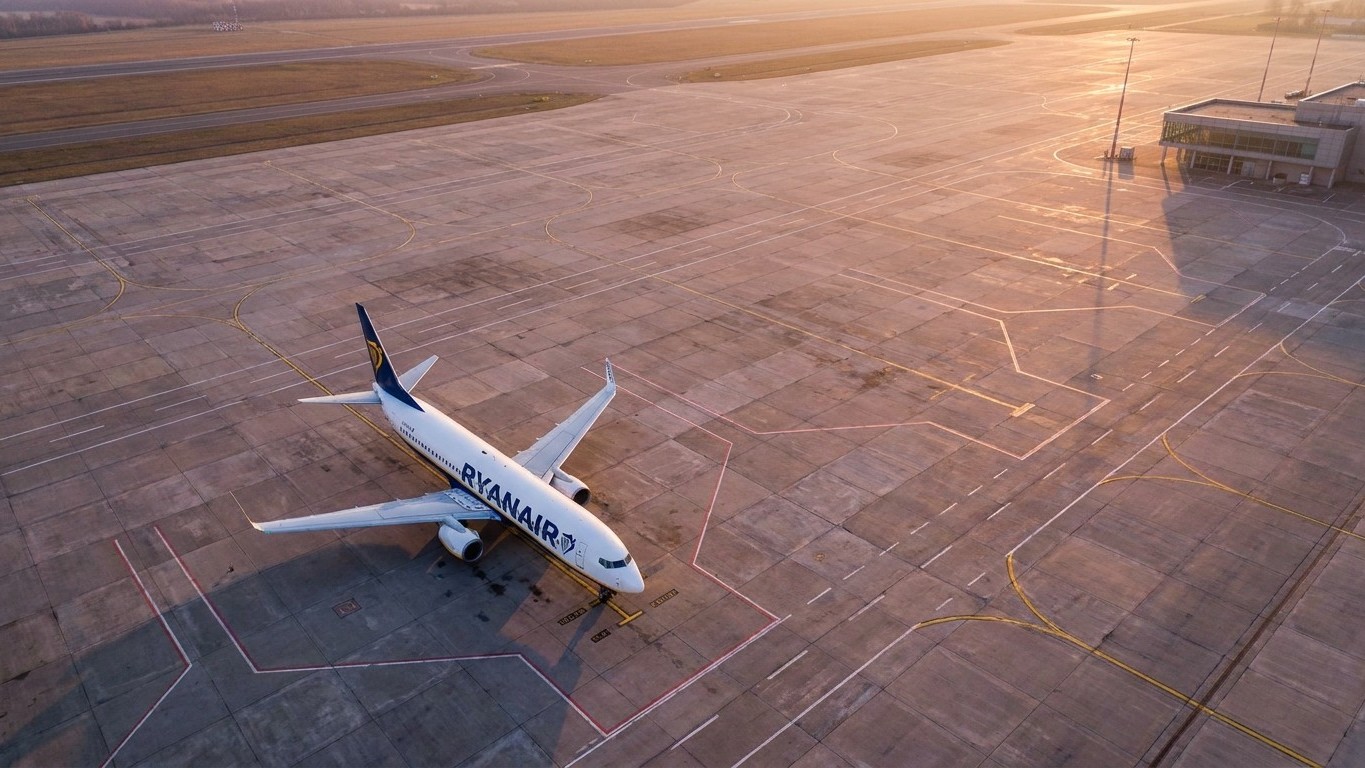
Three million two hundred thousand euros of public money committed in a single year to a regional airport. Of this amount, 2.8 million landed directly in Ryanair’s accounts, the only carrier operating from the Tours-Val de Loire platform. The line written on the invoices? The “promotion” of routes to Porto or Marrakech. A marketing cover that, in practice, masks a barely disguised subsidy system, and which bears nothing of an exception exclusive to Tours.
To note
- Why does 2.8 million euros of public money disappear every year into the accounts of a single airline?
- How do “promotion” contracts actually hide a subsidy system that Europe has already condemned elsewhere
- What would happen if this colossal envelope were redirected toward everyday transport?
A well-honed mechanism, denounced elsewhere too
The principle isn’t complicated. A local authority pays an airline so that it displays a destination on its website, under the banner of tourism activity. The idea: a public body gives money to an airline to “promote” a destination online, a move marketed as tourism, but which effectively operates as a subsidy in exchange for keeping routes open. In Tours, the mechanism works exactly the same: every euro spent on “promotion” actually funds the maintenance of a route that, without that support, would probably not survive on profitability alone.
This scheme is not unique to the Touraine region. Between 2010 and 2017, the Association for the Promotion of Tourist and Economic Flows, funded almost entirely by public money, paid 8.5 million euros to Ryanair in exchange for the “promotion” of Montpellier. The result? The European Commission ruled that those payments constituted illegal state aid and ordered France to recover them. A similar pattern appeared in La Rochelle, where comparable contracts signed between 2003 and 2010 led, in July 2022, to a repayment order of 8.4 million euros. And in Carcassonne, agreements from 2001 to 2011 were deemed incompatible with state aid to the tune of 1.8 million euros. Three precedents that should, logically, have urged caution. Yet they apparently did not lead to any change in Tours’ practices.
Thirteen euros per passenger, and an accepted dependence
In Tours, the logic of dependence has been documented for a long time. As early as 2020, local elected officials pointed to a system in which metropolitan leaders largely wanted to stop subsidizing Ryanair, which receives 13 euros for every passenger carried. A sum far from negligible when a one-way low-cost ticket can be negotiated for under thirty euros. In concrete terms, a significant portion of the ticket price is effectively financed upstream by regional, departmental, or metropolitan taxpayers, without always being aware of it when buying a ticket online.
The president of the Tours metropolitan authority, Wilfried Schwartz, himself acknowledged the fragility of the model: “If this system had been effective, it could have launched itself without public subsidies, or by reducing them, but that has never been the case.” A sentence that encapsulates, in a few words, two decades of hesitation over the Tours airport. The issue is not new: already in its 2007 report, the Regional Court of Auditors noted that from 1999 to 2005, total public subsidies amounted to 7,271,319 euros. Twenty years later, the bill continues to grow, line after line, contract after contract.
Why do the communities persist nonetheless
The answer comes down to one word: employment and perceived attractiveness. The successive managers of the platform have long defended the idea that one euro invested yields far greater economic spillovers. The operator, however, contends that the investment pays off in terms of tourism and economic development, with SEMAVAL estimating that one euro of subsidy yields 40 euros in spillovers. An impressive ratio on paper, but few independent studies have actually validated it at the local level, and, in my view, it would deserve far more rigorous scrutiny before being brandished as a yearly budgetary argument.
Moreover, relying on a single operator creates an obvious structural problem. One company handles all traffic, giving it leverage without any counterparty. Ryanair knows how to play this power dynamic. It demonstrated this in 2024 by threatening several French regional networks with outright closure: in November 2024, Ryanair publicly threatened to abandon ten regional French airports if the aviation tax were included in the 2025 budget. The Irish carrier didn’t just threaten; it acted on it, leaving Vatry airport in spring 2025. In Tours, the same instability looms over routes to Marrakech or Marseille, potentially hostage to a pricing deadlock that local communities cannot control.
A European deadline that could change everything
However, the calendar could rearrange the cards sooner than expected. Brussels is set to overhaul its rules on state aid applicable to regional airports, with a deadline of 2027. Some observers see this as an opportunity to sort out, once and for all, dozens of small French platforms propped up for twenty years. The APNA association, which monitors these practices, estimates that around forty French regional airports are affected by this kind of questionable scheme.
There remains one question that local officials often prefer to dodge: what would become of these 2.8 million euros if they were redirected elsewhere, toward daily transport or cycling infrastructure in the Tours urban area? The comparison isn’t trivial, given that the amount roughly matches the annual operating budget of a bus line used by thousands of passengers. The debate is only just beginning, while the contract binding Tours to its sole airline is due to be renegotiated in the coming months.
Sources: francebleu.fr | francebleu.fr
