
In Japan, researchers may have found a solution to a problem dating back a century. These scientists have indeed developed the very first plastic electrostatic motor, operating without any magnets or metallic rotors. This astonishing innovation relies on the use of very particular fluids: ferroelectric nematic liquid crystals.
Moving a liquid against gravity
For about a century, almost all electric motors have operated thanks to magnetism, in other words magnets. It must be said that from the outset, electrostatic force (static electricity) has always been considered too weak to drive electrical machines. Yet, scientific certainties on this question may no longer hold, thanks to the work of a duo of researchers from the Tokyo Institute of Sciences, Japan, as detailed in a press release about their work published in Communications Engineering at the end of 2025.
In their studies, the Japanese researchers demonstrated that special liquids – ferroelectric fluids – are capable of producing a fairly strong movement under the influence of an electric field. Moreover, this force can be substantial enough to move a liquid against gravity. The scientists’ experiment even showed that this force could drive a prototype motor without magnets or metallic rotors.
Promising experiments
Concretely, the researchers first placed the fluid between two electrodes separated by a few millimeters. The result was immediate: the liquid moved laterally over a distance of about 10 cm, a clear demonstration of a striking battle against gravity. By contrast, conventional fluids tested under the same conditions remained inert. Furthermore, the authors observed that the force increases proportionally with the applied voltage.
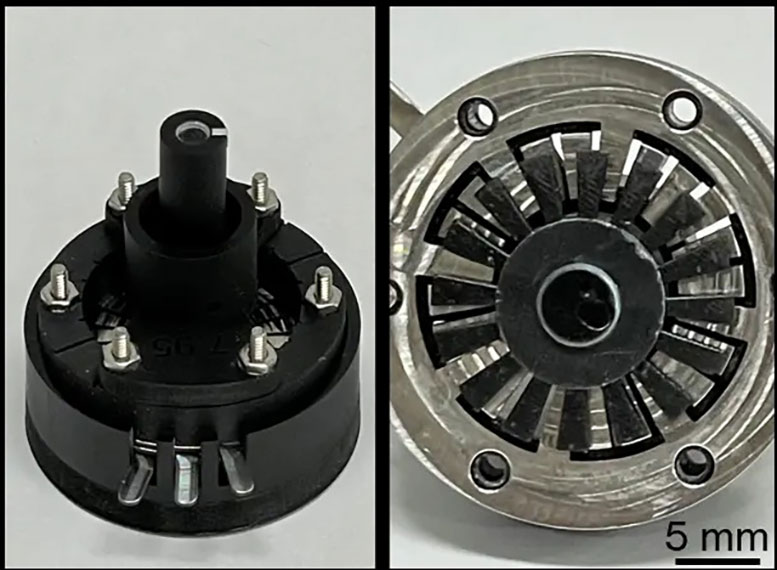
The two researchers then studied the phenomenon more precisely. According to them, the electric field orients the liquid’s molecules into a particular arrangement in order to achieve the lateral thrust. This allowed them to manufacture a motor prototype equipped with a plastic (resin) rotor, without any magnets or moving metal parts. Further tests showed that the electrostatic force could indeed power this same motor.
In practice, this is a brand-new motor, capable of operating with an electric field 1,000 times weaker than those associated with motors in previous attempts.
Advantages and areas of application
It is highly plausible that this marks a major technological breakthrough. With their motor made from ferroelectric nematic liquid crystals and resin, the Japanese scientists have certainly opened the door to unprecedented applications for traditional magnetic motors. The appeal of this innovation mainly lies in pursuing independence from rare earth elements, the replacement of very heavy materials such as copper, immunity to external magnetic fields, and also the possibility of durable, low-cost manufacturing.
The motor in question could be integrated into Magnetic Resonance Imaging (MRI) machines, as well as insulin pumps and other next-generation implantable artificial hearts. Integration into the design of biological and flexible robots (soft robots) would also be possible, as would artificial limbs — for lighter prosthetics.
Other applications could involve aviation and space, with the design of ultra-light drones or the reduction of metal parts in vessels and other satellites – with an absence of electromagnetic interference, a critical factor in space. Finally, the innovation could somewhat alter the landscape in extreme industrial environments, such as metallurgical plants and power stations.
