
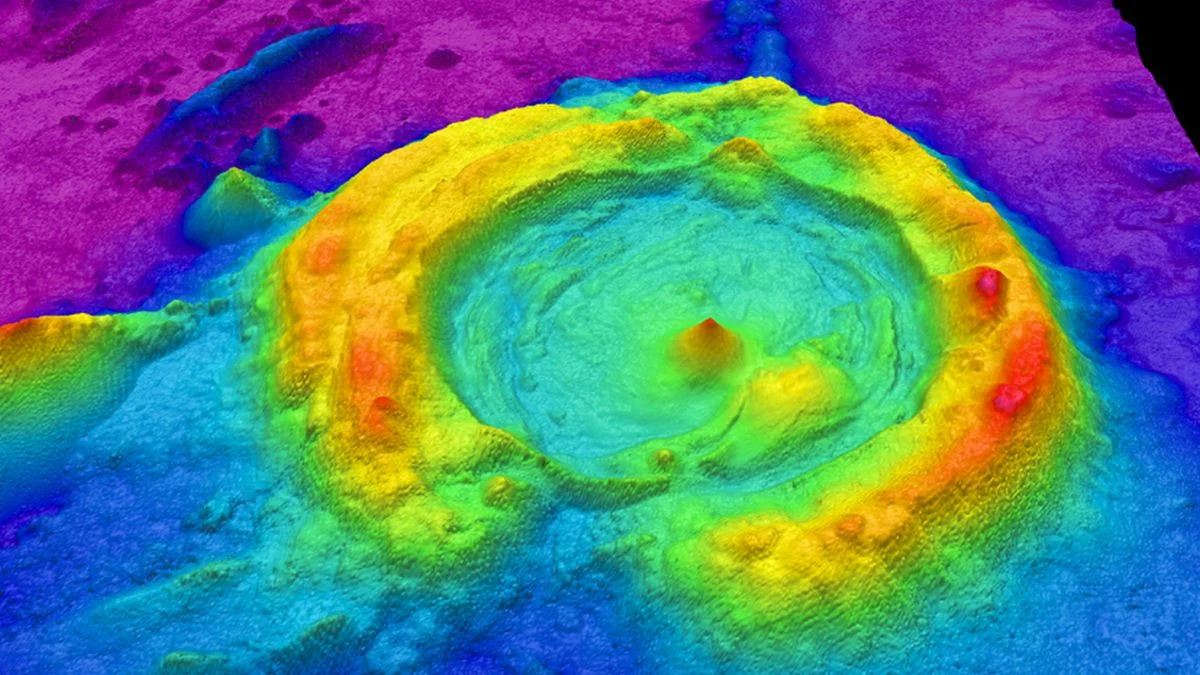
An artificial intelligence initially designed to detect impact craters on Mars has just identified 73 submarine volcanic calderas—previously unknown—potentially tripling the total number of such structures recorded on Earth. A crucial discovery as the 2022 eruption of Hunga Tonga-Hunga Ha’apai reminded the world of the destructive power of these hidden volcanoes beneath the oceans.
What you will learn
- How an algorithm designed for Mars enabled scanning the ocean floor and filtering 87,435 candidate formations down to 73 probable calderas
- Why these submarine calderas represent a largely underestimated volcanic risk
- Where the majority of these new discoveries are located—and why it’s not where you would expect
A danger hidden beneath the waves
Most of planetary volcanic activity occurs beneath the sea, where tectonic plates pull apart, collide, and slide beneath one another, allowing magma to rise and form volcanoes on the seafloor. Much of this activity consists of relatively gentle basaltic eruptions along ocean ridges—but calderas, those large depressions formed when a volcano empties its magma chamber and collapses, can unleash far more violent events: massive eruptions, tsunamis, shock waves, and ash plumes.
The Hunga Tonga-Hunga Ha’apai caldera eruption in 2022 acted as a stark warning: it generated atmospheric pressure waves detectable even in space, produced major tsunamis, and caused damage thousands of kilometers away. Before this new study, fewer than 30 submarine calderas had been cataloged worldwide—a major gap in knowledge for risk assessment.
A Martian algorithm applied to the ocean floor
A team led by volcanologist Andrea Verolino of the University of Paris-Saclay adapted an algorithm initially designed to detect impact craters on Mars, applying it instead to bathymetric maps that record the topography of the seafloor.
The algorithm initially flagged 87,435 potential formations. After applying successive filters and manually inspecting the remaining candidates, the team narrowed the list to 78 probable calderas — of which five were already known, confirming the method’s reliability. The 73 remaining are completely new discoveries, which would potentially triple the total number of known submarine calderas if these results are confirmed.
Calderas where they were not expected
An analysis of their geographic distribution revealed a surprise. Only eight of the newly discovered structures lie along the mid-ocean ridges—the classic boundaries between tectonic plates. Nine others were identified in volcanic arcs. But the vast majority — 61 out of 73 — were found in internal tectonic settings, such as underwater mountain chains, far from the plate boundaries traditionally associated with volcanic activity.
Seven of these newly identified calderas have been highlighted as priority targets for future exploration, their locations, depths, and shapes suggesting particular importance for understanding submarine volcanic risks.
A foundation for assessing future risks
The study does not determine whether any of these calderas are currently active—but recent research shows that even volcanoes considered extinct can quietly recharge with magma and become active again. This mapping therefore serves as a crucial foundation for the future assessment of submarine volcanic hazards, rather than as a definitive global inventory. The researchers plan to refine their method as higher-resolution bathymetric data become available.
The study is published in Communications, Earth & Environment.
