
Since the 1970s, footballs — especially World Cup balls — have changed a great deal. Indeed, their design has evolved through many shapes, for better and for worse. What are these shapes? Are these designs still useful?
The Ball for the 2026 FIFA World Cup
At present the FIFA World Cup 2026 is taking place, with the final scheduled for July 19. This 23rd edition, historic, brings together 48 teams instead of 32, for a record total of 104 matches. Its official ball is Adidas’ Trionda, representing the three host nations: the United States, Canada and Mexico.
As explained by an infographic published in the German newspaper Die Zeit and later republished by Courrier International on June 28, the ball is thermally fused from four triangular panels, the smallest number of panels ever used on a World Cup ball. Thus, the ball’s shape is a tetrahedron, the simplest of the Platonic solids. According to the manufacturer, this design allows the Trionda to display a perfectly stable and predictable trajectory in the air for players.
The 1970 Revolution, Preceding the Curious Change of 2002
The infographic shows seven balls, the first being the “original ball” in use before 1970. It was a heavy untreated leather ball, brown (or beige) in color, characterized by a visible lace-up stitching. Its shape resulted from the assembly of 12 to 18 rectangular and elongated leather strips (strips). Far from today’s designs, the ball looked like an imperfect oval and could deteriorate significantly over the course of a match, especially in rain.
Everything changed in 1970 with Adidas, which took on the task of designing all World Cup balls up to today. The World Cup in Mexico 1970 welcomed the Telstar ball, which became the most famous in history thanks to its revolutionary nature. This revolution, however, is largely geometric: the ball features 32 panels hand-sewn, namely 20 white hexagons and 12 black pentagons (an icosahedron). This design achieved the most perfect sphere then attainable, ensuring regular bounces and much smoother trajectories. The success of the Telstar was such that the ball was reused in 1974 in West Germany.
Later, the other World Cup balls adopted exactly the same mathematical basis as the Telstar. The first geometric break comes with the Fevernova in South Korea in 2002, a change later confirmed in Germany with the Teamgeist. This time, the ball features only 14 curved panels in a helical shape – an octahedron without its angles – and assembled by thermally sealing (seamless). The manufacturer’s aim was to achieve perfect sphericity, but unfortunately the ball proved too smooth and tended to float in the air, regularly fooling goalkeepers.

The Jabulani, the Most Controversial Ball in History
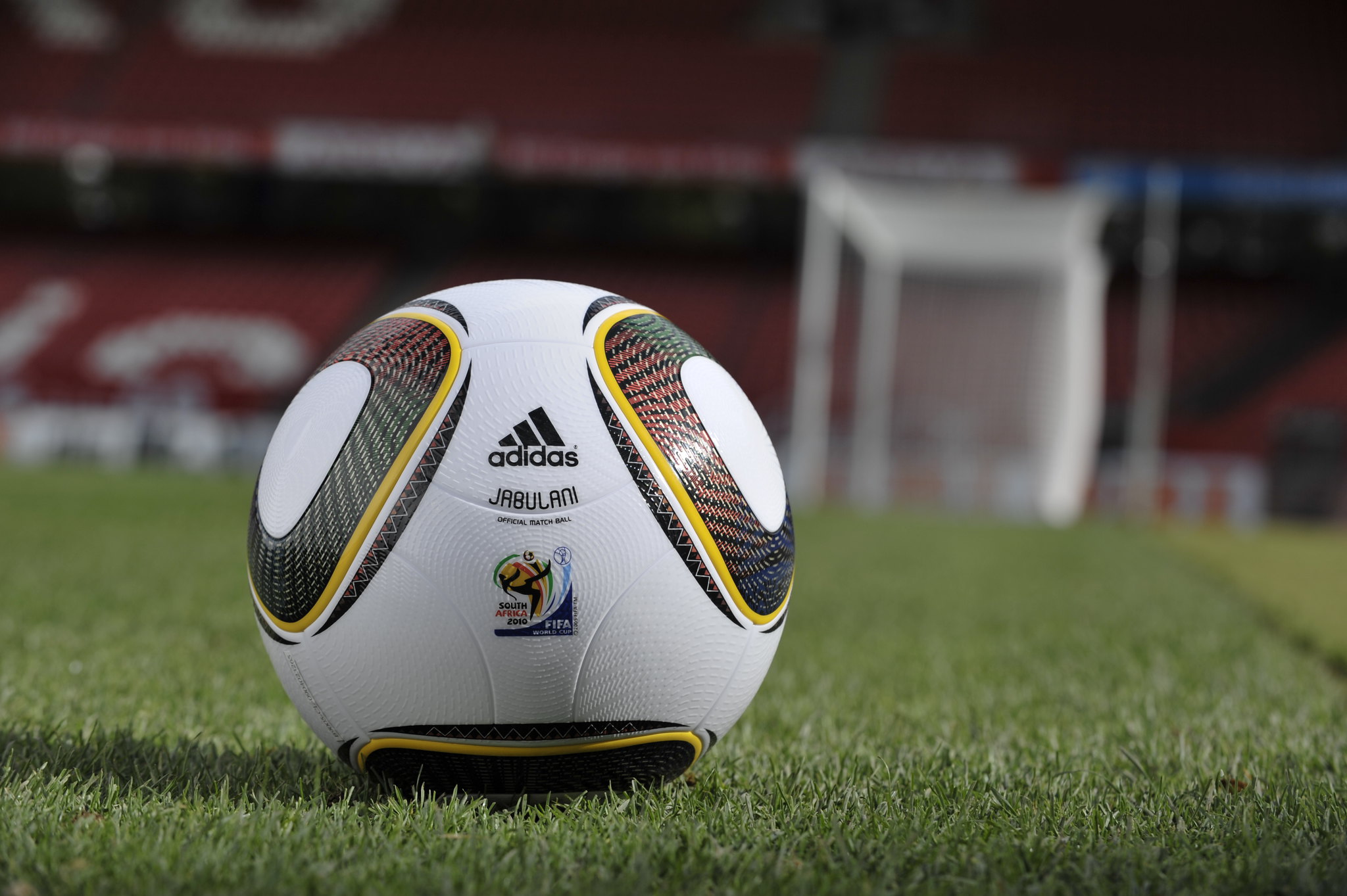
In 2010, for the World Cup in South Africa — the first on the African continent — Adidas unveiled the Jabulani (see main photo). This ball is simply the most controversial and dreaded in the history of the tournament. Failing to heed the lesson of 2006, the manufacturer pushed the obsession with the perfect sphere even further with a design of eight three-dimensional panels thermally bonded — a tetrahedron without its angles — and seams hidden to the maximum. If it was the most perfectly round ball ever produced, it proved to be an aerodynamic nightmare, with its incredible and completely unpredictable floating effect.
In 2014 for the World Cup in Brazil, Adidas could not afford another mistake. Its new ball — the Brazuca — features only six panels but this time, the seams are much longer and deeper. These acted as micro-stabilizers for optimal friction with the air, thus delivering a stable trajectory.
Before 2026, the most notable recent change occurred in 2022 for the World Cup in Qatar. The Al Rihla ball featured 20 distinct polyurethane panels in triangles and diamonds. This design recalled the original 1970 icosahedron but embodied a modern asymmetric version. The ball also stood out for incorporating revolutionary connected technology and was notable for being the fastest ball in the air in World Cup history.
