
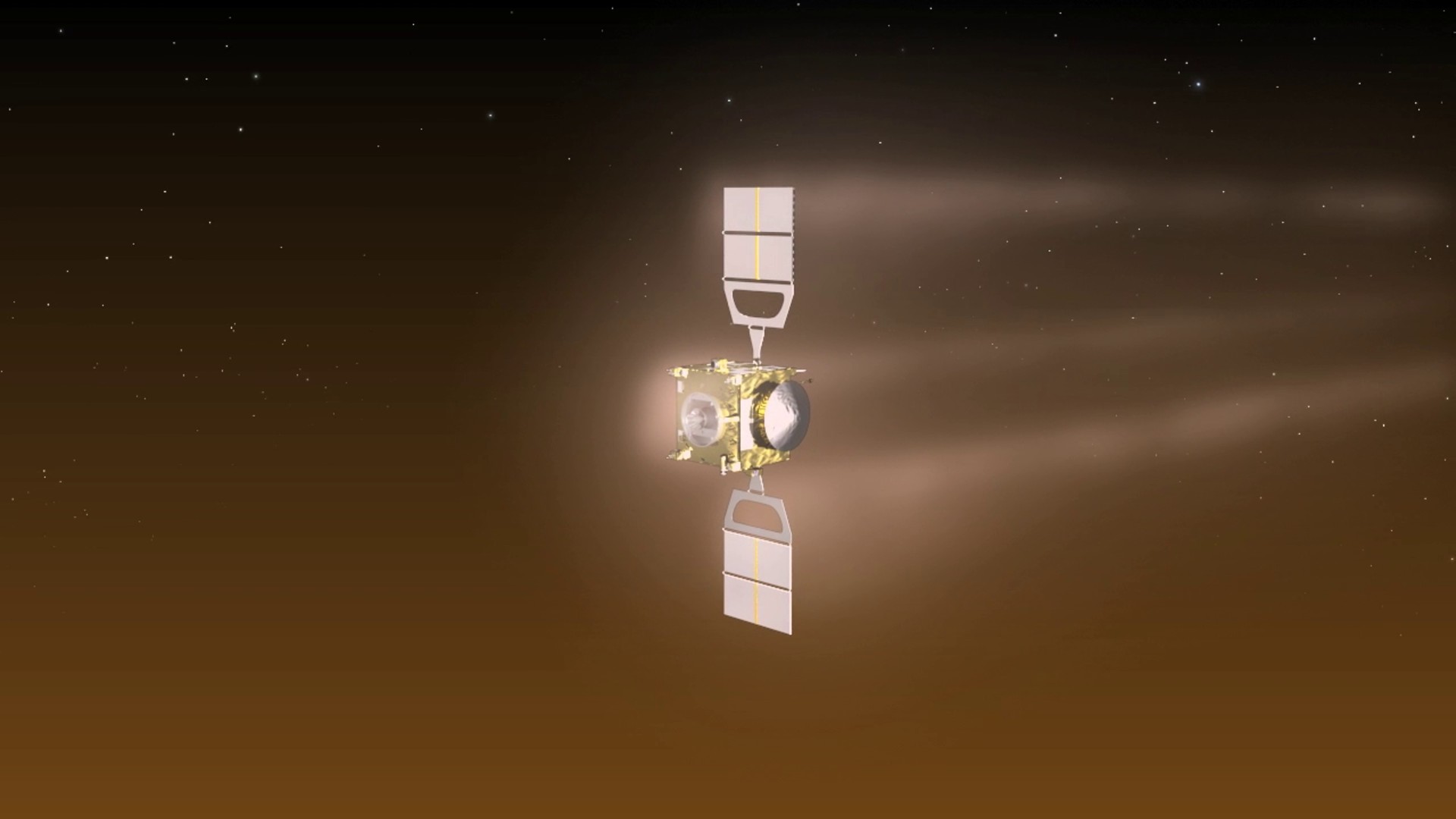
A day on Venus lasts 243 Earth days, while its atmosphere completes a circuit around the planet in just four days. On Venus, this gap isn’t a measurement anomaly; it’s one of the Solar System’s most puzzling phenomena, confirmed in stark terms by the European spacecraft Venus Express. The winds of this super-rotating atmosphere wrap the planet in four Earth days, far faster than the 243 days required for the planet to rotate on its axis. The clouds advance about sixty times faster than the rocky ground they skim, a velocity ratio unmatched by any other rocky planet in the Solar System.
Key takeaways
- An atmosphere that travels sixty times faster than the rocky surface: how is that possible?
- Winds mysteriously sped up from 300 to 400 km/h during the Venus Express mission
- Solar thermal tides partly explain the phenomenon, but the puzzle remains unresolved
An atmosphere that rolls on itself like an ocean
At about 70 km altitude, where Venus’s cloud tops reside. It is at this height that Venus Express, in orbit from 2006 to 2014, conducted its chase of cloud masses. By following the movements of distinct cloud structures over a span of ten Venusian years, i.e., six Earth years, scientists observed that in 2006, the average wind speeds at the cloud tops between 50° north and south latitudes hovered around 300 km/h. A figure dizzying by itself, roughly the top speed of a high-speed train set to full power, yet blowing continuously, day and night, over an entire planet.
The most surprising thing, however, lies elsewhere. Detailed cloud-tracking studies revealed that these winds, already remarkably rapid, became even faster, reaching 400 km/h during the mission. A planet that accelerates its atmosphere for no apparent reason over six years, that is enough to intrigue any meteorologist. On Earth, such a sustained surge of prevailing winds would be a major climatic event; on Venus it has become almost routine, yet completely unexplained.
A decoupling that has puzzled scientists since the 1960s
This phenomenon, dubbed super-rotation, isn’t a Venus Express discovery. The first observations of super-rotation were made from Earth, and the Venera missions in the late 1960s provided the first direct evidence thanks to Doppler tracking of the descent of the probe. But the European mission brought unprecedented precision, with nearly a decade of continuous Venus observation.
The mystery rests on a simple-to-state yet hard-to-solve equation: Venus’s solid surface spins very slowly, completing one rotation every 243 days, but its thick atmosphere loops the planet in just four days, a phenomenon that requires a continual input of angular momentum from an unknown source to overcome friction with the surface. Without this constant energy input, the air-surface friction would slow these winds within months. Yet they persist, still and always, since humanity began observing them.
Venus Express added a puzzling wrinkle to the puzzle. A separate study showed that the planet’s rotation had slowed by 6.5 minutes since NASA’s Magellan measurement twenty years earlier, with no known direct link between the acceleration of the winds and the slowdown of the surface. A coupling between the atmosphere and the rocky crust seems to exist, but the precise mechanism remains fuzzy. It reads almost like a planet that negotiates constantly, through exchanges of angular momentum, an equilibrium it never quite finds.
Thermal tides, a leading hypothesis but not definitive
A notable advance came from the Japanese probe Akatsuki, complementary to Venus Express in this dossier. By integrating wind-mapping data into a global angular momentum transport model, researchers found that super-rotation is sustained by thermal tides triggered by solar heating. Concretely, the energy from the Sun cyclically heats the atmosphere and this thermal pulsation injects kinetic energy at the cloud tops, a bit like a hand regularly nudging a spinning top to keep it from slowing.
But the matter is far from settled. Other forces counter these thermal tides: slow planetary waves that appear on any planet covered by liquid or gas in rotation, as well as small-scale atmospheric turbulence, act against the thermal tides and slow the wind at Venus’s equator. A planetary scientist from Sorbonne University, cited in Science, has noted that the question of whether this analysis provides a complete picture of the angular momentum budget remains open, especially since Venus’s clouds are nearly 20 km thick and the situation could differ by layer. More recent research, published late 2025 in the journal Eos, has reinforced the thermal-tide route as the main driver, without definitively closing the debate on the full mechanism.
A wind that shapes an entire planet
This atmospheric ballet leaves visible traces. Winds are strongest at the equator and weaken toward the poles, creating a “V” shaped structure visible on images of the cloud layers. A signature that spacecraft observe from space as a gigantic, moving fingerprint on the planet’s yellowish clouds. And paradoxically, it is these extreme high-altitude winds that explain why Venus’s surface, at about 460°C, maintains nearly the same temperature from day to night: they redistribute heat far more effectively than a stationary rocky surface would.
One question remains that even the best climate models struggle to settle: on the ground, wind hardly ever exceeds a few kilometers per hour, while at 70 km above our heads it blows in a permanent storm. Two speeds, two worlds, one planet, and a mechanism for energy transfer between the two that continues to fuel debates among planetary scientists, long after the Venus Express mission ended in 2014.
Sources: sci.esa.int | futura-sciences.com
