
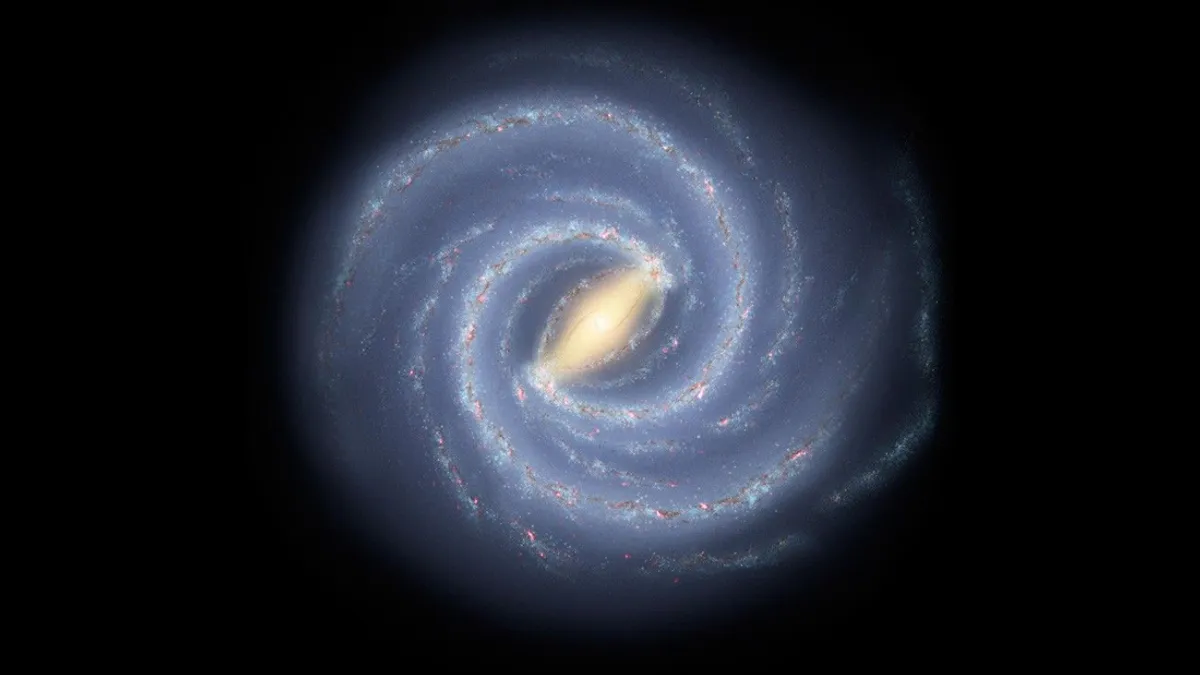
The outer arms of the Milky Way are up to 10% farther away than previously thought. This unprecedented measurement was achieved thanks to an ingenious trick: using X-ray echoes from gamma-ray bursts that occurred in distant galaxies to measure distances directly from inside our own galaxy.
What you will learn
- Why measuring the size of our own galaxy is so difficult — and why traditional methods leave room for error
- How gamma-ray burst X-rays from explosions in other galaxies served as a yardstick to map the Milky Way’s spiral arms
- What these new distances imply for our understanding of galactic structure
Measuring from within
Mapping the Milky Way presents a unique challenge in astronomy: we are inside it, with no opportunity to observe it from an external vantage point. It took years for the European Space Agency’s Gaia program to confirm that our galaxy hosts four spiral arms rather than two. Yet the distances to the outer arms remained highly uncertain, estimated indirectly from models of galactic rotation — a method that invites error.
A team led by Beatrice Vaia of the Italian National Institute for Astrophysics chose a radically different approach, described in Astronomy & Astrophysics.
Cosmic explosions as a measuring yardstick
Gamma-ray bursts are among the most energetic events in the universe — immense releases of energy resulting from supernova explosions in distant galaxies. They emit X-rays that travel across intergalactic space and, as they pass through the Milky Way’s spiral arms, are scattered by the dust grains present in these arms.
ESA’s XMM-Newton and NASA’s Chandra X-ray observatories detected concentric rings formed by these X-ray echoes. The geometry of these rings — their size and their timing — enables a direct calculation of how far away the dust that produced them lies, and consequently of the spiral arms themselves.
Three gamma-ray bursts occurring in galaxies much farther away thus served as natural light sources to illuminate the outer arms of our own galaxy — like flashes for which the echo is measured to determine the distance of a wall.
Arms farther away than expected
The measurements first confirm the distance between our own spiral arm—the Orion Arm—and the adjacent arm—the Perseus Arm. Then come the two outermost arms: the outer arm and the outer Scutum-Centaurus arm are both located up to 10% farther than previously estimated. The outer Scutum-Centaurus arm lies about 62,000 light-years from Earth.
Ten percent might seem modest, but on a galactic scale that translates into several thousand light-years of difference — enough to prompt revisions to models of the Milky Way’s structure and rotation.
An old telescope, a new utility
This discovery also highlights the long scientific life of XMM-Newton, launched in 1999 and still operational. A space telescope more than 25 years old has just contributed to directly measuring, for the first time, the distance to the outer arms of our own galaxy — using the universe’s most powerful explosions as measuring instruments.
