
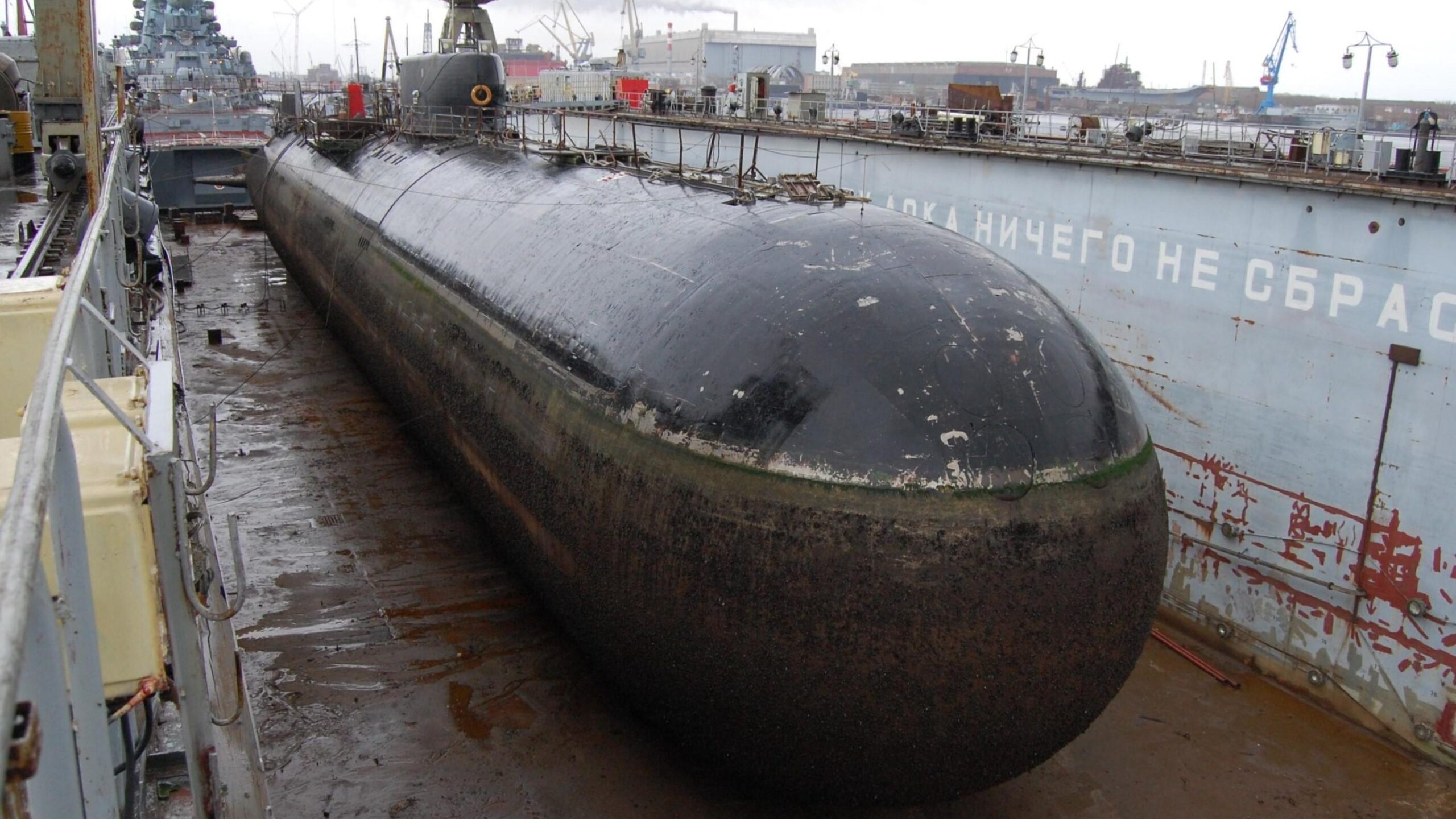
On December 18, 1970, at a depth of 100 meters in the Barents Sea, the gauges on a Soviet submarine’s instruments registered a value no one had ever recorded before. The K-222 entered naval history by reaching 44.7 knots submerged, that is to say 82.8 kilometers per hour. More than half a century later, this figure remains unchallenged: no military vessel has ever approached such performance underwater, neither from the American side nor the Russian side. This submarine, later renamed K-222, remains the fastest machine ever sent underwater by a human being. And no one has sought to recreate the same gamble, for very good reasons.
Key takeaways
- A Soviet submarine surpasses 82 km/h underwater in 1970: a record never matched since
- Its titanium hull cost about 1% of the Soviet GDP and demanded 400 unprecedented technical innovations
- At high speed, internal noise reached 100 decibels: loud enough for an enemy to hear it easily
A Project Forbidden to Be Repeated
The K-222 was born from a direct directive of the Soviet Communist Party’s Central Committee and the country’s Council of Ministers, during the summer of 1958. The mandate was simple, and reckless: build a submarine capable of catching up with any U.S. carrier battle group, firing its missiles, and then disappearing before the response could arrive. Unique in its kind, Project 661 rested on a total innovation, with the design engineers expressly forbidden from relying on prior design principles. The result? This sole representative of Project 661 incorporated nearly 400 technical innovations.
Among the three base materials considered for construction—steel, aluminum, and titanium—it was titanium that won out. This choice carried a higher cost but allowed a substantial reduction in the submarine’s overall mass and a significant decrease in its magnetic signature. On paper, it was pure genius. In the workshops at Severodvinsk, it was another story: the project demanded the development of new manufacturing techniques and argon-atmosphere welding. Four hundred companies and suppliers participated in the build. Six years of work, for a single vessel.
The final price was dizzying. The submarine would have cost up to two billion rubles, roughly one percent of the Soviet GDP in 1968. The sailors nicknamed it the “Golden Fish,” an irony that said a great deal about the crews’ mindset toward this titanium beast that nobody could copy or truly master.
82.8 km/h Underwater: What It Means in Practice
The K-222 was powered by two pressurized-water reactors, each delivering about 80,000 horsepower—double the output of any other submarine in the world. At 44.7 knots, it far surpassed the designers’ initial expectations, who had aimed for around 38 knots. To put this achievement in perspective, the Seawolf, one of the most capable nuclear submarines ever built by the U.S. Navy, managed only about 35 knots, roughly 64 kilometers per hour. And the Seawolf comes from the 1990s—a generation of technology far removed from the K-222.
The nuclear reactor driving the submarine was operating at only 97% of its capacity during the record run, meaning it could theoretically have gone even faster. A lesser-known fact: unofficially, the K-222 reached 44.85 knots on March 30, 1971—a figure that circulated for a long time within specialized circles but never appeared in official records. The officially recognized record remains 44.7 knots. Yet the operational reality of this legendary sprint was far less glamorous than it might seem.
During a full-speed twelve-hour test, some exterior hull fittings were ripped free, and parts of the water intake grills detached and were crushed by the circulation pumps. The machine seemed to be devouring itself as it shattered its own records.
The Din That Betrayed It All
A submarine exists to remain unheard. That is its raison d’être, its sole real protection. Yet the K-222 had a fatal flaw: the titanium hull rendered the sub virtually invisible to sonar up to about 35 knots. Beyond that threshold, the vessel emitted a powerful hydrodynamic roar caused by turbulence along the hull.
The 82-man crew endured cabin noise levels reaching 100 decibels at speeds above 35 knots. To picture this: 100 decibels is the sound level of a circular saw at one meter, or a rock concert in a stadium—for hours. In a sealed metal tube. In the control room, one heard not only the roar of an aircraft but the thunder “of a locomotive’s machine room.” Witnesses estimated that the noise exceeded 100 decibels.
The propeller vibrated intensely at high speed due to cavitation from bubbles forming around the rotor. The noise generated during high-speed operation was likened to the sound of a jet plane, interfering with the onboard sonar’s ability to track targets. The irony: in attempting to hunt American aircraft carriers, the K-222 itself became a perfect target for enemy sonar operators. The government program had simply omitted a requirement to minimize acoustic signature, an omission that encapsulates the sometimes Kafkaesque logic of the Soviet military-industrial complex.
A Lesson Etched in Titanium
During its first operational deployment in the North Atlantic in 1971, the submarine conducted a high-speed chase of a US Navy battlegroup. During this patrol, it tailed a group centered around the aircraft carrier USS Saratoga as it returned to the United States from the Mediterranean. The demonstration was real, but no one in Washington needed a sophisticated sonar to detect the K-222 in full sprint.
The vessel underwent substantial repairs between 1972 and 1975 to address hull cracks. In 1980, it suffered a reactor incident during a refueling when unauthorized procedures caused overheating of the core and a release of radioactive steam into the machinery compartment. These technical and operational challenges led to the K-222 being withdrawn from service in 1988, followed by its dismantling in 2010. Notably, during the 2010 dismantling, the two nuclear reactors and their fuel remained aboard, as the submarine’s design had not anticipated a method to remove them.
The speed of all large Soviet and American submarines of the third and fourth generations built since then has not exceeded 35 knots. This ceiling is not a technological limit: it is a lesson drawn from the K-222. Nevertheless, the K-222 pioneered the technologies needed to work titanium at a large scale, enabling subsequent, more refined models such as Projects 705 Lira, 945 Barracuda, and 945A Kondor. The K-222’s conning tower was preserved and converted into a memorial monument in the city of Severodvinsk: a piece of titanium welded in argon, exposed to the northern wind, the sole physical relic of a machine that set a world record without ever firing a single missile in combat.
Sources: hellobiz.fr | dailygeekshow.com
