
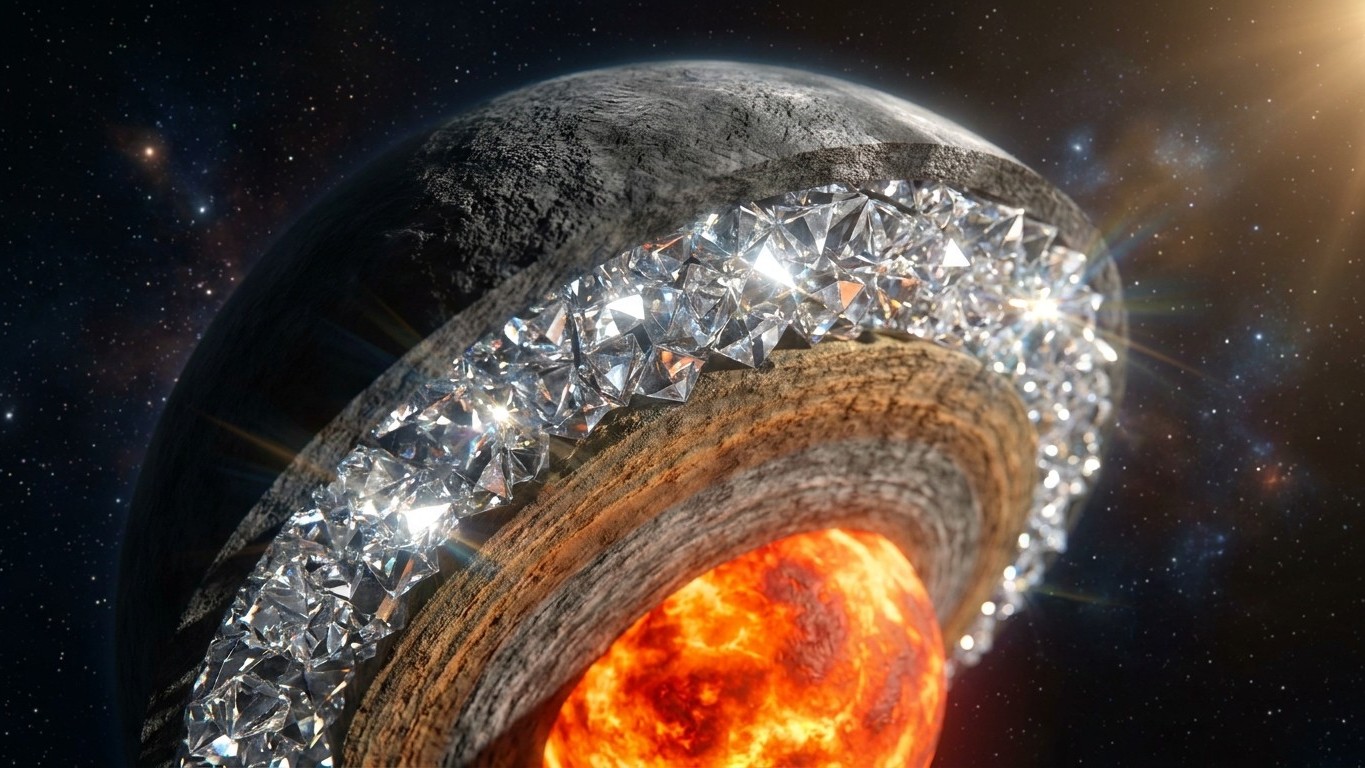
Forty light-years away. That is the distance separating us from 55 Cancri e, an exoplanet that astronomers had casually classified as a rocky super-Earth—more massive than Earth, yet less spectacular than a gas giant. Yale researchers have nonetheless found that this rocky planet orbiting a neighboring star could be a diamond planet. The conclusion is dizzying: at least one third of the planet’s mass, about three Earth masses, could be diamond. Three Earth masses. Pure diamond.
Key takeaways
- A planet once deemed ordinary could harbor the equivalent of three Earths in pure diamond
- Researchers had to devise a new approach to overcome the cognitive bias that makes us assume planets resemble Earth
- The scientific debate persists: James Webb observations add layers of complexity to this cosmic mystery
A Planet Too Ordinary to Dwell On (Until Now)
55 Cancri e was discovered in 2004 after astronomers noticed fluctuations in the radial velocity of the star 55 Cancri. It was not until 2011 that the planet was observed transiting its host star, allowing astronomers to measure its mass and radius with precision. The result of these measurements? 55 Cancri e is a super-Earth with a radius twice that of Earth and a mass eight times higher. Nothing extraordinary at first glance for a world of this type.
It completes an orbit around its host star in merely 18 hours, so close that its surface temperature climbs to a scorching 2100 degrees Celsius. By comparison, that is enough to vaporize iron. It orbits the star 55 Cancri, a star visible to the naked eye about 40 light-years away in the Cancer constellation. It’s the kind of object you can glimpse on a clear night without any optical gear, aware that one of its planets could hold more diamonds than Earth’s geology has ever produced.
The Yale Method: Breaking the Earth-Centric Prism
For years, planetary models applied to 55 Cancri e rested on a comfortable but risky assumption: the planet resembled Earth. Scientists believed 55 Cancri e contained a substantial amount of superheated water, assuming its chemical makeup mirrored Earth’s. The new research, by contrast, suggests the planet contains no water at all and appears to be dominated by carbon (in the form of graphite and diamond), iron, silicon carbide, and possibly silicates.
Astronomer Nikku Madhusudhan of Yale University clarified that their model differed from previous ones by not basing its assumptions on Earth’s chemical composition. This new information, combined with the latest mass estimate, allowed the Yale team to infer the planet’s chemical makeup by using interior models and calculating all possible combinations of elements and compounds capable of producing these specific characteristics. This isn’t scientific poetry: it’s brute computational modeling, probing the space of chemical solutions until finding the one that fits the data.
Astronomers had previously reported that the host star contains more carbon than oxygen, and the team confirmed substantial amounts of carbon and silicon carbide, with negligible water ice, were available during the planet’s formation. It is this carbon-to-oxygen ratio greater than 1 in the host star that opened the door to a conclusion once the stuff of science fiction. The team hypothesized that the high temperatures and pressures on the planet would trigger the crystallization of carbon into diamonds.
The interior illustration of 55 Cancri e reveals an extremely hot world with a surface primarily of graphite encasing a thick diamond layer, beneath which lies a layer of silicon-based minerals and a molten iron core at the center. An onion-like cosmic structure, each layer redefining what we once meant by a “rocky planet.”
A Brilliant but Questioned Hypothesis
The discovery made headlines worldwide in the autumn of 2012, published in The Astrophysical Journal Letters. Such a structure implies that plate tectonics observed on Earth would not occur on 55 Cancri e, due to both the thick carbon crust and the absence of water. “These two factors together could potentially inhibit plate tectonics on this planet, unlike oxygen-rich planets for which previous studies suggested tectonics was almost inevitable,” according to Madhusudhan. A planet without continents, without earthquakes, without surface renewal. Static. Frozen in its carbon layers.
However, the hypothesis was quickly challenged. In 2013, a group of astronomers from Arizona State University led by Johanna Teske used the Spitzer, Hubble, and MOST space telescopes and discovered that the 55 Cancri star contains more oxygen than carbon, reducing the likelihood of diamond formation on the planet. Their study found that the host star of 55 Cancri e contains 25% more oxygen than carbon. “In theory, 55 Cancri e could still have a high carbon/oxygen ratio and be a diamond planet, but the host star does not have such a ratio,” Teske said. A significant caveat, but not a definitive refutation: a planet’s composition can diverge substantially from that of its star depending on the formation conditions in the protoplanetary disk.
The identification of a carbon-rich super-Earth means that rocky distant planets can no longer be assumed to share chemical constituents, interiors, atmospheres, or even potential biologies similar to Earth, emphasized Madhusudhan. This is the real challenge of the discovery: not cataloging cosmic diamond reserves, but challenging a deep cognitive bias in how we search for habitable worlds.
What the James Webb Has Changed About the Equation
The debate gained new perspective in 2024 with data from the James Webb Space Telescope. A study published in May 2024 used observations from JWST’s NIRCam and MIRI to produce a thermal emission spectrum of 55 Cancri e from 4 to 12 micrometers. These measurements ruled out the hypothesis that the planet is a lava world shrouded by a thin atmosphere of vaporized rock, and point to a real volatile atmosphere, likely rich in CO₂ or CO.
JWST observations have provided fresh insights into the planet’s potential atmosphere, but significant degeneracies among models prevent a firm constraint on its composition. Current observations suggest the presence of a thick volatile envelope, potentially rich in CO₂ or CO. This carbon-rich atmosphere, if confirmed, oddly aligns with a carbon-dominated world, even if it does not settle questions about the interior composition.
55 Cancri e therefore remains an open object, in the strict scientific sense. The diamond remains neither proven nor disproven there. Yet the planet has already achieved something rare in astrophysics: forcing the community to abandon its terrestrial certainties. Earth’s interior is oxygen-rich but extremely carbon-poor, less than one in a thousand by mass, recalled Kanani Lee, co-author of the Yale study. What was once taken as the norm was merely one special case among billions of possible worlds.
Sources: notre-planete.info | arxiv.org
