
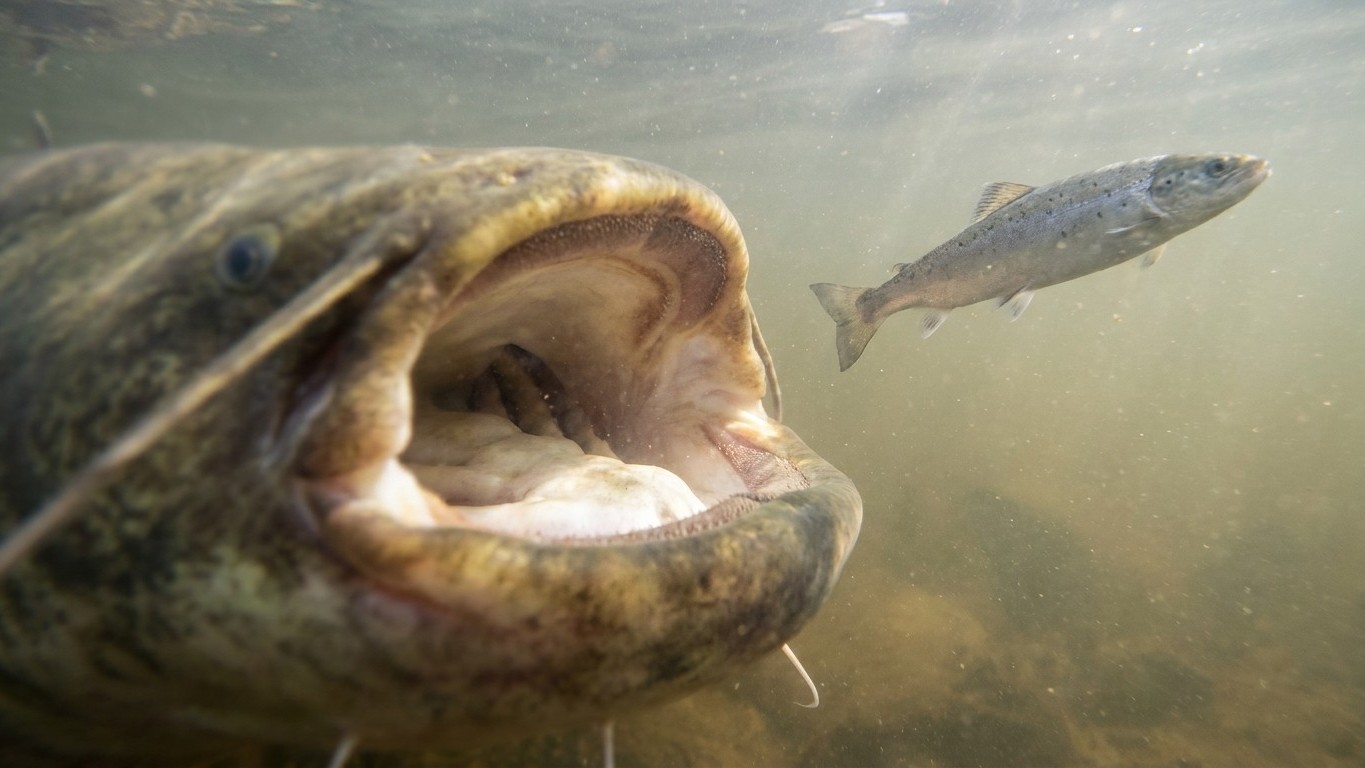
Of the 39 Atlantic salmon that attempted to ascend the Garonne in 2016 via the Golfech fish ladder, 14 never reached their spawning grounds. Not because of a turbine, pollution, or drought. In 2016, 14 of the 39 salmon observed during their migration to reproduce ended up as prey for the “ogres” of the freshwater. In other words, 35% of the annual cohort was swallowed by ambushing catfish right inside the very device meant to protect them. The height of ecological irony.
À retenir
- A device designed to protect salmon becomes a deadly trap
- Catfish have developed an unexpectedly intelligent and evolving hunting strategy
- Less than 1,000 salmon facing 40,000 catfish: the equation becomes desperate
A protective corridor turned into a pantry
Everything began with the fish lift installed in 1987 at the Golfech hydroelectric plant, a device intended to help migratory fish from the sea pass the dam, which rises about ten meters, built alongside the plant that began operation in 1973. The aim was admirable. Three decades later, the result remains ambiguously mixed.
All salmon that climb the Garonne toward Toulouse to breed pass through this lift. They move from a river spanning about 150 meters to a passage barely two meters wide. That abrupt constriction is precisely what dooms them. A study published in 2018 in PLoS ONE highlighted that a number of catfish have specialized in predation on migratory fish at dam walls and in their fish passes, taking advantage of how easy it is to catch prey in these confined spaces. A salmon is typically a difficult target for a catfish, but in such passes, where fish are tightly packed, interception becomes straightforward.
Here lies the real rupture: in open waters, the Atlantic salmon is faster and more agile than the catfish, which cannot compete. But the dam reverses the balance. By concentrating prey in a narrow corridor, the dam turns what would be a challenging hunt into an almost guaranteed feast.
A hunter’s intelligence sharpened season after season
What strikes researchers is less the act of predation than its sophistication. Since 2014, certain catfish—typically nocturnal predators—have aligned their daily hunting period with the migratory birds’ own travel window, roughly from 8 a.m. to 5 p.m., as explained by Frédéric Santoul, a lecturer-researcher at EcoLab and co-author of the April 2018 article “The Atlantic salmon has a new freshwater predator.” Animals that modify their circadian biology to match a prey’s habits. This is learned behavior, perhaps transmitted, refined year after year.
Back in 1995, Golfech’s fish pass camera recorded the crossing of the first three catfish in its history. In 2007 and 2012, they numbered 1,134 and 956 respectively crossing the dam. Today, they remain, more or less, around 600 yearly lingering near the vicinity. A gradual, methodical colonization that speaks volumes about the species’ capacity to adapt. The European catfish, Silurus glanis, is among the 20 largest freshwater fish worldwide, and it is the largest fish in Europe, reaching up to 2.7 meters in total length—twice the size of native predators in France such as the pike. A creature of that size stationed in a two-meter-wide canal is almost a sport in itself.
And this is not just a salmon issue. Studies conducted in 2019 in the Garonne and Dordogne by Migado report a troubling impact of the catfish on the basin’s biodiversity: they estimate an 80% predation rate on lampreys, show that 50% of its diet consists of anadromous species, and that they target 40% of the bulls of aloses at the Golfech spill canal. Scientists estimate that catfish consume between 90 and 200 tonnes of migratory fish in this basin each year.
Salmon that can no longer afford to make mistakes
The Atlantic salmon population in the Garonne was already in a critical state before catfish settled into the pass. It used to see about 100,000 annual passage in the 19th century; today it comprises fewer than 1,000 individuals. At this scale, losing 35% of migrants at a single passage is not just a pressure—it becomes a potential sentence. Since 2025, Atlantic salmon can no longer be fished, having become rare in many of the country’s waterways where they were originally present – coastal Breton rivers, the Loire, Dordogne, Garonne, and Adour among them.
Dams, often deemed the principal culprits, bear historical responsibility. The main threats facing the species include reduced access to freshwater habitats due to thresholds and barriers, which also degrade those habitats. Yet reducing the issue to hydraulic structures alone ignores the emergence of a predator for which the Atlantic salmon had no evolutionary defense prepared. Anadromous fish are typically protected from predation by other fish in their upstream migration due to their large adult size. But introductions and invasions of new predator species have upended this rule—because some predatory fish are larger than the migratory ones they prey upon.
Grilles, nets, et une course de vitesse
Confronted with this reality, managers did not wait. The 2016 study at Golfech demonstrated that regularly removing migrants from the canal allowed them to resume a conventional migratory pattern. After enhancing crossing conditions by installing, among other measures, a non-return grid upstream of the transfer canal, the 2017 results show that the measures implemented significantly reduced the catfish’s impact on large migratory species. Good news, but a grid alone does not solve everything. The catfish that end up in the pass are eventually caught in the nets of professional fishermen who have signed an agreement with EDF.
Nationwide, the question of the catfish’s legal status has been a source of debate for several years. Classifying the catfish as a species capable of causing ecological imbalances, and as an exotic invasive species, could enable prohibiting “no-kill” releases of caught catfish—a practice that sustains and propagates the catfish, as recalled by the National Council for Nature Protection in its advisory of October 16, 2024. Fisheries aiming to reduce predation by the catfish on migratory fish have been conducted in the Garonne and Dordogne basins between 2021 and 2023.
The debate remains open, and at times passionate. The catfish’s introduction has divided the fishing world: the “anti-catfish” faction, fearing its impact on local fauna, opposes the “pro-catfish” faction, which praises its sporting value and fishing interest. Meanwhile, scientific estimates of catfish density lead to hypotheses of about 40,000 individuals in the Garonne and Dordogne. Forty thousand catfish facing fewer than a thousand salmon. The imbalance speaks for itself, and no single barrier can re-balance such an expansive equation.
Sources: dailygeekshow.com | biodiversite-nouvelle-aquitaine.fr
