
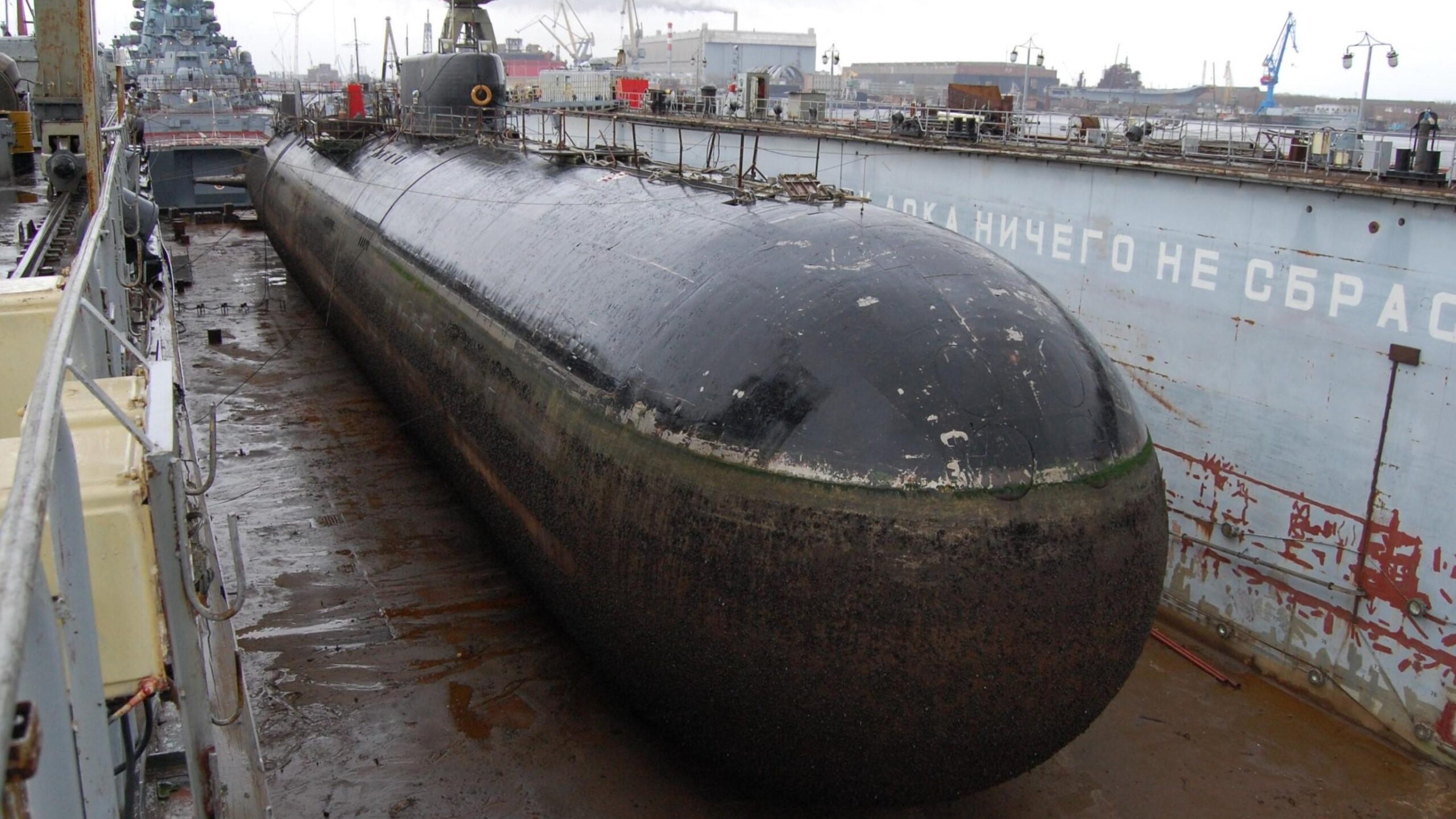
On December 18, 1970, the gauges on the onboard instruments went berserk as a Soviet submarine lay 100 meters beneath the surface of the Barents Sea. The K-162 made naval history by reaching 44.7 knots while submerged, equivalent to 82.8 kilometers per hour. A figure that, more than five decades later, still stands. No military vessel has ever approached this performance while submerged since, on either the American or the Russian side. Only a single unit was built. And when you understand why, you grasp the magnitude of the gamble the USSR had undertaken.
À retenir
- A speed record underwater set in 1970 that has never been beaten
- A revolutionary titanium hull welded with argon, a colossal technological first
- An astronomically high cost that turned a shipyard into a laboratory for advanced metallurgy
A machine designed to intimidate American aircraft carriers
In the middle of the 20th century, the United States had halted its new military strategy: to dominate the oceans with aircraft carrier groups. The USSR, still recovering from the war, did not have the funds to build carriers, nor the means to counter them effectively. The Soviet answer took the form of a decree: build a submarine capable of hunting down and destroying these battle groups before they could approach the shores. In 1958, an outrageously ambitious program was authorized, demanding a vessel that could move very quickly and launch its missiles while submerged.
The project was deliberately constrained to be entirely innovative: reusing earlier technical solutions was forbidden. This fueled innovation but slowed development. This sole representative of Project 661 incorporated nearly 400 technical innovations. It was propelled by a pair of 80,000 horsepower pressurized-water reactors, double the output of every other submarine in the world. The K-162 was laid down on December 28, 1963 and commissioned on December 31, 1969 at Severodvinsk. Six years of construction. For one vessel.
It was armed with 10 SS-N-7 Starbright missiles housed in individual tubes at the bow of the sail, between the inner and outer hulls, both of which were made from titanium alloy. The nuclear reactor powering the submarine used only 97% of its capacity during the record: it could theoretically have gone even faster. A figure that leaves one做aer a shiver.
The titanium: the choice that changed everything, and made everything harder
Among the three materials considered for construction—steel, aluminum, and titanium—it was titanium that was chosen. This decision carried a higher cost but allowed a substantial reduction in the submarine’s overall mass and a significant decrease in its magnetic signature. A strategic advantage not to be overlooked: the titanium hull protected the sub from magnetic mines and prevented detection by the magnetic anomaly detectors (MAD) used by NATO anti-submarine aircraft.
The problem lay in the fact that no one had ever welded titanium on this scale. The manufacture of large titanium components was unknown worldwide at the time, so the Soviet Union had to develop entirely new techniques and equipment. The Sevmash shipyard invested in gear capable of shaping plates up to 60 mm thick and trained its workers to weld under an argon atmosphere, in a clean-room environment to avoid any contamination of the welds. Welders wore full-body suits powered by oxygen, quasi-spacesuits, to work inside hermetically sealed halls emptied of air and filled with inert argon. Four hundred companies and suppliers participated in the construction of this project.
The build was hampered by the delivery of outer-hull plates contaminated with hydrogen, which cracked easily. About 20% of these plates had to be replaced, contributing to the substantial delay before the vessel’s launch, on December 21, 1968. A shipyard transformed into a cutting-edge metallurgy laboratory, and the bill rose accordingly.
The “Golden Fish”: too expensive, too noisy, too solitary
Within the Soviet Navy, the K-162 was commonly nicknamed the “Golden Fish,” a reference to its development and construction costs. The submarine reportedly cost up to two billion rubles, about 1% of the USSR’s annual GDP in 1968. To put that in perspective: it would be like France today allocating more than 25 billion euros to build a single ship.
But cost was not the only problem. The titanium hull rendered the submarine virtually invisible to sonar—yet only up to 35 knots. Beyond that, the craft emitted a powerful hydrodynamic noise due to the turbulence created by the flow along the hull. Soviet reports compared the noise to that of a jet aircraft, making the submarine easily detectable by enemy sonar and disrupting its own onboard detection systems. At full power, the K-162 was no longer a silent hunter; it became a target.
It was planned that the K-162 would be followed by ten more units, then the number was reduced to five in 1964, then to three; finally, only a single unit was built. The main reasons were the USSR’s titanium shortage, the high level of technical sophistication involved, and the limited mastery of new technologies. The Soviet Navy rejected the plan for mass production because the vessel’s flaws outweighed its advantages, but the project had paved the way for the technologies necessary to work titanium at scale, enabling later, more refined designs such as Projects 705 Lira, 945 Barracuda, and 945A Kondor.
The submarine served in the Soviet Northern Fleet throughout the 1970s, but the discovery of cracks in the hull triggered a long repair period from 1972 to 1975. On September 30, 1980, one of its nuclear reactors was damaged during a maintenance operation. In 1988, it was placed in reserve at Severodvinsk. From March 2010, the vessel was dismantled by Sevmash. Even its demolition was complicated: the unique construction techniques used did not permit the use of conventional demolition methods.
An intact record, a lesson etched in titanium
The speed of all major Russian and American third- and fourth-generation submarines built since then does not exceed 35 knots, according to open sources. This ceiling is not a technological limit; it is a lesson drawn from the K-162. Beyond 35 knots, the hydrodynamic noise becomes unmanageable, the acoustic signature spikes, and the submarine betrays its position. Maximum speed is also the maximum tactically acceptable speed, and no one since has been willing to pay the price of the Golden Fish to learn otherwise.
The conning tower of the K-162 has been preserved and repurposed as a commemorative monument in the city of Severodvinsk, where it was built and where it spent its days. A piece of titanium welded with argon, exposed to the great northern wind: the only physical relic of a machine that set a world record without ever firing a single missile in combat.
Sources: dailygeekshow.com | hellobiz.fr
