
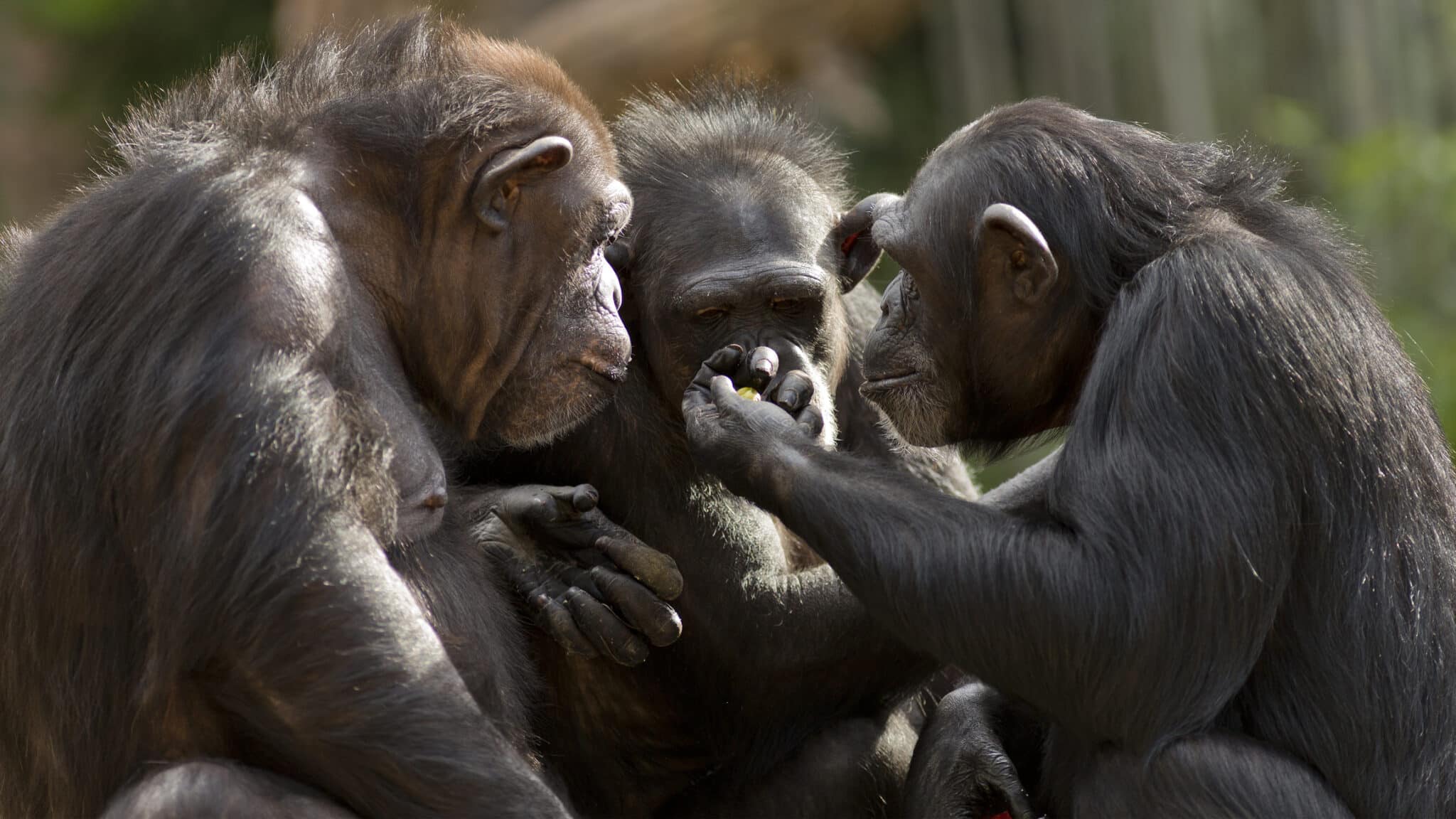
Chimpanzees, our closest relatives in the animal kingdom, have long been studied for their social behaviors, their use of tools, and the interactions within their groups. Yet a new study has opened a fascinating perspective on an aspect until now little explored: cumulative culture. This groundbreaking research shows that, just as with humans, chimpanzees are capable of transmitting complex behaviors across generations in a structured way. Even more surprising: this cultural transmission could be intimately linked to the migrations of female chimpanzees.
The cumulative culture of chimpanzees
The cumulative culture is a captivating phenomenon that refers to a species’ ability to accumulate knowledge and skills over time, with ideas and practices becoming more complex and refined with each generation. In humans, cumulative culture underpins our technological and scientific progress: our ancestors passed along know-how and inventions from one generation to the next, allowing each successive generation to build on the achievements of those before. This phenomenon is not exclusive to our species, but it has been challenging to observe in other animals.
Recently, a study explored the culture of chimpanzees and how it is transmitted. Culture among chimpanzees is not a novel concept. Long before this study, researchers already knew that these primates used tools. However, the question remained: how do these behaviors spread within groups? And more importantly, why do some chimpanzee communities develop more complex behaviors than others?
One key element of the study was identifying more complex behaviors in certain chimpanzee groups, such as the use of multiple tools in combination (for example, using sticks to extract termites or stones to crack nuts). These behaviors did not seem to appear spontaneously; they required intergenerational transmission and a continuous refinement process.
In other words, just like humans, chimpanzee behaviors are not simply copied or reproduced; they accumulate and become more complex over time. This means that chimpanzees can build on the discoveries of their predecessors, creating tools and behaviors that are more sophisticated as generations pass.
The importance of females and their migrations
The female chimpanzees play a central role in the transmission of culture within groups. At sexual maturity, they generally leave their natal group to join other communities, creating a gene flow between populations. This migration phenomenon also facilitates the spread of cultural behaviors, as migrating females can share practices learned in their original group. Researchers observed that more complex behaviors, such as the use of specific tools, were more likely to diffuse between groups when a migrating female integrated into them.
To understand this process, scientists employed an innovative method dubbed the genetic time machine. By studying chimpanzee genetic data across multiple generations, they were able to draw connections between the genetic mutations of migrating females and the propagation of certain cultural behaviors. This approach helped overcome the challenges associated with studying ephemeral tools by tracing the evolution of cultural behaviors across generations.
Genetic data showed that in places like Taï National Park in Côte d’Ivoire, behaviors such as using stones to crack nuts were stable and transmitted over the long term, especially when there were exchanges between groups via female migrations. Thus, migrations play a crucial role in the diffusion and enrichment of cultural techniques among chimpanzees.
The cumulative culture in the context of social groups
Researchers highlighted a crucial aspect of chimpanzee societies: their social structure. Unlike humans, chimpanzees maintain a strict social hierarchy, and cultural behaviors can be influenced by this hierarchy. A female arriving in a new group might not immediately have the chance to transmit her cultural behaviors if she holds a lower social rank. This shows that cumulative culture in chimpanzees, while real, can be fragile and dependent on the social dynamics within groups.
Implications of this discovery for the study of human evolution
This discovery carries profound implications not only for the study of chimpanzees but also for understanding human evolution. If cumulative culture exists among our closest relatives, it raises the question of whether this capacity was already present in our last common ancestor with chimpanzees, and whether it played a role in shaping the evolution of our own cultural abilities.
The identification of chimpanzees as carriers of cumulative culture also opens up intriguing avenues for research into the earliest human societies, particularly hunter-gatherers. By comparing migration patterns and the spread of cultures between chimpanzees and humans, scientists hope to gain a clearer picture of how culture evolved in both species and which social factors facilitated or hindered that evolution.
