
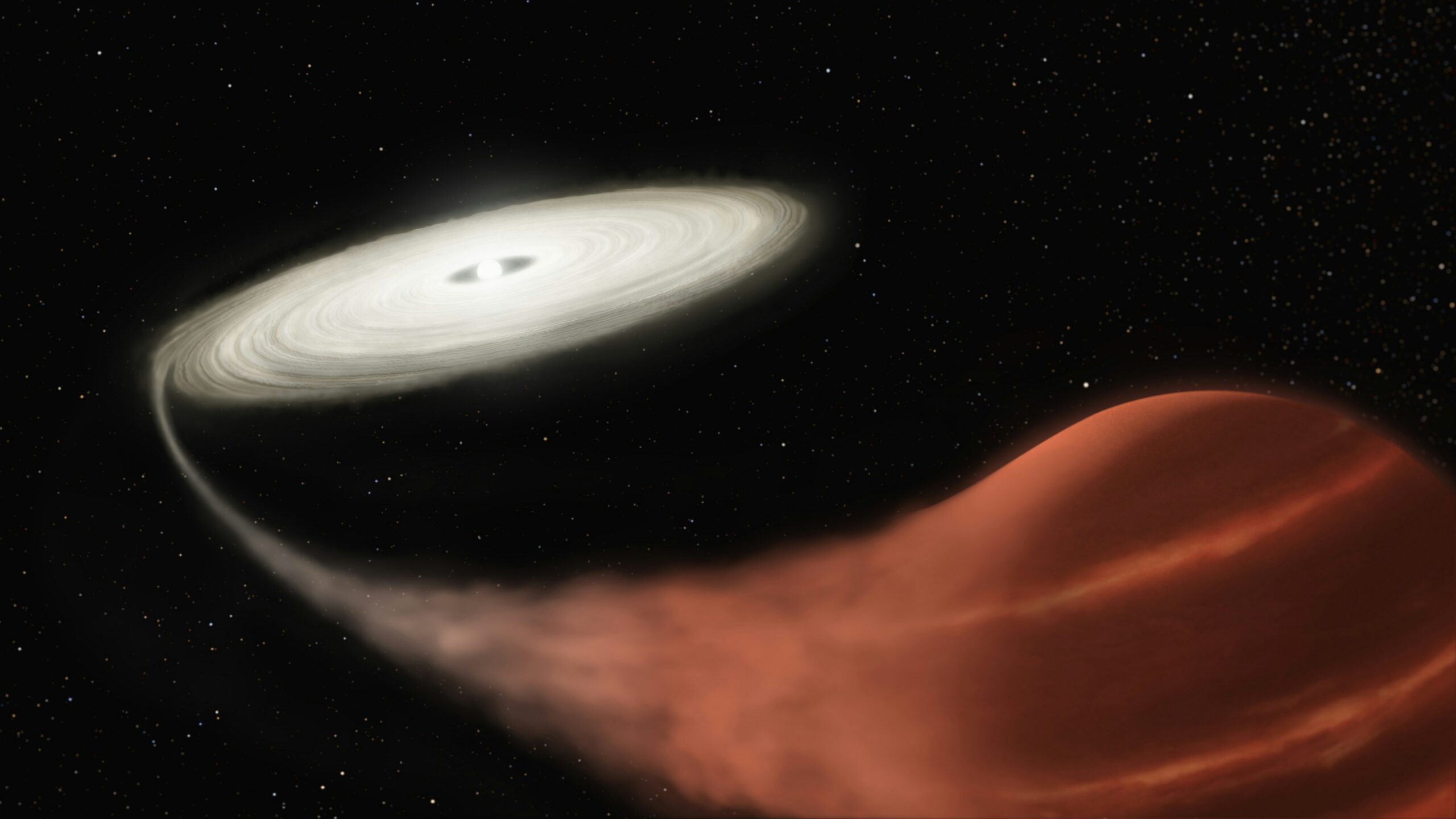
The Inescapable Fate of Earth and the Sun
Like all stars, our Sun is bound to evolve over time. Today, at roughly mid-life, it will eventually exhaust its nuclear fuel in about five billion years. At that moment, it will swell into a red giant, a star whose diameter will probably exceed Earth’s current orbit. Mercury and Venus, the first two planets of the Solar System, will be completely engulfed by the Sun. As for Earth, it could end up on a new, more distant orbit or suffer the same fate.
This transformation process of the Sun will culminate in the ejection of its outer layers, leaving behind only a dense and extremely hot star called a white dwarf. This star will be much smaller, but will continue to attract what remains of its planetary entourage. If Earth survives this red giant phase, it will end up on an orbit twice as far from the Sun as today, well beyond the habitable zone, turned into a cold and sterile world.
A Discovery Illuminating Earth’s Future
The recently discovered system, consisting of a white dwarf and a planet similar to Earth, closely resembles what could befall our own Solar System in a distant future. The planet, in fact, is on an orbit twice as large as Earth’s around the Sun today.
This discovery is not merely an astronomical curiosity; it also helps scientists better understand the final stages of evolution for stars like the Sun, as well as the impact of these transformations on the surrounding planets. According to researchers, although this planet now lies outside the habitable zone of its white dwarf, astronomers believe it could have hosted conditions conducive to life when its star was still a normal star comparable to the Sun.
The Gravitational Microlensing Technique
Astronomy is rich with astonishing techniques to detect invisible objects in the cosmos. The planet in question was discovered thanks to a method known as gravitational microlensing. This technique relies on a phenomenon predicted by Einstein’s theory of relativity: the gravity of a massive object, such as a star, can bend spacetime and amplify the light of a more distant star that lies in its alignment.
In 2020, this planet briefly amplified the light of a more distant star, also located in the Milky Way, at about 25,000 light-years from Earth. This effect then allowed researchers to estimate the presence of a white dwarf and two planets, one of which was Earth-sized.
To confirm that this star is indeed a white dwarf, astronomers used the Keck II telescope in 2023. Thanks to adaptive optics that remove the blur caused by Earth’s atmosphere, they confirmed that the microlensing star could not be a normal star. Its low luminosity and mass clearly indicate that it is a white dwarf, a remnant of a Sun-like star.
A Distant Future for Humanity?
Even if this scenario seems distant, it raises a fascinating question: what could become of humanity when the Sun begins to fade? Some scientists estimate that as the Sun swells into a red giant, the habitable zone of the Solar System where life as we know it can exist will move beyond Earth, orbiting giant planets like Jupiter or Saturn.
However, we know that some moons of these planets, such as Europa, Callisto, or Ganymede around Jupiter, or Enceladus around Saturn, host oceans hidden beneath their frozen surfaces. If these moons were to temporarily fall within the new habitable zone of the red Sun, they could for a time offer a potential refuge for humanity.
A Window into the Initial Conditions of Life Elsewhere?
This discovery also opens a fascinating reflection on the possibility of life emerging in similar systems. If the planet discovered around this white dwarf could have once been in a habitable zone, it raises questions about how long the conditions favorable to life can endure around stars evolving toward their final phase. These systems could be top targets for the search for exoplanets that may have harbored, or still harbor, primitive life forms. By studying such systems, scientists hope to better understand the mechanisms that render a planet habitable, but also comprehend how long these conditions can persist in such extreme contexts.
The research team, led by Keming Zhang, now a postdoctoral researcher at the University of California, San Diego, announced their discovery in the journal Nature Astronomy.
