
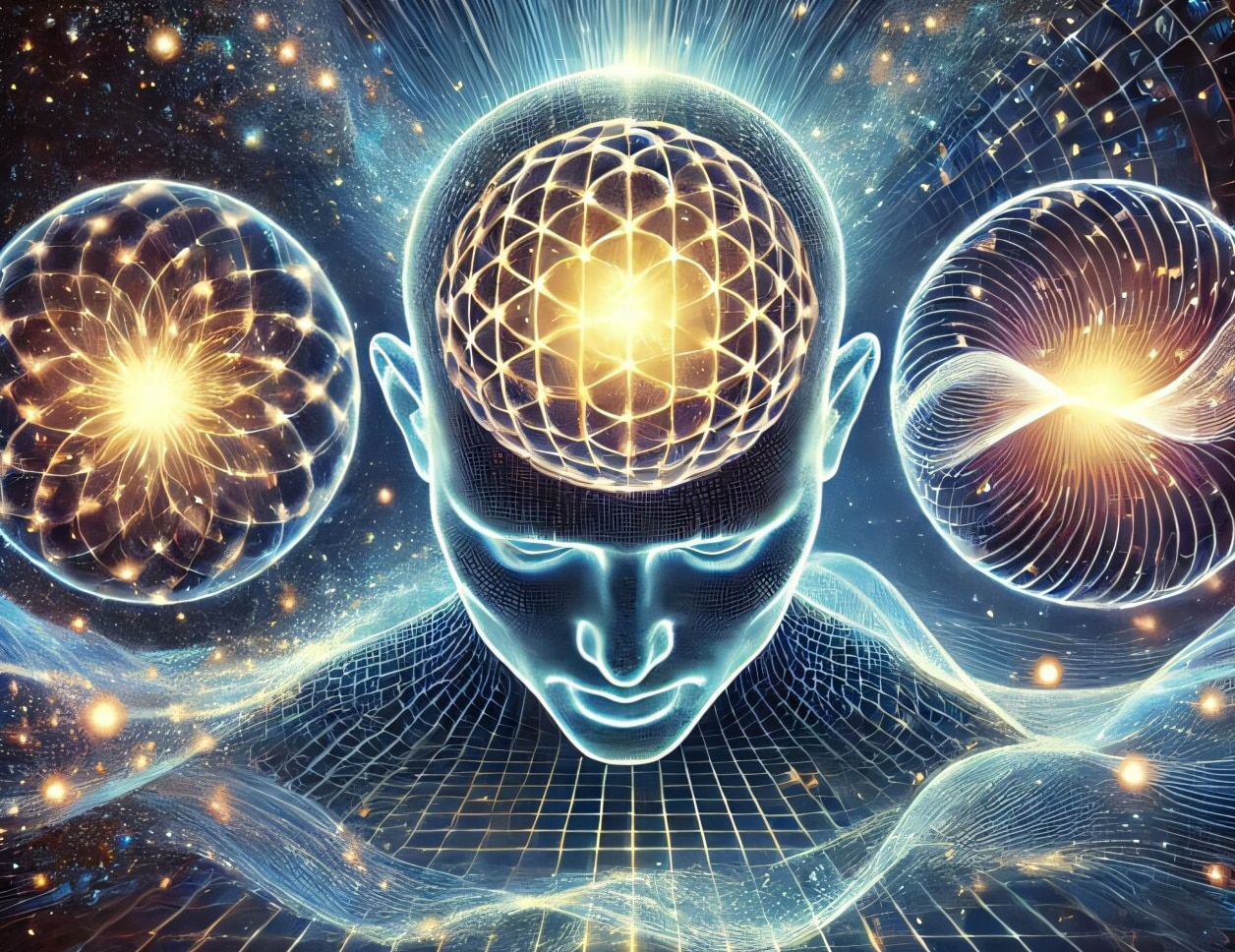
We have always believed that our consciousness emerges from the electrochemical activity of our neurons, a kind of emergent property of brain complexity. Yet a Swedish physicist has just published a theory that upends this certainty: what if it were exactly the opposite? And if consciousness existed before matter, before time, before space itself? Maria Strømme, a professor at Uppsala University, proposes a mathematical model in which reality as we know it is only a consequence of something far deeper.
When a nanomaterials specialist rewrites the laws of the universe
Maria Strømme is not a philosopher chasing vaporous speculation. She is a rigorous scientist, specialized in nanotechnology and materials science. Her daily work normally involves studying atomic structures, matter at the tiniest scales. Yet she has just published in the journal AIP Advances a theory that makes a vertiginous leap: from nanomaterials to the very foundations of reality.
Her paper, designated the best paper of the issue and featured on the cover, proposes a theoretical framework rendered in the mathematical language of quantum physics. Not vague metaphysics here, but equations, testable predictions, and an openly declared scientific ambition: to describe how our universe truly operates.
The central hypothesis rests on a single sentence that unsettles our certainties: consciousness precedes everything else. Time, space, and matter would be mere secondary manifestations of a fundamental field of consciousness.
A complete reversal of perspective
According to Strømme’s model, what we call matter is not the elementary building block of reality, but rather a representation, or even an illusion. For an engineer accustomed to treating matter as fundamental, this admission signals a major conceptual turn.
Within this theoretical framework, individual consciences are not isolated islands produced by separate brains. They are portions of a larger, interconnected field of consciousness, comparable to waves on the surface of a single ocean. Our sense of separation, our impression of being discrete entities, would stem from a limited perception of this unified reality.
This vision strikingly echoes the stance explored by the pioneers of quantum physics. Einstein, Schrödinger, Heisenberg, and Planck all, at various times, hinted at similar intuitions. Strømme acknowledges relying on several of the pathways they opened, while pushing the reasoning far beyond.
When the mystical meets the measurable
One of the most unsettling consequences of this model concerns phenomena typically relegated to the scientific margins: telepathy, near-death experiences, certain forms of unexplained intuition. If our consciences do indeed bathe in a shared field, these manifestations would cease to be paranormal and would become natural, albeit rare, expressions of this interconnection.
Strømme does not claim that these phenomena exist necessarily, but that her model provides a framework for studying them scientifically rather than dismissing them a priori. She proposes predictions that can be tested in physics, neuroscience, and cosmology, turning philosophical speculation into testable hypotheses.
Her theory also suggests that individual consciousness survives physical death, returning to the universal field from which it emerged. A bold assertion, framed not as comforting belief but as a logical consequence of the equations she developed.
Modern science and ancient wisdom
Paradoxically, this ultra-contemporary theory resonates with millennia-old intuitions. The sacred texts of major religious traditions have long spoken of an interconnected consciousness, a fundamental unity behind the apparent diversity of the world. The Bible, the Qur’an, the Hindu Vedas—all describe, in metaphorical language, something that resembles the consciousness field Strømme seeks to model mathematically.
For her, these convergences are not incidental. Ancient authors may have intuitively perceived truths that science is only now beginning to express rigorously. The early quantum physicists arrived at similar conclusions through experimental methods. Perhaps it is time for modern natural sciences to seriously explore these questions with their sharpest tools.
A paradigm shift in the making
Strømme explicitly compares her proposal to the great upheavals in the history of science: the discovery that the Earth is spherical, the Copernican revolution that dethroned our planet from the center of the universe. Each time, humanity had to abandon an obvious certainty to embrace a counterintuitive reality.
If this model were validated, it might mark the dawn of a new era in our understanding of what we are and the place we occupy in the universe. In the meantime, the predictions are laid out. Science will do its work of verification.
