
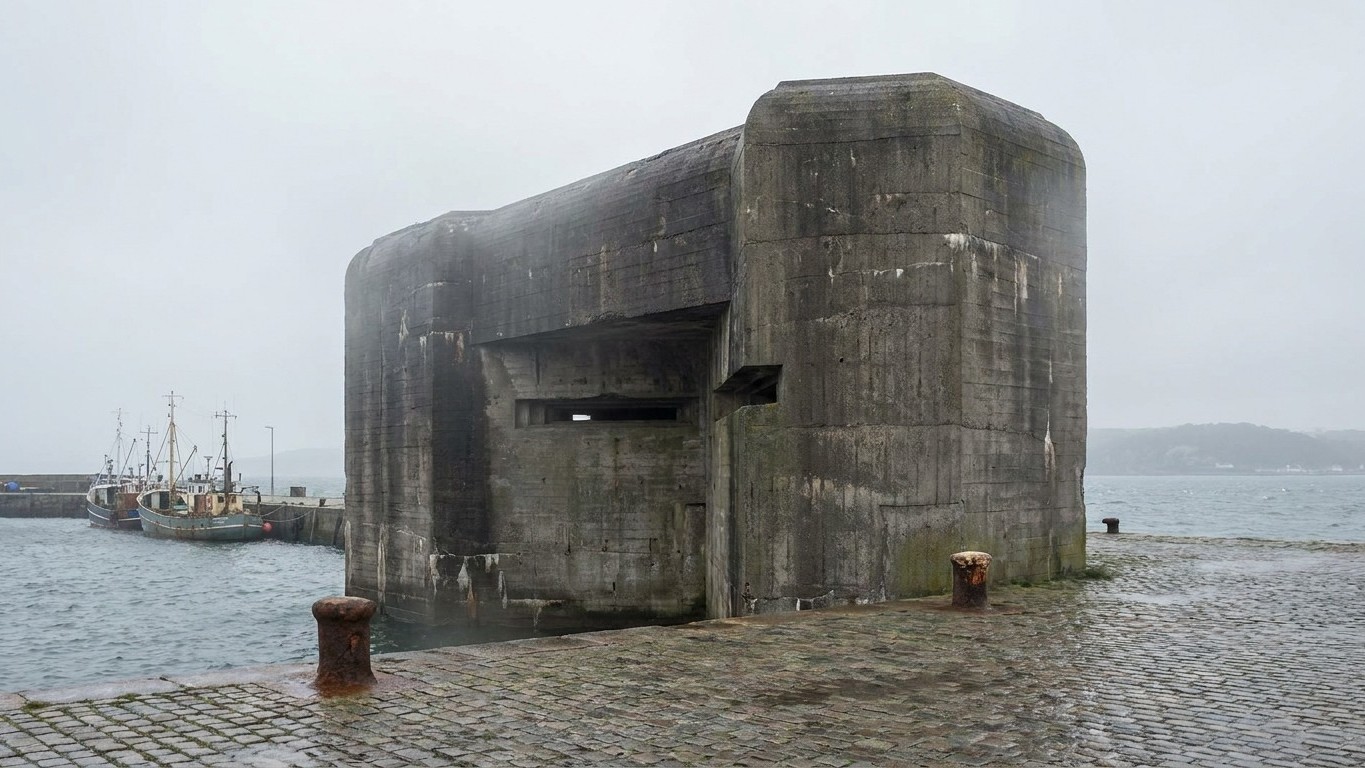
The city of Lorient was razed to the ground. The Keroman bunkers, by contrast, had not budged an inch. It stands as one of the starkest paradoxes of World War II on French soil: the town was destroyed by nearly 90% in Allied bombing raids in January and February 1943, civilians fled, buildings burned, and the neo-Gothic center collapsed. The Keroman submarine base, though, remained standing. Intact. Eighty years on, this enormous mass of reinforced concrete still dominates the port, unclassifiable, indestructible, repurposed as a cultural site because it could not be shot down.
To note
- A bunker poured in seven months withstood what 4,000 tonnes of bombs could not destroy
- The German engineers devised a revolutionary anti-blast device named ‘Fangrost’ that channels the explosions
- The real Allied victory was not military but intelligence-driven: 80% of German submarines sunk at sea thanks to a French spy
The Organisation Todt and the wildest construction project in the Atlantic
When German troops entered Lorient on June 21, 1940, the town quickly became a major military objective: facing the Atlantic, endowed with a deep harbor and a modern port, it offered the Kriegsmarine an ideal position from which to launch its U-boats against Allied convoys. Admiral Karl Dönitz did not hesitate. He met with Hitler on October 28, 1940 to request the construction of bases at Lorient, Brest, and Saint-Nazaire. On November 7, Hitler ordered the building of protective bunkers for submarines along the Atlantic coast, and a first meeting took place in Lorient with Fritz Todt present on November 15.
What then rose from the ground surpassed the industrial imagination of the time. Under the bombardment of Royal Air Force planes, 15,000 workers successively built between February 1941 and January 1943 three vast reinforced concrete blocks of impressive dimensions: 130 meters on each side and 18.5 meters high for blocks Keroman I and Keroman II, with roofs 3.5 meters thick. 60,000 wagons of material were moved to the site, as well as 40,000 m³ of timber for formwork. Several railway lines had to be built to bring in the sand needed to pour the concrete. The K1 alone required 160,000 cubic meters of concrete between April 1, 1941 and June 21, 1941. In seven months. A speed record that can be explained by a simple constraint: British bombs were already falling.
Keroman III, the largest of the three blocks, housed up to 13 U-boats in afloat basins. Its concrete slab reached 7.5 meters in thickness, a shielding so massive that even 5.4-tonne Tallboy bombs would never pierce its roof. Seven and a half meters of reinforced concrete above each submarine. The equivalent of a two-storey building poured in a single block, reinforced with 49 kilograms of steel per cubic meter.
When engineering makes bombs useless
The resilience of Keroman’s bunkers does not rely solely on the raw thickness of their walls. German engineers designed a particularly sophisticated anti-blast system. The so-called Fangrost system consists of a stack of rounded reinforced concrete beams, 1.40 meters high, crossing perpendicularly and resting on a succession of concrete walls 1.80 meters tall. Developed at the end of 1943 to counter the evolution of Allied air bombs, it creates an empty space where the blast can be channeled without damaging the roof slabs. In plain terms: the bomb explodes into the void, the roof remains intact.
The result was spectacular. The night before the first GIs arrived north of Lorient’s defenses, the RAF tried unsuccessfully to destroy the roof of one of Keroman’s bunkers by dropping a six-tonne bomb. The result: a crater in the concrete. Nothing more. After more than 30 massive air raids, close to 95% of the town’s houses had been damaged, but not a single submarine was ever damaged.
Faced with this tactical failure, the Allies changed approach. Churchill ordered on January 14, 1943 to destroy the towns surrounding these bases in order to choke off their supply lines. Lorient was designated the primary target: the town was razed by more than 4,000 tonnes of bombs between January 14 and February 17, 1943. Within a few weeks, 3,500 buildings were destroyed, 40,000 residents evacuated, and the historic city erased from the map. This case is unique in France: a city literally sacrificed to hit a target that nothing could touch.
The resistance playing out inside the walls
While bombs crashed uselessly onto concrete, another war raged quietly in the depths of the complex. The engineer Jacques Stosskopf, responsible for the construction of the alveoles, played a central role in a clandestine network: he fed the British services with precise information on the movements of the German submarines. For months, he acted undercover, risking his life at every moment. Arrested in 1944, tortured, then deported to Natzweiler-Struthof, he was executed shortly before the Liberation. In 1946, his name was given to the base, a reminder that even at the heart of one of the Kriegsmarine’s strongholds, the French resistance never ceased to fight.
Of the 168 submarines based at Lorient during World War II, 135 were sunk by the Allies, accounting for 80% of losses. But these sinkings occurred at sea, never inside the alveoles. The bombs did not penetrate the walls, but Stosskopf’s intelligence allowed them to destroy the U-boats where they were vulnerable: in the middle of the Atlantic.
A concrete that no one knows how to demolish
The Navy left the site in 1997. It was then that discussions began about repurposing this military complex. What to do with the million cubic meters of concrete that make up the Base? The economic answer quickly became evident. Demolishing these structures would have cost local authorities a fortune, with an estimate of 31 million euros for the Lorient submarine base alone, not to mention technical constraints. Facing this impossibility, the municipalities chose another path: reuse.
From the 2000s onward, the former Lorient military base was successfully repurposed. It has since become a major economic, tourist and nautical hub, hosting the Eric Tabarly Sailing City, the Flore submarine and its museum, the Lorient Sea Museum, the Offshore Racing hub, and venues for contemporary music such as Hydrophone. Since 2019, Keroman II bunker has housed a stage for contemporary music. Concerts inside the bowels of a U-boat shelter.
The final paradox belongs to the long term. Unprecedented works in their scale aim to address a major flaw in Saint-Nazaire: the submarine base takes on water. Designed to withstand bombs, the imposing roof cannot stop the seepage threatening the cultural facilities installed below. What thousands of tonnes of bombs failed to do, rain and weather are slowly accomplishing. In Lorient, Keroman’s concrete still holds. The largest submarine base of the Atlantic Wall spans 26 hectares and can accommodate nearly thirty submarines. The war ended more than eighty years ago. The bunker, however, has not received the memo.
Sources: patrimoine.region-bretagne.fr | un-historien-a-lorient.fr
