
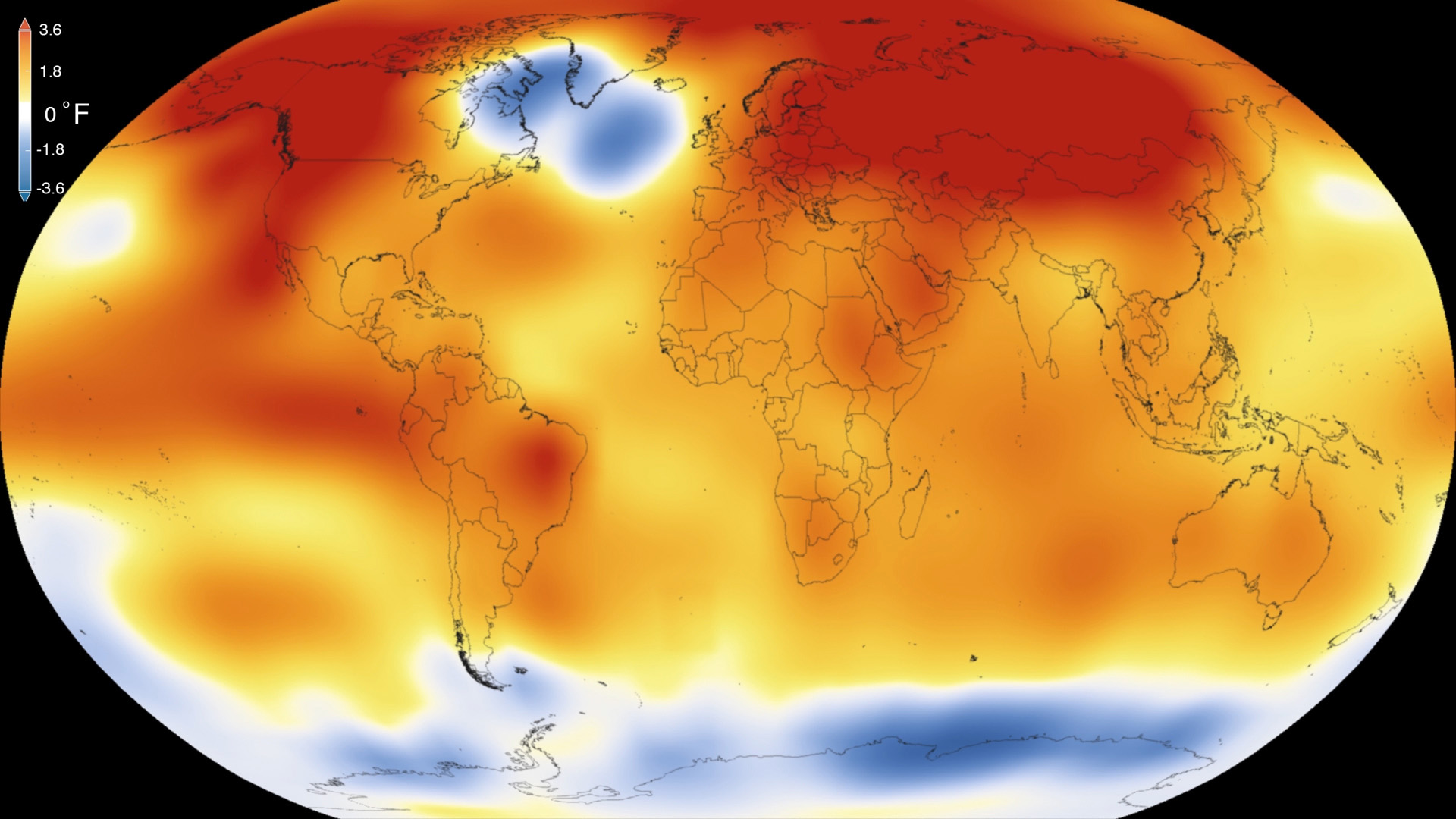
According to a recent publication, researchers have studied an intriguing mass of cold water off Newfoundland, Canada. It is a “cold blob” that could unfortunately signal the end of the Atlantic Meridional Overturning Circulation (AMOC), a system of currents essential to maintaining a temperate climate in Europe.
Potential Climate Disruptions
The current global warming trend is driving temperatures higher on a worldwide scale. Yet there are very rare exceptions, notably a small patch of the North Atlantic Ocean to the east of Newfoundland (Canada). While waters are reaching record heat levels elsewhere, this zone is characterized by abnormally cold waters. As noted in a Geophysical Research Letters publication from May 28, 2026, it concerns a “cold blob” located in a region with a strong link to the Atlantic Meridional Overturning Circulation (AMOC).
The AMOC is a major component of the thermohaline circulation, whose surface element is the famous Gulf Stream. Europe owes to the AMOC a much more temperate climate and milder winters than regions at the same latitude in North America, notably Canada.
The Potsdam Institute for Climate Impact Research team is concerned about a possible slowdown of the AMOC as the cold blob traverses it. If this formation persists over time, climate disruptions could occur around Greenland, Iceland, and Northern Europe.
An Area Spanning 2 to 3 Million km²
Usually, the AMOC currents carry warm, saline water from tropical regions and from the Gulf of Mexico toward the North Atlantic and Europe. When this water approaches Greenland, it releases its heat to the atmosphere, cools down, and undergoes glaciation effects. It then becomes colder, saltier, and thus denser, causing it to sink to the depths of the ocean. However, the acceleration of Arctic ice melt brings more freshwater into the system, making this sinking harder. Moreover, a slowdown of the AMOC automatically means a reduced inflow of warm water.
The researchers recalled that since the preindustrial era, the global average temperature has risen by about 1°C. Yet, during the same period the cold blob that has gradually formed since the early 20th century has cooled by 1°C. It is worth noting that the blob could cover a surface area of 2 to 3 million km² – with a depth of 3 km – between the 40th and 65th northern parallels.
For scientists, this is not merely a meteorological curiosity but a systemic anomaly confirming a decrease in oceanic heat transport toward the north, with the possible crossing of a climate tipping point. If the AMOC collapses, the Northern Hemisphere would experience a massive cooling, while the Southern Hemisphere would warm even more. Additionally, sea level would rise in certain regions and seasons could reverse in places.
Unlikely Collapse Before 2100
The cold blob does not by itself necessarily indicate an AMOC collapse. It should be noted that weather conditions (winds) over the past months in the North Atlantic have reinforced this cooling. Furthermore, it is possible that the Atlantic Multidecadal Oscillation (AMO) also contributes to this cooling. Two processes are therefore at work: the human-caused component of warming and natural variations of the climate system.
According to the models of German scientists, the cold blob could persist, making the future of the AMOC uncertain. In the meantime, the Intergovernmental Panel on Climate Change (IPCC) has already addressed the topic, stating that such a collapse is unlikely before the end of the current century.
