
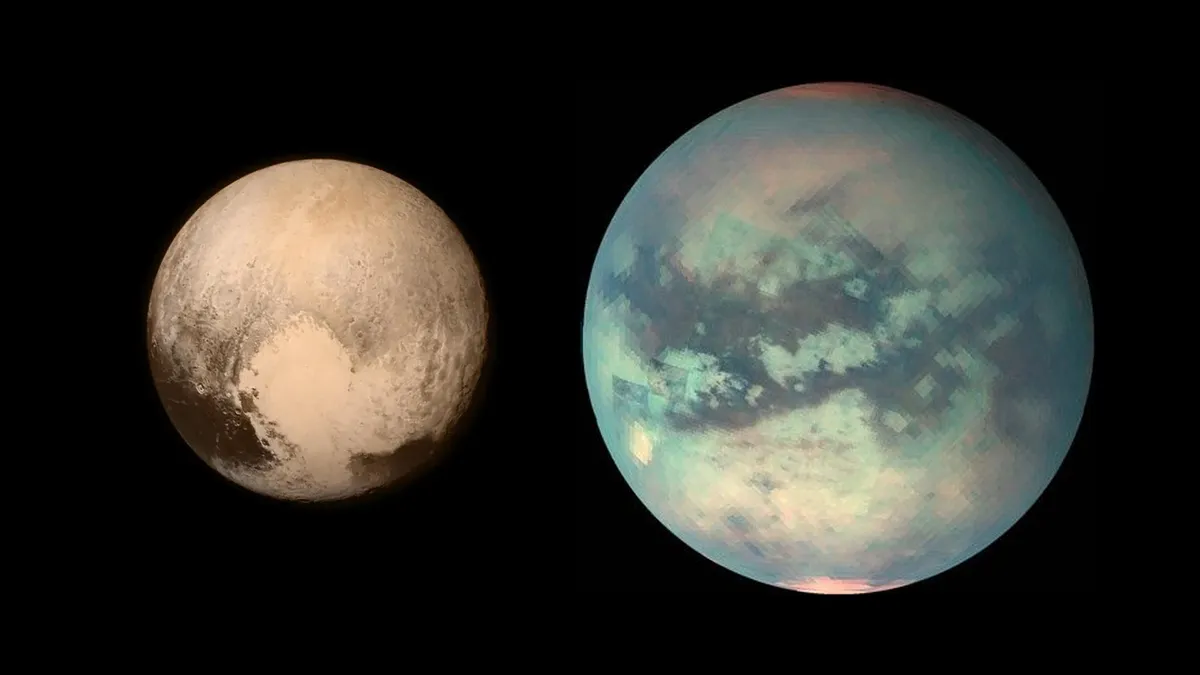
The James Webb Space Telescope has just detected an unknown light signature on Titan’s surface — and the same wavelength appears on Pluto. Two radically different worlds share a mysterious substance that scientists have yet to identify. Allenes are suspected, but nothing has been confirmed.
What you will learn
- How an identical infrared signature on two such different bodies intrigues astronomers
- Why identifying Titan’s surface composition is so challenging despite decades of observations
- What this discovery could reveal about the prebiotic chemistry of primitive Earth
Two different worlds, one mysterious signature
Titan, Saturn’s largest moon, and Pluto have almost nothing in common. Titan has a dense atmosphere, methane lakes, and it rains there. Pluto is a frozen dwarf planet with a thin atmosphere. Their sizes, densities, and environments differ drastically.
And yet, the James Webb Space Telescope has just detected an identical spectral signature on the surfaces of both bodies — an infrared absorption at exactly 5.11 micrometers. A coincidence that Dr. Bruno Bézard’s team at the Paris Observatory cannot ignore.
Identifying Without Recognition
Detecting a signature in a light spectrum is one thing. Identifying it is another. Astronomers have vast databases cataloging the emissions and absorptions of known molecules — but these catalogs are incomplete, and not all compounds in all conditions have been characterized.
The team ruled out many simple ices likely to form by condensation on Titan — hydrocarbons, nitrates, photochemical compounds. None match. Compounds called allenes, with chain-like molecular structures, come close. But the signature on Pluto, although centered at the same wavelength, is three times broader than Titan’s — suggesting different molecular structures, mixtures, or surface states on each body.
Why Titan is so difficult to observe on the surface
Titan’s surface is particularly hard to access. Its thick methane-rich atmosphere is opaque to many infrared wavelengths — precisely those used to identify chemical compounds. The presence of water ice and organic particles deposited from the atmosphere is suspected, but no clear identification has yet been established.
That is why JWST’s detection is so valuable: it opens a window through that opacity, even without being able to read what it reveals.
The Dragonfly mission and the years ahead
NASA’s Dragonfly mission, a nuclear-powered rotorcraft, will be launched in 2028 and will reach Titan in 2034. If it does not carry an infrared spectrometer, it will be equipped with instruments capable of revealing the compounds present on the moon’s surface. Researchers will then be able to determine which of them correspond to JWST’s infrared signatures.
In the meantime, the team is collaborating with a group led by Jonathan Lunine to map the distribution of this mysterious compound across Titan’s surface — a possible correlation with the vast dune fields that cover entire regions of the moon.
A window onto primitive Earth
The stakes go beyond simple geochemical curiosity. Titan’s chemistry is often compared to Earth’s pre-life chemistry — a planet still rich in nitrogen and carbon, before oxygen became abundant. Understanding what covers Titan’s surface could offer a unique window into the chemical processes that preceded life on our own planet.
The study has been accepted by the journal Astronomy & Astrophysics and a preprint is available via ArXiv.
