
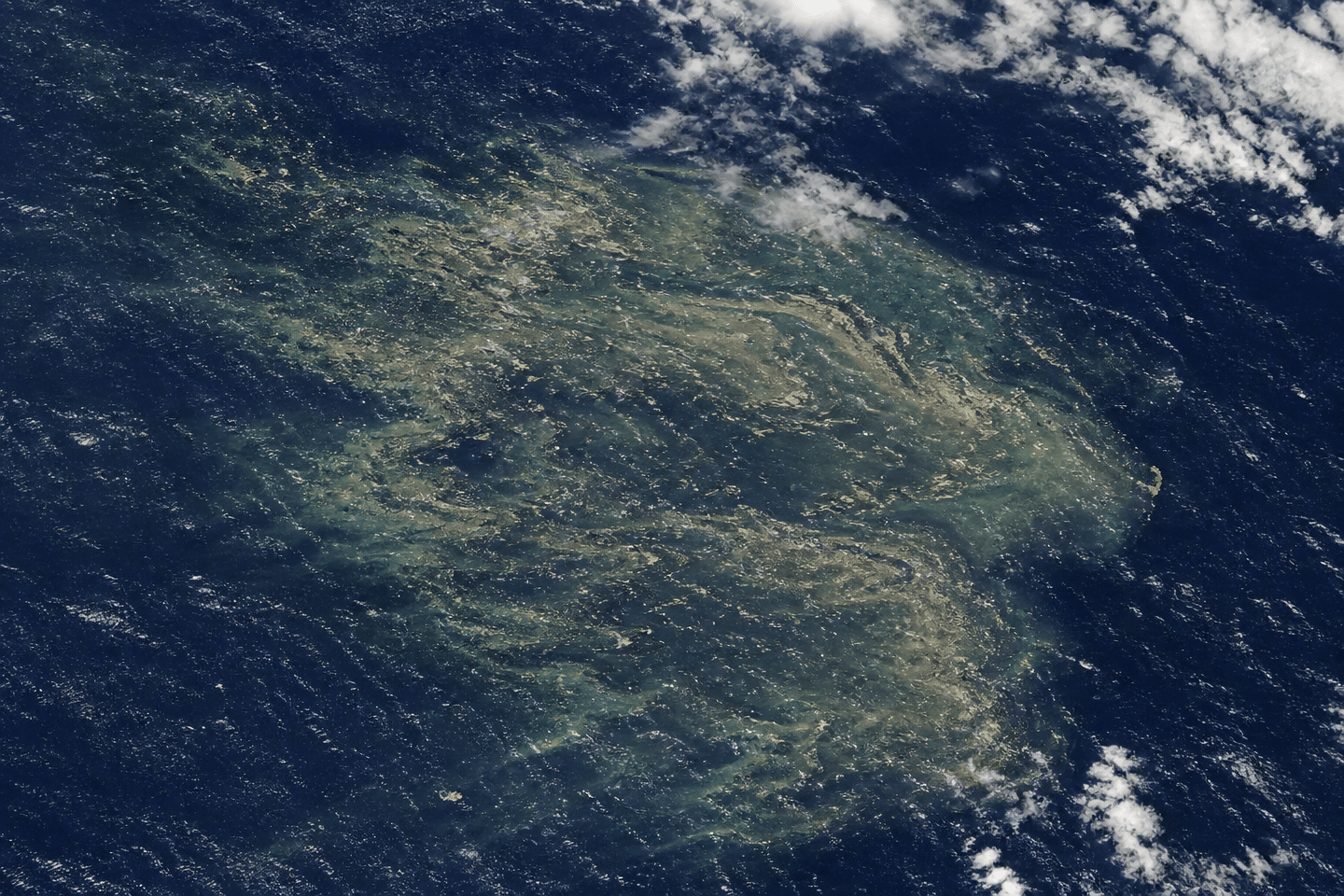
We often imagine the Great Pacific Garbage Patch as a compact island of plastic visible to the naked eye from space. That’s not true. This floating mass remains undetectable in standard satellite imagery. Yet a Norwegian team has just traced its indirect mark: an unprecedented tint of the ocean, revealed by the latest satellite measurements.
- A Norwegian team detected a new cyan tint in the ocean near the Great Pacific Garbage Patch, an indirect signature of microplastics that scatter light rather than absorb it
- Microplastics account for 94% of floating fragments but only 8% of the gyre’s total mass, estimated at 79,000 tonnes
- Definitive confirmation requires on-site sampling, and there is currently no solution to remove these particles already present in the water
- An invisible gyre made visible from orbit
- When microplastics rewrite the laws of marine optics
- The plastisphere, this verdant ecosystem that betrays plastic from space
An invisible gyre made visible from orbit
Credit: © Cheatham et al., Communications Earth & Environment, 2026
In the middle of the North Pacific drifts a giant created by our own waste. The Great Pacific Garbage Patch spans an area about twice the size of Texas, continuously stirred by a vast system of circulating currents known as a gyre.
Contrary to the image of a continent of piled-up bottles, this zone remains highly diffuse. The fragments are scattered across an immense surface, which had until now made it invisible from space. At least, that’s what scientists believed.
A study led by ocean optics specialists Shea Cheatham, Daniel Koestner, and Børge Hamre, from the University of Bergen, challenges this certainty. By analyzing satellite data of the region, the team observed an unexpected change in the ocean’s color. Cheatham confessed to being “shocked, excited, and a little alarmed” when he saw the same signature reappear on the map.
As a precaution, the researchers checked two other sets of satellite data before taking the result seriously. The finding held up. Behind this apparently invisible gyre lay a colossal mass: a 2018 study estimated its contents at 1.8 trillion plastic pieces, totaling about 79,000 tonnes.
When microplastics rewrite the laws of marine optics
A large portion of this mass comes from discarded fishing gear, notably from industries in Japan, China, South Korea, Taiwan, and the United States. But by piece count, microplastics dominate: they account for about 94% of floating fragments, yet only 8% of the total mass.
That is precisely what the study focused on, starting from laboratory work somewhat removed from the gyre itself. The researchers compared how microplastics absorb and scatter light relative to other natural components of seawater, such as phytoplankton or suspended minerals.
Phytoplankton absorbs blue and red wavelengths, which gives the water a greener tint. Dissolved organic matter, on the other hand, absorbs mainly blue light and darkens the ocean, giving it a brownish appearance. Microplastics, by contrast, follow a different logic: they absorb very little visible light but scatter it strongly.
Practically, this means they brighten the water rather than darkening it, and do so simultaneously across blue and green wavelengths. A combination deemed unusual by the researchers, hard to reproduce with natural variations in phytoplankton or sediments alone. By cross-referencing satellite observations spanning 2002 to 2022, the team detected a progressive lightening of the ocean near the Great Pacific Garbage Patch, an increasingly cyan hue that matched exactly the signature predicted by their simulations.
The plastisphere, this verdant ecosystem that betrays plastic from space
Other phenomena could have confounded the clues. Mineral dust, for example, also scatters light and lightens the water. But they are mainly present in coastal areas, and measurements from a nearby research station show that dust deposits remained stable over the entire study period.
Another avenue raised by the researchers is the proliferation of specific algae directly on suspended microplastics. These floating fragments indeed become colonized by marine organisms, forming a true plastisphere, an entire ecosystem that thrives on the surface of the plastic. This living layer would, in turn, alter the way light reflects off the water, contributing to the now-confirmed verdant optical signature seen in satellite readings.
For now, none of these natural explanations fit the data as well as the microplastics and their associated plastisphere hypothesis. The researchers themselves admit that it would be absurd not to pursue this lead, given how striking the match is between simulations and satellite observations. But definitive confirmation requires one more step: going on-site.
Cheatham states plainly: water samples must be collected from the waste accumulation zone, direct optical measurements performed, and microplastics precisely quantified. A task the team hopes to undertake in the future.
The stakes go beyond mere scientific curiosity. The smallest microplastics, those under 300 micrometers, are the hardest to detect and remove from the water. Yet they are the most likely to infiltrate the marine food chain, and potentially into our plates.
Cheatham summarizes the situation bluntly: it is nearly impossible to eliminate these fragments once they are in the water column. Today, the only lever remains upstream, simply preventing these plastic particles from ending up in the ocean in the first place.
Cleanup operations have already removed the largest debris from the gyre. But for this plastic dust invisible to the naked eye, yet capable of changing the color of an entire ocean, there is currently no retrieval solution. And perhaps that is the most telling signal sent from space.
👉 A small gesture for Space Group? Follow us on Google, add us to your favorites, and find us on Google News so you don’t miss any discoveries.
