
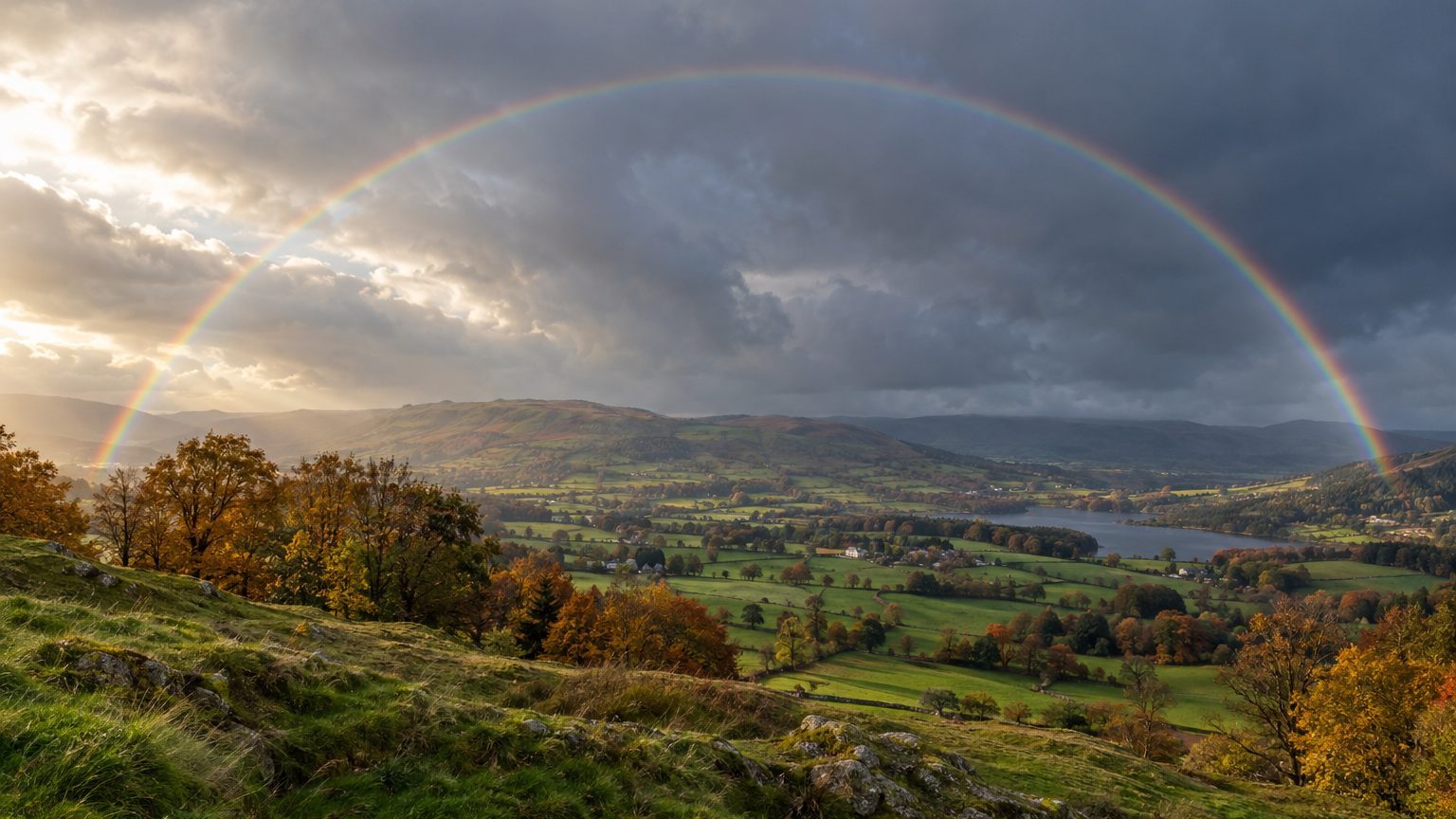
The number to remember is two digits long: 42. It is the angle, measured in degrees, that separates the red edge of the primary rainbow from the antisolar point directly opposite the Sun, and it governs everything else. According to the World Meteorological Organization’s International Cloud Atlas, as soon as the Sun rises above 42° in altitude, the arc slips below the horizon.
At local noon in the height of summer, the geometry leaves no room for error.
- The primary rainbow always forms at 42° from the antisolar point, regardless of the type of rain
- When the Sun exceeds 42° in height, the arc entirely dips below the horizon and becomes invisible
- In autumn the Sun stays lower and allows full arches around midday, unlike in summer
A fixed angle, two colors
Météo-France like the WMO give the same values for the primary rainbow: violet sits on the inside, 40° from the antisolar point, and red on the outside, at 42°. The classic optical description specifies that this maximum angle does not depend on the size of the droplet. Neither fine drizzle nor heavy downpour shifts the arc by a millimeter. To picture 42°, imagine roughly four tightly clenched fists stacked at arm’s length.
The arc is a circle whose center lies on the line connecting the Sun to your eyes, on the other side of your head. This center, which the WMO Atlas calls the antisolar point, sits at the same height as the Sun but below the horizon. With the Sun 20° above the horizon, the arc’s center is therefore 20° below it.
The calculation that raises the arc
The height of the arc’s summit is obtained by subtracting the Sun’s height from 42°. A Sun at 10° gives a summit at 32° above the horizon, about three fists. A Sun at 30° brings it down to 12°, just a bit more than one fist.
At 40° of height, only the summit barely touches the horizon.
The Atlas describes the progression. On flat ground, at sunrise or sunset, the arc can form nearly a full semicircle. As the object rises, the arc’s center drops and the circle sinks below the horizon. From a hill, however, the observer can see an arc larger than a semicircle, since their own horizon is lower.
Why October does better than July
In autumn the Sun stays below the 42° threshold for most of the day. A shower in late morning or mid-afternoon can thus be accompanied by a tall, complete arc. In the height of summer, rainbows appear only at the very start and end of the day, when the Sun is low enough for the circle to rise above the horizon.
The direction to look changes with the hour. Since the arc appears opposite the Sun, you search to the west in the morning and to the east in the afternoon. An arc in the morning often signals a shower approaching from the west, while an afternoon arc announces rain clouds moving away to the east, as after a storm, according to the Canadian weather service meteo.org.
A rainy summer does not alter this rule.
When the Sun is low, the secondary arc, fainter, has its chance as well. It forms higher, around 50–53°, depending on sources like Futura Sciences, and its colors are reversed, with red on the inside. At 40° of solar height, it remains clearly visible in the sky while its primary counterpart already skims the horizon. With your back to the Sun and your gaze toward the curtain of rain, you thus have the best conditions to glimpse both arcs.
The 42° rule also applies to the Moon: the Atlas of the WMO extends it to any bright light source, solar or lunar.
Sources: cotemeteo.fr | futura-sciences.com
