
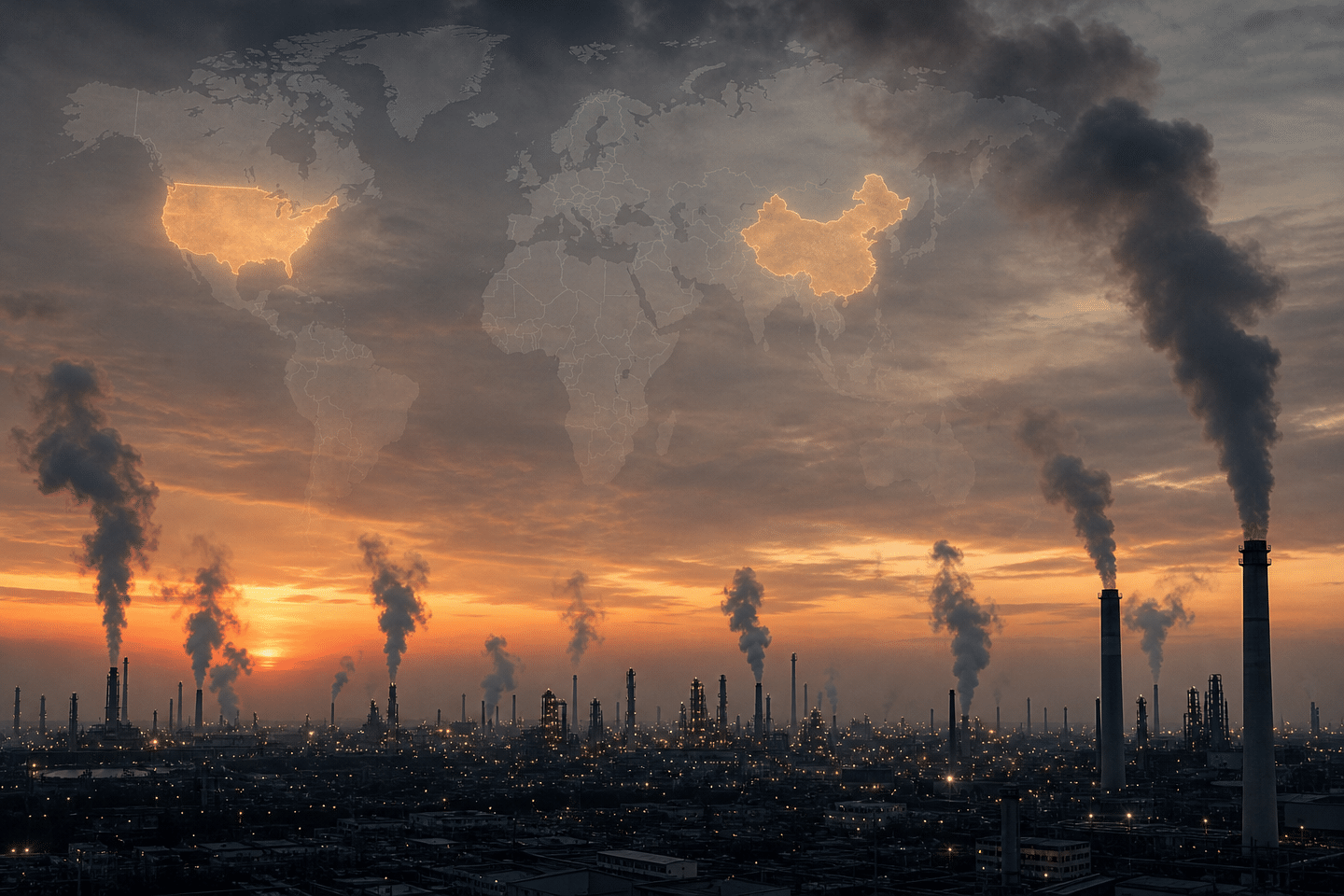
Many people assume that breathing is climate-neutral, a closed loop with no consequences. This is false, or at least incomplete. A study from the University of Bath has precisely quantified what humanity exhales each year: 2.05 billion tonnes of CO₂. Enough to rival the emissions of a fully industrialized country.
- In 2015, humanity exhaled 2.05 billion tonnes of CO₂, an amount comparable to Germany’s annual emissions.
- This quantity has risen by 74% since 1985, a surge driven by more than 60% demographic growth rather than a more active individual metabolism.
- This inhaled/exhaled CO₂ comes from a short carbon cycle (via food) and should not be confused with fossil carbon responsible for climate change.
- The human breath weighs as much as German factories
- A figure that has risen by 74% in thirty years without anyone getting out of breath
- Why breathing has never been a climate crime
The human breath weighs as much as German factories
Credit: © The Lancet Planetary Health (2026)
Every breath converts our food into energy, and that process releases carbon dioxide. Nothing new in itself: it is the essence of metabolism. But no one had ever truly quantified what this meant on a global scale.
This is now accomplished. The study, published in The Lancet Planetary Health and led by Professor Javier Gonzalez, a member of the University of Bath’s Centre for Exercise, Nutrition and Metabolism, puts forward a striking figure: 2.05 billion tonnes of CO₂ exhaled by humanity in 2015.
To put the scale into perspective, this volume matches the annual emissions of a major industrialized country, namely Germany. In other words, the simple act of breathing, times billions of people, weighs as much in the carbon ledger as the emissions of an entire industrialized nation.
This result is not merely a statistical curiosity. According to the researchers, it provides scientists with a new metric to understand where carbon originates and how it moves, especially in densely populated urban areas where human metabolism plays a non-negligible role.
A figure that has risen by 74% in thirty years without anyone breathing harder
Let’s go back a bit in time. In 1985, humanity exhaled 1.18 billion metric tonnes of CO₂ per year. Thirty years later, in 2015, that figure rose to 2.05 billion tonnes. That is a 74% increase, far from negligible.
One might think that our bodies have become hungrier for energy, or that our metabolism has sped up. That is not the case. The researchers are clear: demographic growth explains more than 60% of this increase.
To reach this conclusion, Gonzalez’s team cross-referenced thousands of individual measurements—from infancy to old age—with global population and body weight data. The result: it is not that individuals emit more, but that the number of people has increased.
Gonzalez sums up the situation as follows: “We all emit carbon dioxide simply by converting food into energy, but until now we didn’t have a good sense of how much this represents on a global scale.” A scientific blind spot now filled.
Why breathing has never been a climate crime
Before crying foul, one must make a crucial distinction. The CO₂ we exhale has nothing to do with the emissions from burning oil, coal, or gas. This is a major nuance, and it changes everything.
The carbon we release by breathing comes from our food, and thus from plants that have recently absorbed atmospheric CO₂ to grow. It is a short, nearly circular cycle: the plant captures carbon, we eat it, we return it. Fossil fuels, by contrast, release carbon that has been buried for millions of years, a carbon that had no reason to be in the atmosphere anymore.
Gonzalez emphasizes this point: “We are not saying that breathing drives climate change.” The researchers are not aiming to shame our breath, but to refine the global carbon accounting.
In other words, no one is asked to breathe less or to change their diet to save the planet. The goal lies elsewhere: to better understand carbon fluxes so that, in the long run, we can more accurately predict the effectiveness of emission-reduction strategies.
This work from the University of Bath reminds us of a fundamental truth too often overlooked: behind every big climate number hides a banal biological reality—the billions of bodies that breathe, eat and live. Understanding this metabolic background sharpens the precision of climate models, without ever losing sight of the real problem, fossil carbon that is extracted from the ground and released into the air.
👉 A small gesture for Space Group? Follow us on Google, add us to your favorites, and find us on Google News so you don’t miss any discoveries.
