
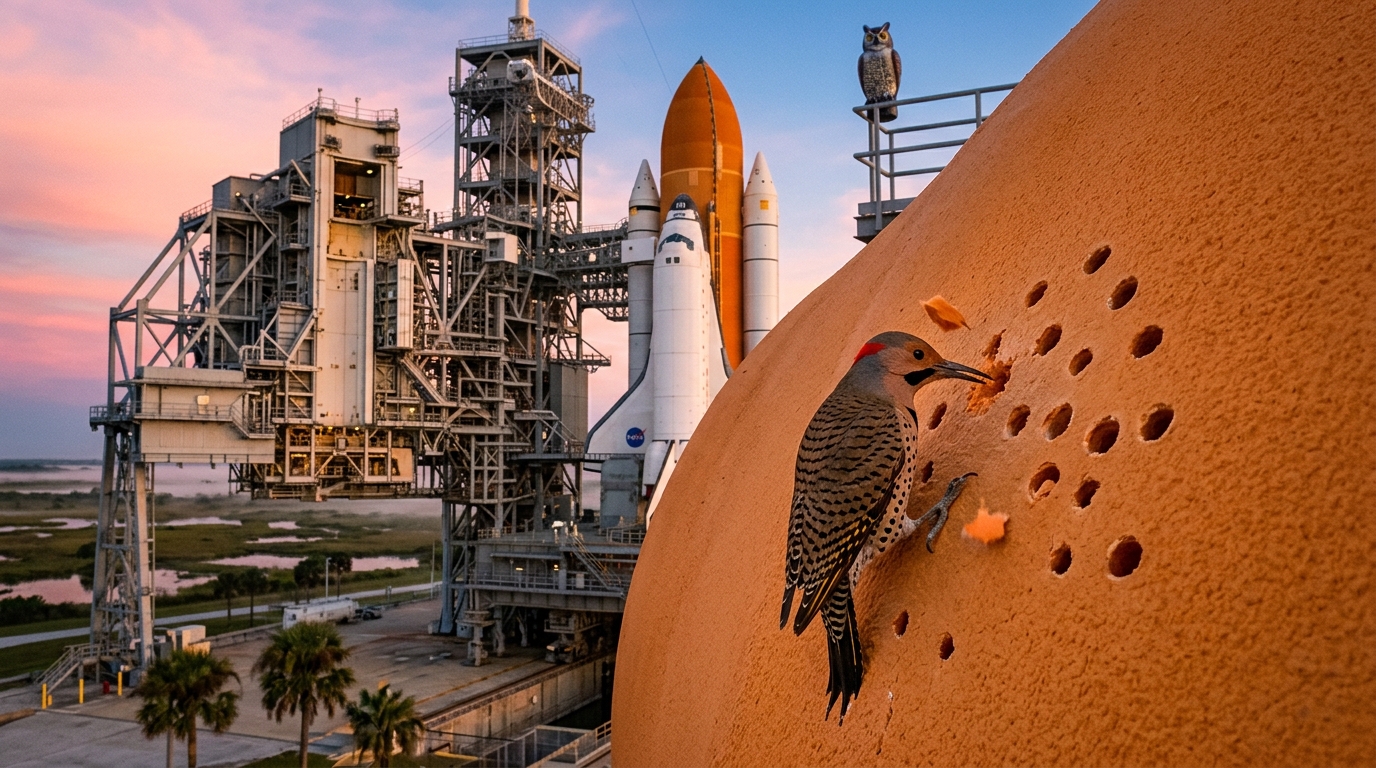
What if birds had managed to succeed where no technical failure had ever occurred? In May 1995, flamboyant woodpeckers transformed Discovery’s external tank into a giant Swiss cheese. Their repeated pecking forced NASA to delay an entire launch while repairs were carried out on dozens of holes in the insulating foam.
- Flamboyant woodpeckers bored 71 holes (up to 200 according to some sources) in the insulating foam of Discovery’s external tank, forcing its return to the assembly building and pushing the launch back to July 13, 1995.
- The incident cost nearly $100,000, just for moving the shuttle between the launch pad and the assembly building.
- To prevent a recurrence, NASA created the BIRD Team and installed plastic owl decoys as well as recordings of owl hoots to deter birds from the launch pad.
- Flamboyant woodpeckers turn the external tank into a giant Swiss cheese
- A forced return to the assembly building that costs a month of delay
- Plastic owls stand guard at the launch pad
Flamboyant woodpeckers turn the external tank into a giant Swiss cheese
On May 31, 1995, the teams in charge of the STS-70 mission discovered the scale of the damage to Discovery’s external tank. The most commonly cited tally reported 71 holes, ranging in diameter from 1.27 cm to 10 cm, drilled directly into the thermal-protective foam covering the tank.
The culprits were quickly identified: flamboyant woodpeckers with yellow wings, birds that had chosen Launch Pad 39B as a nesting site. Some holes were so deep that they reached the metallic wall of the tank, though without causing damage.
Numbers vary depending on the sources consulted. If official mission documents list a total of 71 impacts, other NASA pages and the astronaut Don Thomas’s account mention nearly 200 holes, some reaching four inches in diameter, about 10 centimeters. This discrepancy shows how much the event stuck in people’s minds, to the point of being recounted differently by witnesses.
A forced return to the assembly building that costs a month of delay
Facing the extent of the damage, technicians first tried to repair the foam directly at the launch pad. Trials failed: the tank’s configuration made the operation impossible under those conditions. On June 2, 1995, NASA officials decided to postpone Discovery’s flight, swapping its launch order with STS-71.
Discovery had to return to the assembly building to repair the foam and did not launch until July 13, 1995, after which NASA placed owl decoys around the launch pad. The shuttle left the launch pad on June 8 to join the VAB, where teams carried out the necessary repairs, before returning to Pad 39B on June 15.
This back-and-forth is not trivial financially. The press at the time estimated the operation at nearly $100,000, solely for moving the shuttle between the launch pad and the assembly building. The launch finally took place on July 13, 1995, at 9:41:55 a.m. Eastern Time, roughly a month after the damage was discovered.
Plastic owls stand guard at the launch pad
To prevent a repeat of such an episode, NASA consulted ornithologists. Their recommendation bordered on a Western ploy: install plastic owl decoys around the facilities, supplemented by broadcasts of great horned owl hoots, natural predators of the flamboyant woodpeckers.
The agency did not stop there. A dedicated team was formed, the Bird Investigation Review and Deterrent Team, better known by its acronym BIRD Team. Technicians equipped with air horns were mobilized near the launch pad to deter the birds.
This mobilization, as surprising as it may be for a space agency, illustrates how a single natural detail can disrupt one of the most complex machines ever built by humans. The flamboyant woodpeckers posed no technical threat, but their nesting instinct was enough to immobilize Discovery for an entire month.
This episode remains one of the most striking examples of the unpredictability that can weigh on a space program, even the best-prepared. Between the precision of orbital calculations and the determined search for a cozy nest by a bird, it was ultimately nature that dictated NASA’s schedule for a few weeks in 1995.
