
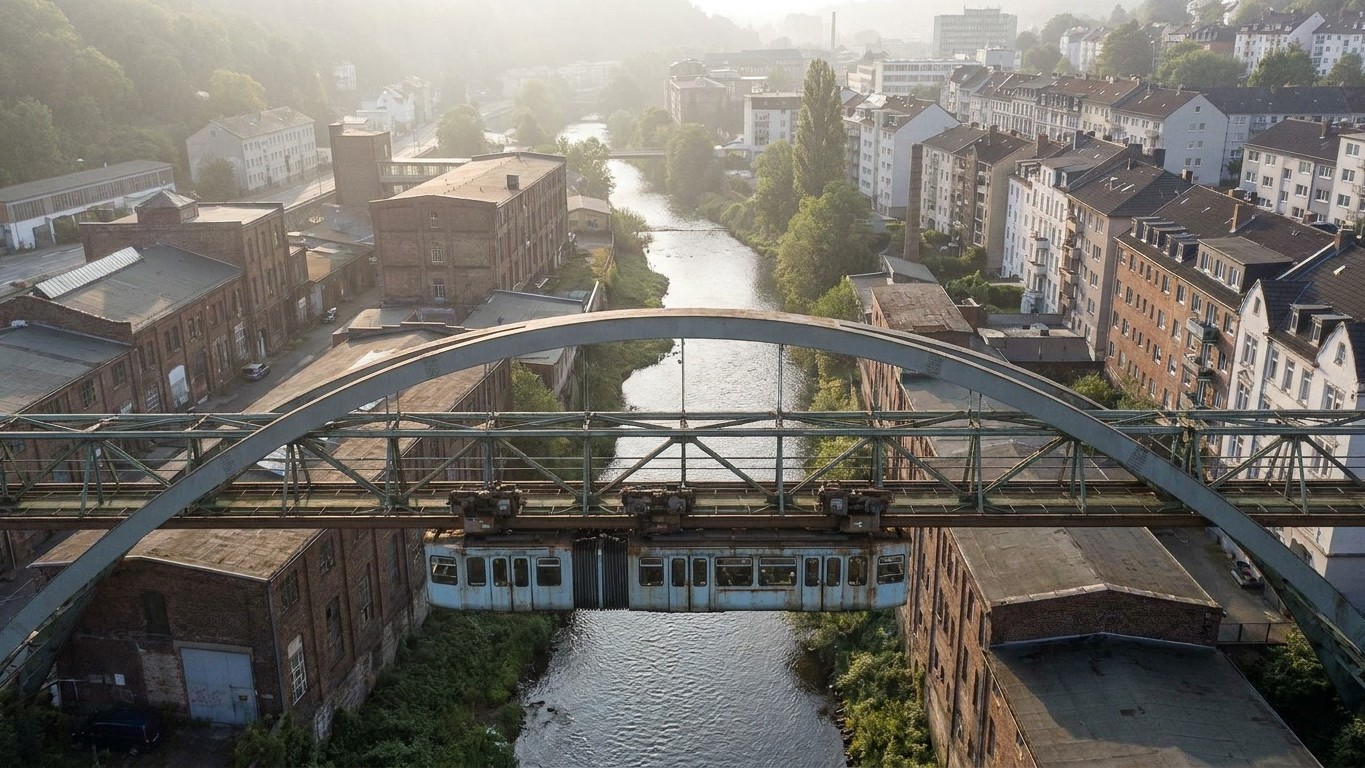
On March 1, 1901, the first passengers boarded a car suspended from a single rail, several meters above the Wupper River. A hundred and twenty-five years later, the same technical principle still functions, with only intermittent, long-lasting exceptions, in this city in North Rhine-Westphalia. The Wuppertal Schwebebahn remains, according to Wikipedia, a rail suspended in Wuppertal, Germany, and it holds a title that few infrastructures can claim: that of the world’s oldest electric suspended monorail still in service.
Key takeaways
- Why a German engineer chose to suspend carriages above a river rather than dig or build on the ground
- How a centenarian technical system managed to transport about 1.49 billion people without major failures
- The day a circus elephant tested the Schwebebahn’s limits and forever altered local history
A train that hangs, literally, under its own rail
Let’s put aside the classic image of a subway running on rails laid on the ground. Here, the mechanism is reversed in its entirety. According to the technical definition cited by a Swiss media outlet, it is a guided transport system in which the vehicle is attached beneath the rigid carrying track at least at two successive points, and which, thanks to this suspended construction, can swing around a longitudinal axis above the vehicle. In concrete terms: the cars never touch the ground, they are suspended from a metal framework by bogies that roll on a single rail mounted high above.
The system, officially named Einschienige Hängebahn System Eugen Langen after its inventor, extends, according to Structurae, over a 13.3 km route with 20 stations, used daily by 82,000 passengers. Most of the journey actually glides above the river: the line traces 13.3 kilometers, at about 12 meters above the Wupper River between Oberbarmen and Sonnborner Straße (10 kilometers), and about 8 meters above the valley road between Sonnborner Straße and Vohwinkel (3.3 kilometers). A complete trip, from one end to the other, takes roughly half an hour.
This engineering feat dating from the late 19th century rests on an architecture impressive in its scope: according to a German technical article, the supporting structure comprises over 13 kilometers of works, built from 1898 to 1903, in service since 1901, relying on more than 450 lattice bridges, most of them directly above the Wupper River. Each pole, every piece of this framework was designed to bear the load without ever resting on a ground that, in this enclosed valley, was desperately short of space.
Why suspend a train rather than dig or build at ground level
Geography explains everything. Wuppertal stretches along a narrow, industrial valley, densely built since the 19th century along the course of the Wupper. An article devoted to the system summarizes the initial constraint: the system was built because Wuppertal needed to solve a real mobility problem in a narrow and densely industrialized valley. The Wupper River occupied the most logical corridor for a transport line, but constructing above or below presented serious geological difficulties.
Thus it was impossible to dig a conventional metro into an unstable subsoil already saturated with factories. It was also impossible to widen streets squeezed between hills to accommodate an above-ground tramway. The solution chosen by Eugen Langen was to gain height, using the riverbed as the only available free space in the entire metropolitan area. A choice that, initially, was also intended to benefit Berlin: according to several sources, created by Eugen Langen, originally planned to be installed in Berlin, it was built in Wuppertal in 1900. The capital ultimately preferred a traditional underground metro, leaving Wuppertal the sole claim to this suspended technology.
An almost flawless safety record in 125 years
Statistically, the Schwebebahn sports a track record that many urban metros might envy. In a century and a quarter of daily operation, only one fatal accident has been recorded. On April 12, 1999, a train struck a piece of maintenance equipment left on the rail by workers. According to Wikipedia, a Wuppertal Schwebebahn train derailed and fell into the Wupper River near Robert-Daum-Platz station. The accident, involving car number 4 of the WSW GTW 72 series, killed five people and injured 47 others. It remains the worst accident in railway history and the only fatality since opening in 1901. The rail had been struck at around 50 km/h before the bogie detached and pulled the car into the river.
Aside from this isolated tragedy, linked to human error during construction rather than a failure of the suspended principle itself, the system operated without major incidents for more than a century. A figure to put into perspective: over the same period, the line has carried about 1.49 billion people since it began service in 1901. Relative to this volume, the 1999 accident remains statistically marginal, which is why the Schwebebahn enjoys a reputation as a particularly safe mode of transport.
The Tuffi episode, or when an elephant tested the system’s limits
Yet there is an incident etched into the collective German memory, more humorous than dramatic. On July 21, 1950, a circus director staged a bold publicity stunt: to put his four-year-old elephant, named Tuffi, aboard a Schwebebahn car. A Swiss media outlet recounts that the unusual noises and vibrations made the animal increasingly nervous, until it finally broke the wagon’s side panel and jumped nine meters down into the Wupper.
Against all expectations, the animal survived with only minor injuries. According to the same source, the several-ton Tuffi only suffered minor injuries and lived another 39 years, while two journalists present and another passenger also sustained minor contusions. German justice then ruled on responsibilities: the circus director Althoff and the head of the municipal transport department, who had authorized the trip, were fined for endangering transport; the court concluded that the Schwebebahn was not suited for transporting elephants. The anecdote, now immortalized on plush toys and souvenirs sold throughout the city, illustrates how this century-old system continues to fascinate, far beyond German borders.
Sources: belgiqueinsolite.com | structurae.net
