
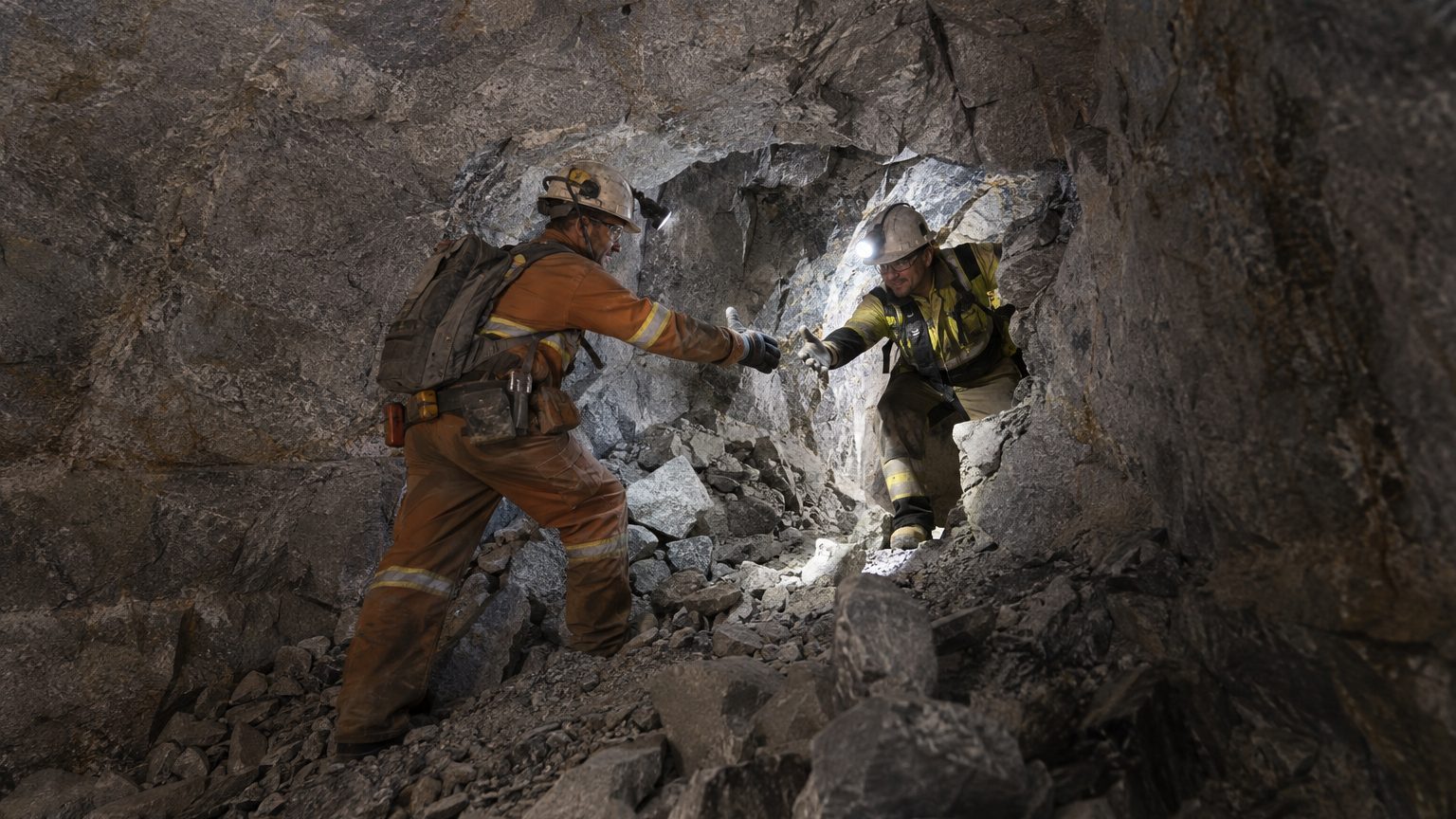
On August 14, 1962, a final wall of rock gave way beneath Mont Blanc, and two teams that had stood side by side for so long found themselves facing one another. The French miners, starting from Chamonix, met the Italian miners, who began from Courmayeur, after 11.6 kilometers of gallery. The gap between their two axes measured about 13 centimeters.
Above their helmets, 2,480 meters of rock.
This thickness was recorded at the highest point, directly above the Aiguille du Midi. It equals more than seven times the height of the Eiffel Tower, stacked above a roadway. Neither team could see the other during the digging: only calculation ensured that the two tunnels would cross, and they did cross.
- The French and Italian teams meet with roughly a 13 cm gap after 11.6 km of tunnel.
- The rock cover reaches 2,480 m at the summit, directly above the Aiguille du Midi.
- The tunnel held the world record for road tunnels until 1978.
Two construction sites, one tunnel
The Mont Blanc tunnel is a road project spanning 11.6 kilometers, linking Chamonix in France to Courmayeur in Italy. The boring work advanced from two fronts, each crew pushing toward the other from its side of the massif.
Compared to the overall length, the 13-centimeter gap corresponds to roughly 1 centimeter per kilometer drilled. An intermediate milestone had been reached on August 3, 1962, but the final breakthrough occurred only eleven days later, on August 14. For a project managed from two countries, with two teams and two working methods, the precision of the junction remains striking.
According to accounts, the gap fluctuated between less than 13 cm and 13.5 cm.
French reports tend to describe less than 13 cm, others give 13.5 cm, and “about 13 cm” is the phrasing that does not betray either side. The duration of the project also varies. Some narratives quote “six years of effort,” others three and a half years, and professional public works figures list three years and seven months. It all depends on which starting moment is considered the origin: the first shovel blows on the Italian side are placed either in May 1958 or January 1959.
2,480 m of rock: what that means for a tunnel
Boring beneath a mountain is not merely advancing through stone. It also means bearing, for decades, the weight of an entire massif above a tube through which vehicles travel.
The driver passing through the tunnel never sees this thickness, only the vault and the vehicle’s headlights ahead. The 2,480 m remain a planning figure, but they explain why the project long stood as a feat of engineering. The tunnel held the world record for road tunnels until 1978.
Three years after the junction, in 1965, Charles de Gaulle and Giuseppe Saragat inaugurated the route.
The ceremony brought the two heads of state to a crossing that the teams had brought to completion from the center. After 20 years of operation, 21 million vehicles had used it. That equates to a little over a million passages per year on average, about 2,900 per day. The figure may seem modest, but it supported a transportation axis that did not exist before the project’s completion.
A tunnel that never empties
In 2011, the Mont Blanc tunnel was traversed on average by 5,114 vehicles per day. Of these, 3,409 were cars and 1,660 were heavy goods vehicles, meaning a truck for a little more than two cars. Freight traffic thus weighs heavily in the tunnel’s usage, far beyond tourist traffic alone.
On March 24, 1999, a fire there claimed 39 lives and led to a three-year closure.
This episode marked the tunnel’s history, but it does not summarize its construction or its use. The tube reopened, and it continues to connect two valleys that rock had long kept apart.
With 5,114 vehicles per day, the tunnel sees almost 1.9 million vehicles per year, nearly double the average of its first two decades of operation.
👉 A small gesture for Space Group? Follow us on Google, add us to your favorites, and find us on Google News so you don’t miss any discoveries.
Sources: Alpes-actu.info | rts.ch
