
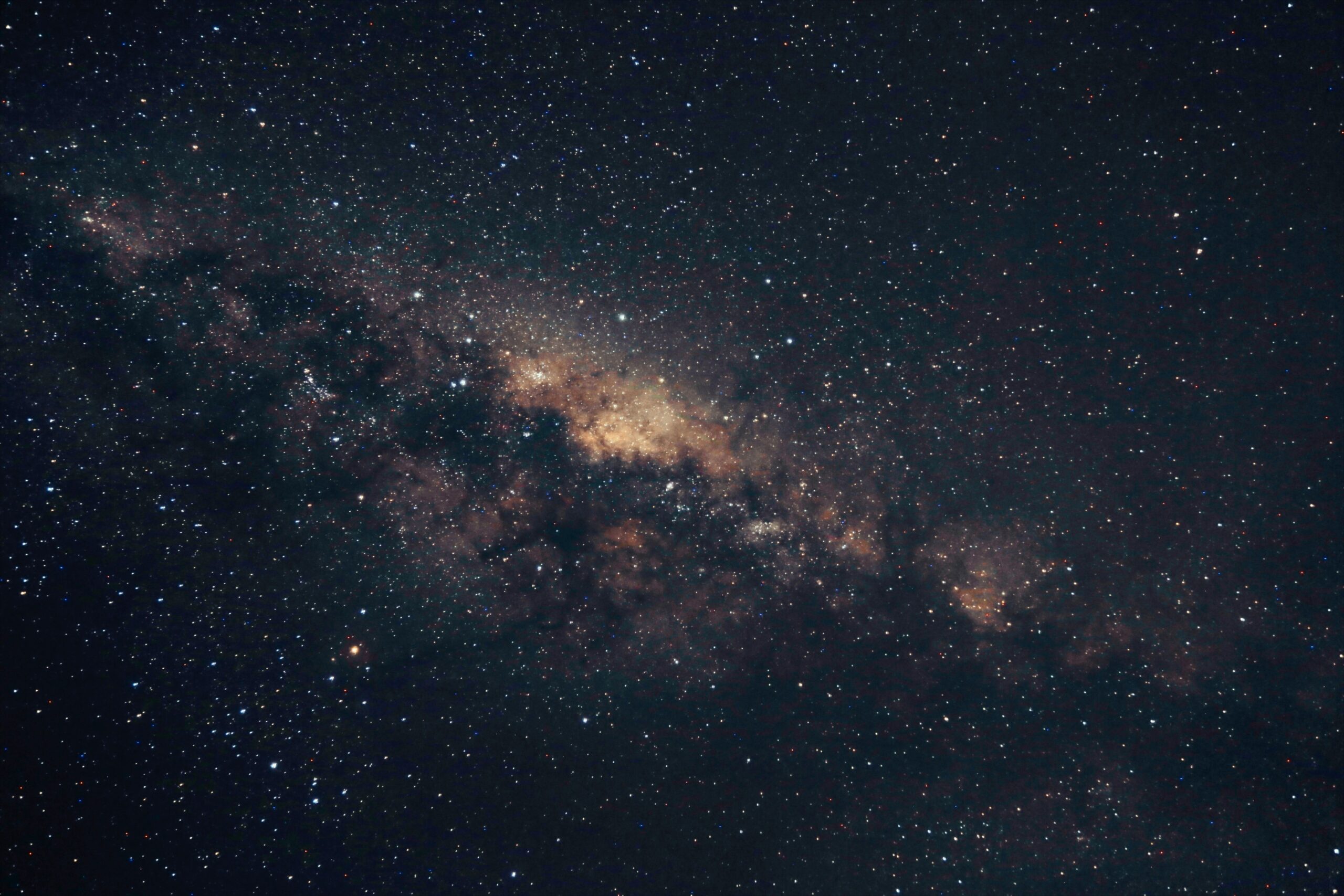
An almost perfect ring of galaxies, 1.3 billion light-years across, defies the standard cosmology model. The Grand Ring, discovered by astronomer Alexia Lopez, far exceeds the maximum size that current theory permits — and it is not alone: a neighboring giant structure, the Giant Arc, further complicates the mystery.
What you will learn
- Why the Grand Ring does not match any known mechanism of galaxy formation
- In what way this structure challenges the fundamental cosmological principle of the uniformity of the universe
- Which alternative theories — from cosmic strings to Penrose’s cyclic cosmology — could explain it
A structure almost three times larger than the theoretical limit
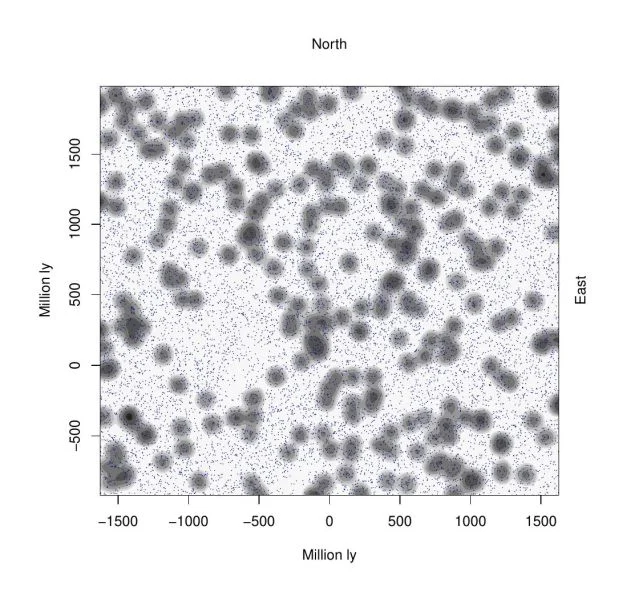
In 2024, astronomer Alexia Lopez from the University of Central Lancashire announced the discovery of a giant and nearly perfect ring of galaxies, roughly 1.3 billion light-years in diameter. The light that revealed its existence has travelled for 6.9 billion years to reach us.
Cosmologists estimate that the theoretical limit for the size of cosmic structures is around 1.2 billion light-years across — beyond that, matter should be distributed uniformly according to the cosmological principle. The Grand Ring surpasses this limit. And it is not an isolated case: it sits in the same region of the sky and at the same distance as the Giant Arc, another giant structure discovered by the same team in 2021, almost three times larger still.
Not a baryon acoustic oscillation
The first natural hypothesis would be to link this structure to baryon acoustic oscillations (BAO) — vast spherical shells of galaxies, fossilized remnants of sound waves that propagated through the early universe before space became too diffuse to carry them. But BAO have a fixed size of about a billion light-years in diameter, and a closer look reveals that the Grand Ring resembles more of an aligned spiral arranged to visually form a ring — a morphology incompatible with a classic BAO.
A challenge to the cosmological principle
What makes this discovery so destabilizing is its implications for the cosmological principle itself — the fundamental idea that, on large scales, the universe should appear broadly uniform in all directions, with no major irregularities beyond a certain size. The Grand Ring and the Giant Arc directly challenge this theoretical expectation.
Candidate explanations, no certainty
Several theoretical hypotheses attempt to explain these giant structures. Roger Penrose’s conformal cyclic cosmology, in which the universe undergoes successive cycles of expansion since the Big Bang, predicts the existence of annular structures — though this model itself grapples with significant unresolved theoretical issues.
Another avenue points to cosmic strings — topological defects in the fabric of space-time, akin to fixed-width wrinkles the size of a proton, that would have formed during the expansion of the primordial universe. Direct physical evidence for their existence remains scarce, but the theoretical framework supporting them is relatively solid.
An improbable coincidence
Lopez emphasizes what makes this discovery so captivating: according to current cosmological theories, one would expect to find at most a single structure as extreme anywhere in the observable universe. Yet the Grand Ring and the Giant Arc are not only gigantic, but neighbor on a cosmological scale — a proximity that seems hard to attribute to mere chance. The best path forward would be to discover other similar structures elsewhere in the universe, confirming that this is not just a statistical anomaly.
The study is published in the Journal of Cosmology and Astroparticle Physics.
